
Hybrid Movie Recommendation: Beyond Collaborative Filtering with Social Tag Analysis
A Hybrid Movie Recommendation Approach via Social Tags
This paper introduces a hybrid movie recommendation approach that integrates social tags into a preference-topic model. By utilizing Multiple Correspondence Analysis (MCA) for tag denoising and KL divergence for user-movie interest matching, the method achieves significant accuracy improvements over traditional collaborative filtering (CF) baselines.
TL;DR
This research addresses the accuracy gap in movie recommendations by moving beyond simple rating-based Collaborative Filtering (CF). The authors propose a hybrid model that extracts, normalizes, and filters social tags using a preference-topic framework. By leveraging Multiple Correspondence Analysis (MCA) for noise removal and KL divergence for interest matching, the system achieves superior precision and recall compared to standard CF baselines.
Background: The Limits of Tabular Data
Most early recommendation engines viewed the world as a sparse matrix of Users × Items. While effective, this "black box" approach ignores the rich semantic context provided by users themselves: Tags. However, social tags are messy—they are often redundant, synonymous, or entirely irrelevant. The motivation behind this paper is to transform these noisy annotations into a structured "Topic Space" that accurately reflects both the movie's essence and the user's soul.
Methodology: The Tag-Processing Pipeline
The core of the paper lies in how it treats the Folksonomy (the collective system of social tagging). The process follows four critical stages:
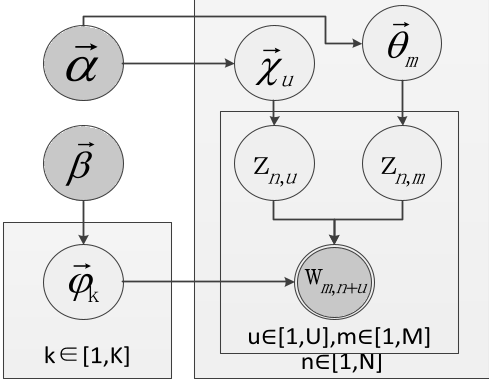
1. The Topic Model (Generative Process)
Building on top of LDA principles, the authors assume that both users and movies can be represented as distributions over latent topics.
- User Preference (): A multinomial distribution over topics drawn from a Dirichlet prior.
- Movie Topics (): The thematic signature of a film.
- Tag Distributions (): How likely a specific tag (e.g., "Noir") is to appear given a topic (e.g., "Classic Thriller").
2. Tag Reconditioning and MCA
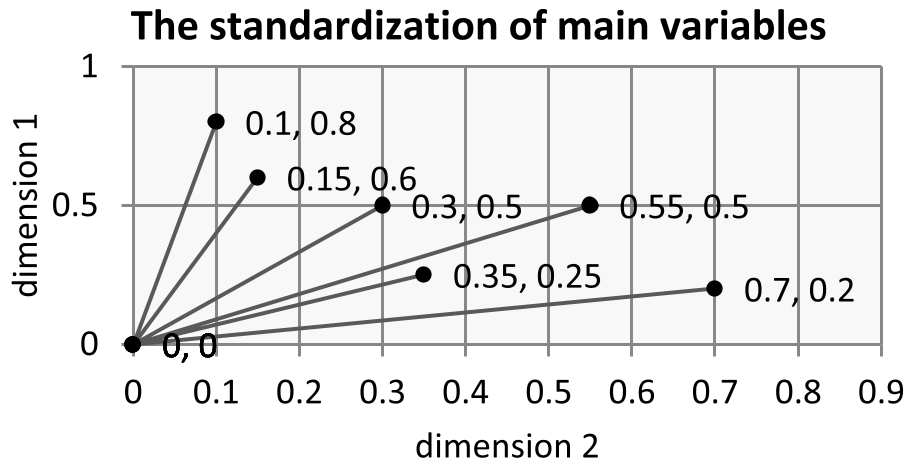
To solve the "Noisy Tag" problem, the authors employ Multiple Correspondence Analysis (MCA). They treat the relationship between movies and tags as a Boolean matrix and project it onto a lower-dimensional symmetric map. By analyzing the angles between tag vectors, the system can mathematically identify and discard tags that have weak correlations with primary concepts.
3. Asymmetric Co-occurrence
Unlike traditional Jaccard similarity which treats tag relationships as bidirectional, the authors argue for asymmetric measures. This captures the specific context where a broad tag might imply a specific one, but not necessarily vice versa, providing better diversity in candidate movies.
Experimental Insights
The model was validated using the MovieLens dataset (over 850k ratings and 13k tags). The researchers focused on three metrics: Precision, Recall, and the F-Measure.
- Perplexity Tuning: The model found its "sweet spot" at a specific number of latent topics, where the log-likelihood of unseen data was maximized.
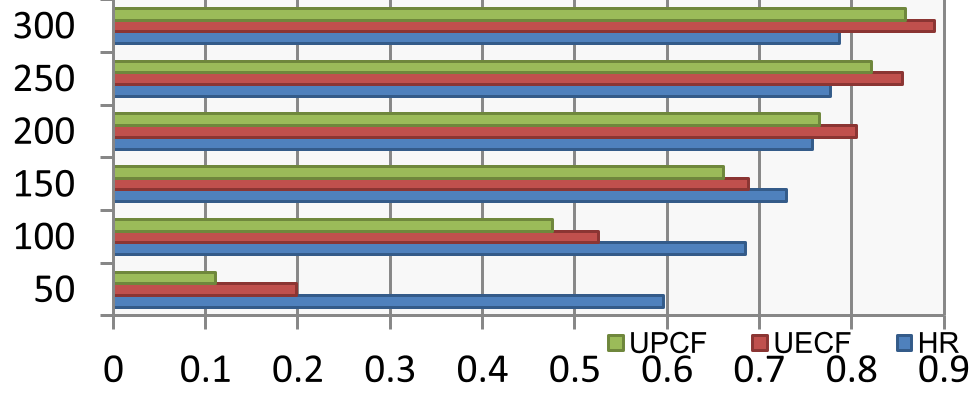
- Precision Supremacy: As shown in the performance charts, the Hybrid Approach (HR) consistently stays above the UPCF and UECF baselines. This suggests that the latent topic distributions provide a much denser and more accurate signal for recommendation than raw user-rating vectors.
Critical Analysis & Future Outlook
The primary contribution of this work is the rigorous normalization of social metadata. By treating tags as a noisy signal that requires statistical filtering (via MCA), the authors successfully bridge the gap between human language and machine-readable preference vectors.
Limitations: The current model is somewhat "static." It treats a user's interest in a genre as permanent. Future Work: The authors hint at "Social Pulse"—incorporating the temporal decay of interests. For instance, a user's recent obsession with "Comedy" due to a specific actor should carry more weight than a decade-old interest in "Horror." This move toward streaming, real-time preference updates is the next frontier for this hybrid model.
Conclusion
By moving the recommendation problem into the "Topic Space" and cleaning the input data with MCA, this hybrid approach proves that what users say (tags) is just as important as what users do (ratings).