
Towards Hybrid NER: Decoding the Human Element in Social Media Extraction
Towards Hybrid NER: A Study of Content and Crowdsourcing-Related Performance Factors
The paper presents a comprehensive study on "Wordsmith," a gamified hybrid Named Entity Recognition (NER) framework that combines automatic techniques with crowdsourcing. By analyzing four distinct datasets, the authors identify critical content and behavioral factors that determine the success of human-in-the-loop entity extraction for noisy social media text.
TL;DR
This study investigates the performance factors of human workers in hybrid Named Entity Recognition (NER) pipelines for microblogs. By deploying a gamified tool called Wordsmith, the research identifies that while crowds are exceptionally good at spotting people and places in short tweets, their performance plummets when faced with "Miscellaneous" categories or high entity density. The paper provides a roadmap for designing more efficient human-machine workflows.
The Challenge: Why Machines (and Humans) Struggle with Tweets
Named Entity Recognition is a solved problem for news articles, yet social media remains a "wild west." The compact style, slang, and inconsistent capitalization of microblogs create a high-noise environment. While crowdsourcing is often proposed as a solution, it isn't a silver bullet. The authors argue that we must understand the content factors (tweet length, entity type) and crowd factors (interface interaction, time spent) to build a truly optimized hybrid system.
Methodology: The Wordsmith Framework
The researchers built Wordsmith, a Game-with-a-Purpose (GWAP) designed to overcome the limitations of standard microtask templates.
1. Advanced Interface Tracking
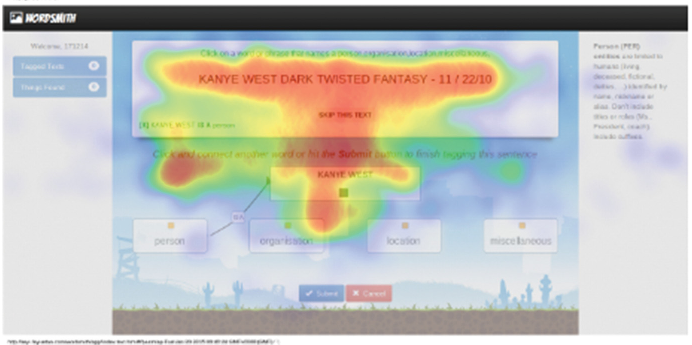
Unlike standard interfaces, Wordsmith tracked mouse movements every 10ms, allowing the creation of heatmaps to see where workers focused their attention.
2. Multi-Dataset Benchmarking
The study is rigorous because it doesn't just look at one dataset; it compares performance across:
- Ritter (2010): Random samples of early Twitter.
- Finin (2008): Early gold standards.
- MSM2013: Controlled, cleaner microposts.
- Wordsmith (2014): A new, 3,380-tweet corpus including hashtags and usernames.
Key Insights: What Makes the Crowd Tick?
People and Places are "Easy," Organisations are "Hard"
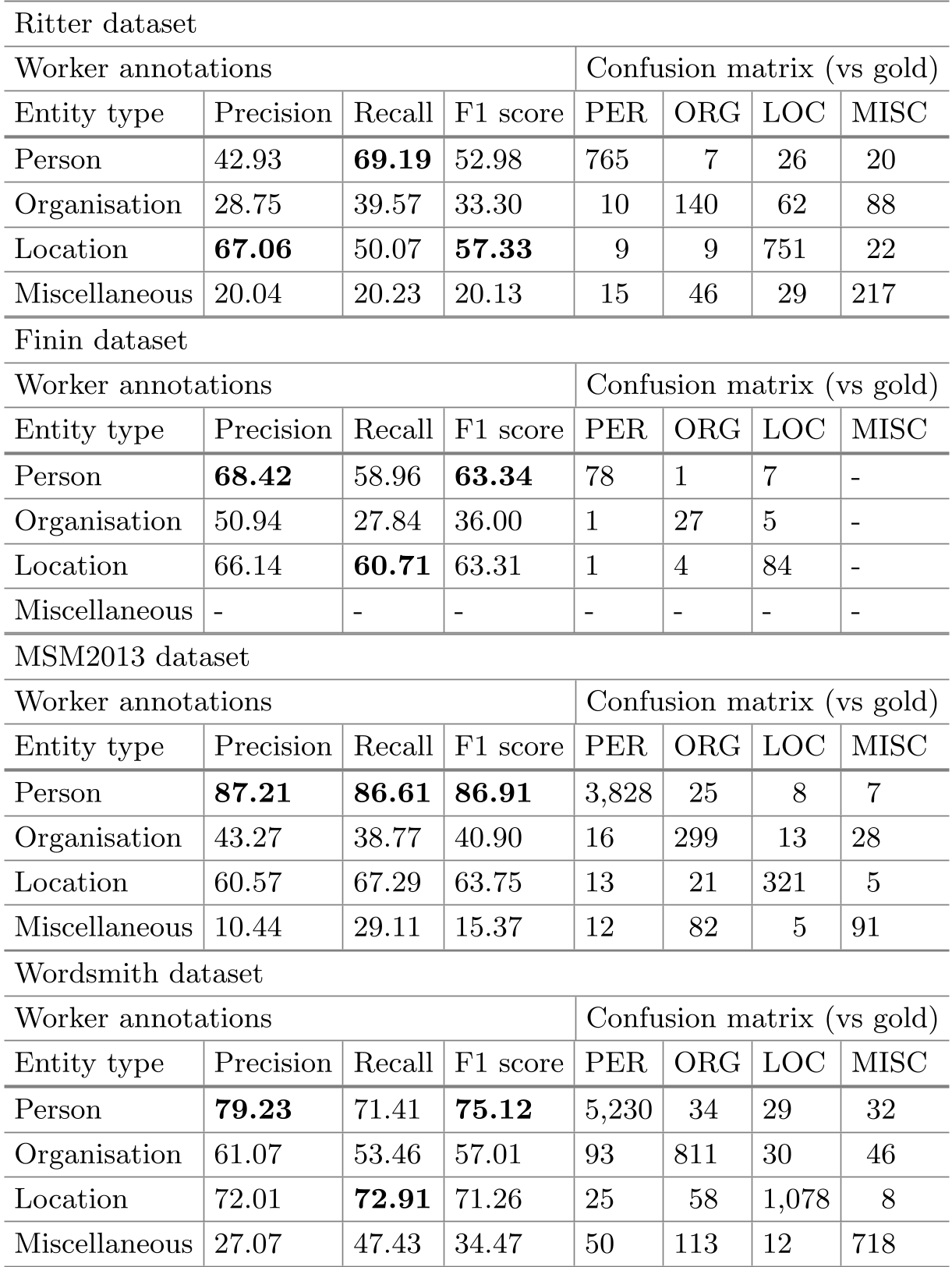
The data shows a clear hierarchy in human capability. Identifying a Person or a Location is almost intuitive for workers. However, Organisation and Miscellaneous types cause confusion. Why? Because organizations often require context to distinguish a brand name from a product or a physical location (e.g., is "McDonalds" a company or a place?).
The "Avoidance" Factor
A fascinating behavioral finding was the analysis of skipped tweets. Workers were more likely to skip tweets that were:
- Longer: Complexity correlates with fatigue.
- Entity-Dense: If a tweet had many entities, workers preferred to skip rather than risk a low-quality annotation.
The Power of Human Reasoning: "Implicit" Entities
Perhaps the most significant value of the crowd is their ability to spot implicitly named entities. While an algorithm might look for proper nouns, a human can recognize that "the stop after Waterloo" refers to a specific geographic entity in context. This "human reasoning" is exactly what hybrid pipelines should leverage.
Critical Analysis & Future Outlook
This paper shifts the focus from "can the crowd help?" to "how do we use the crowd intelligently?"
Limitations: The study relies on a gamified interface which might attract a different demographic than professional annotators. Furthermore, as "entity drift" suggests, human knowledge is temporal—what the crowd knows today about a celebrity might be gone tomorrow.
Future Work: The authors suggest building automated triage systems. Imagine an AI that scans a tweet: if it's long and contains technical jargon, the machine handles it. If it's short, recent, and contains ambiguous references to people, it gets sent to a human "Wordsmith."
Takeaway
Hybrid NER isn't just about combining outputs; it's about routing tasks based on cognitive load and contextual relevance. This research provides the quantitative evidence needed to start building those routing algorithms.