
PB-KNN: Scaling Outlier Detection for the Terabyte Era of Healthcare
A Hybrid Outlier Detection Method for Health Care Big Data
The paper introduces Pruning-based K-Nearest Neighbor (PB-KNN), a hybrid outlier detection method designed for high-dimensional healthcare big data. By integrating cluster-based pre-filtering, attribute-based dimensionality reduction, and dynamic distance pruning, it achieves superior performance over traditional KNN and LOF algorithms on the Hadoop platform.
TL;DR
Healthcare informatics is drowning in data, from EMRs to wearable sensors. Identifying "outliers"—which could signify medical fraud, rare diseases, or data errors—is computationally expensive. This paper introduces PB-KNN, a hybrid algorithm that slashes the complexity of standard K-Nearest Neighbor searches by 70% through intelligent pruning and medical-domain-specific data partitioning.
The Bottleneck: Why Traditional KNN Fails
In the world of Big Data, the K-Nearest Neighbor (KNN) algorithm is a classic "gold standard" for outlier detection because it focuses on the distance to the -th neighbor. However, healthcare data presents three specific nightmares:
- High Dimensionality: Hundreds of fields per patient record.
- Sparsity and Non-Uniformity: Data points are not evenly distributed.
- Volume: Processing 2+ Terabytes using a standard approach is essentially impossible for real-time systems.
Existing solutions like Local Outlier Factor (LOF) handle non-uniform density but crumble under high-dimensional sparsity. The authors identified that we need a way to prune the search space before doing the heavy math.
Methodology: The Precision of Medical Pruning
The core innovation of PB-KNN lies in its three-step filtration process.
1. Domain-Specific Reduction (CCQC & AOR)
Instead of generic PCA, the authors use Case Classification Quality Character (CCQC). This maps medical records to three indicators: Medical Model (Severity), Medical Defect (Errors), and Medical Trend (Progression). They then apply the Attribute Overlapping Rate (AOR) to group similar records and reduce the feature set without losing clinical significance.
2. Strategic Clustering
The system divides data into subsets and sorts them by Density. By starting detection in low-density areas, the algorithm finds potential outliers faster, which helps establish a "threshold" for pruning more effectively later.
3. Mathematical Pruning (The "How")
The paper utilizes the Triangle Inequality to prove two critical theorems. Essentially, if we know the distance from point to a known point , and we know 's neighbors, we can mathematically calculate whether could be an outlier. If it's impossible for to beat the current top-n distance, the algorithm skips the calculation entirely.
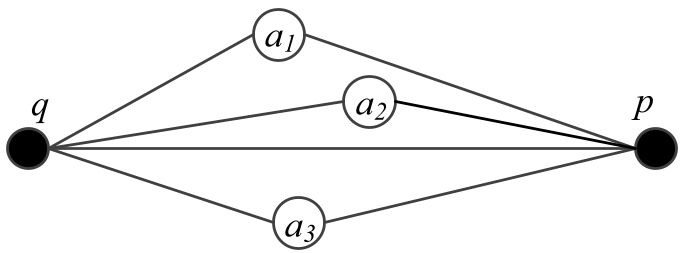 Figure: The geometric intuition behind pruning using triangle-based distance estimation.
Experiments: Performance in the Real World
The authors tested PB-KNN on 19.68 GB of processed data (from a 2.05 TB raw set) on a Hadoop cluster.
- Accuracy: When looking for the "Top-100" outliers, PB-KNN achieved a 76.09% recall rate, significantly higher than KNN (61.96%) and LOF (50%).
- Efficiency: This is where the paper shines. As data size increases, the execution time for standard KNN and LOF explodes. In contrast, PB-KNN remains nearly linear, saving 70% of processing time on average.
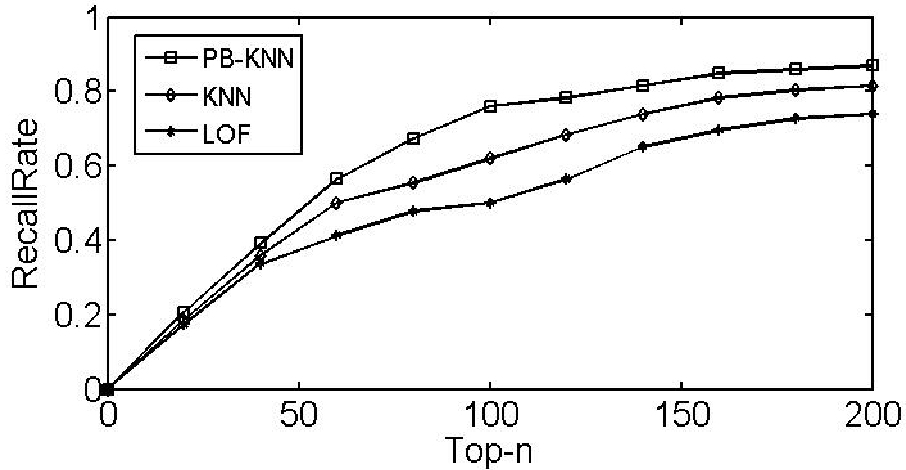 Figure: PB-KNN consistently maintains higher recall across various Top-N settings.
Critical Insight & Conclusion
The genius of this paper isn't just in the math—it's in the hybridity. By using medical domain knowledge (CCQC) to partition the data before applying rigorous geometric pruning (Triangle Inequality), it bypasses the "black box" nature of many AI models.
Takeaway for Engineers: If you are dealing with problems in Big Data, don't just throw more GPUs at it. Look for domain-specific "Fixed Attributes" and geometric constraints that allow you to prune the search space. Parallelizing an inefficient algorithm (Hadoop) is good; parallelizing a pruned algorithm is SOTA.
Limitations: While the pruning is effective, the initial AOR threshold () is still somewhat heuristic. Future work might explore auto-tuning these thresholds using Reinforcement Learning to optimize for different medical specialties.