
MyNet: Bridging the Gap Between P2P Freedom and Infrastructure Reliability
A hybrid P2P/Infrastructure platform for personal and social Internet services
This paper introduces a hybrid P2P/Infrastructure platform that extends the "MyNet" system by integrating Infrastructure-hosted MyNet Virtual Devices (MVD). This architecture bridges decentralized P2P networking with centralized Internet services to provide 24/7 connectivity and seamless third-party service integration.
TL;DR
The paper presents a hybrid architecture for MyNet, a personal and social networking platform. By introducing MyNet Virtual Devices (MVD)—infrastructure-hosted entities that behave like personal hardware—the authors solve the "intermittent availability" problem of pure P2P networks while allowing seamless, secure integration with traditional 3rd-party Internet services.
Context & Motivation: The Tug-of-War Between Centralization and Autonomy
Modern digital life is split between two suboptimal paradigms:
- Centralized Web Services: (e.g., Facebook, Flickr) These offer reliability but create "walled gardens." Users must re-upload content to multiple sites, losing control over their data and dealing with fragmented UI models.
- Pure P2P Networks: (e.g., Early MyNet, Turtle) These grant autonomy and privacy but fail when a user’s laptop or phone is turned off. If the host is offline, the service is dead.
The authors' insight was to create a "Virtual Persona" in the cloud that acts as a 24/7 anchor for the user’s decentralized network, effectively combining the "always-on" nature of the web with the "user-owned" nature of P2P.
Methodology: The Hybrid Architecture
The core of the system is the integration of infrastructure elements into the VIA P2P overlay.
1. MyNet Virtual Devices (MVD)
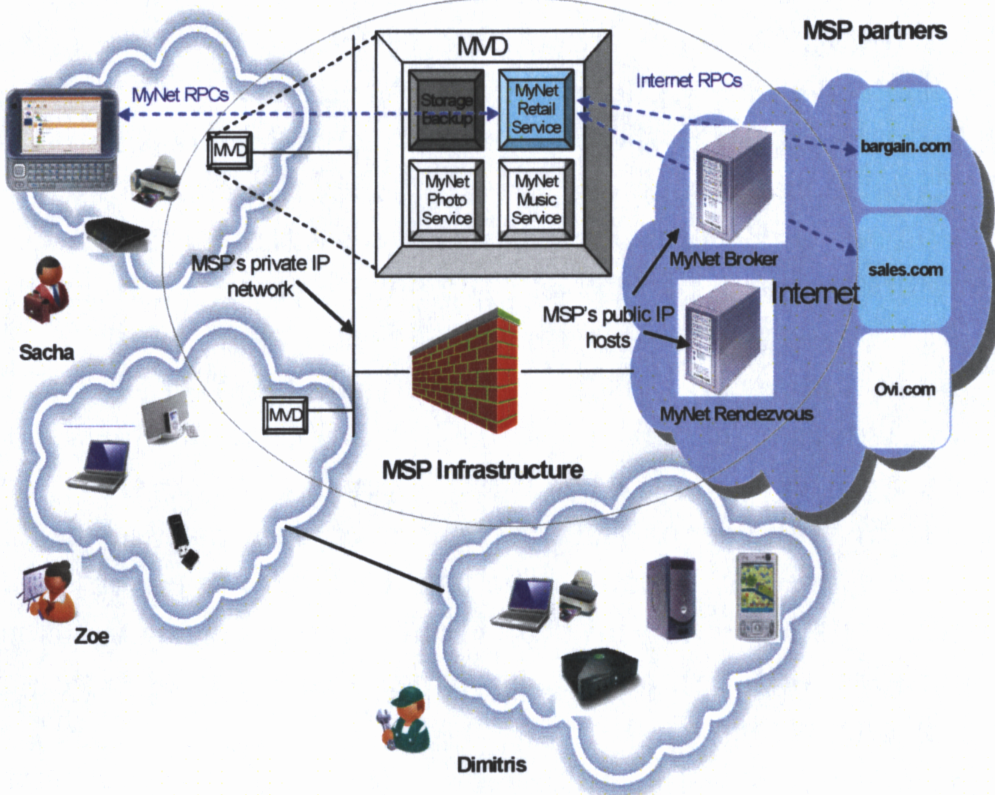
An MVD is essentially a specialized MyNet node running on a hosted server or Virtual Machine. It is a full citizen of the user’s Personal Device Cluster (PDC). Because it is hosted in a professional data center, it provides a stable entry point (Rendezvous) for other mobile devices to find each other.
2. MyNet-aware Internet Services (MaIS)
MaIS are the "translators" of this ecosystem. They sit on the MVD and act as proxies.
- Internet-side: They communicate with 3rd-party APIs (SOAP, XML-RPC).
- P2P-side: They expose these services as native MyNet components. This allows a user to "stream" a song from a web service to a friend via a Passlet (a secure capability token) as if the song were hosted on their own hard drive.
3. Remote Introductions & The Broker
The MyNet Broker solves the "bootstrap" problem. In pure P2P, adding a contact often requires physical proximity (e.g., Bluetooth). The Hybrid model uses the Broker to mediate out-of-band invitations (via Email/SMS) and Exchange Random Invitation Numbers (RIN) to establish encrypted P2P links remotely.
Experimental Validation: User Trust vs. Utility
The authors built a prototype for Ubuntu Linux and Nokia N800 devices. The evaluation focused on the human-centric aspect of the technology:
- Usability: The "Passlet" metaphor (real-world ticket analogy) proved highly successful, with 86% of users finding the security concept easy to grasp.
- Service Adoption: 90% of users saw the value in MaIS for personal networking (e.g., remote backup and access).
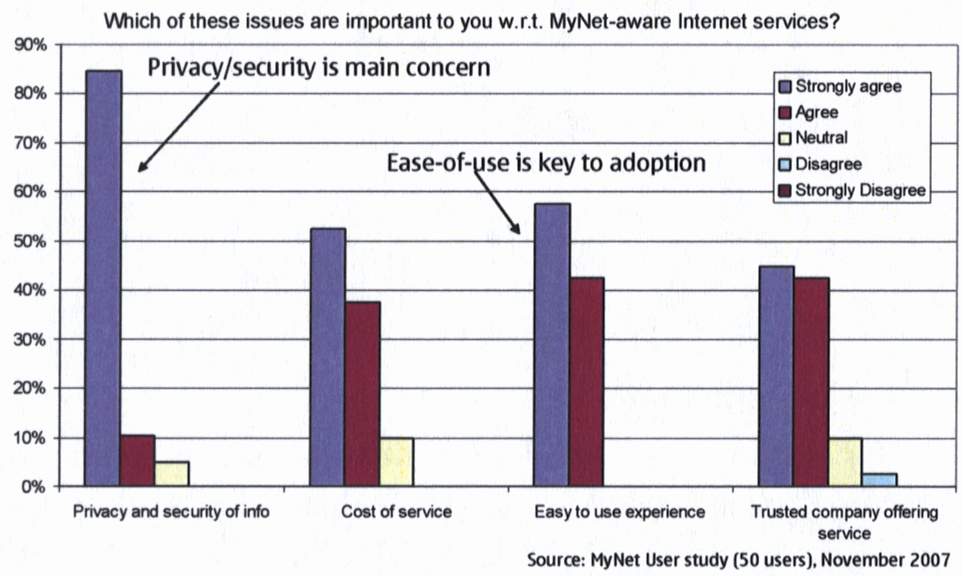
- The Privacy Trade-off: Interestingly, while the infrastructure adds value, it introduces a "trust gap." As shown in the results, privacy/security remained the primary concern for users when adopting hosted virtual devices.
Critical Insight & Conclusion
The "Hybrid MyNet" isn't just about adding a server to a P2P network; it's about Abstracting Infrastructure. The user treats the cloud MVD exactly like their mobile phone. This Inductive Bias—that "the cloud is just another one of my devices"—is a powerful UI/UX pattern for decentralized systems.
Takeaway for the Future: This work pre-dates the modern "Personal Cloud" or "Self-Sovereign Identity" (SSI) movements but provides the technical framework for how they should operate: a blend of high-availability infrastructure nodes acting as proxies for a sovereign, P2P social graph.
Limitations: The study notes that MVD scalability remains a hurdle. Transitioning from heavy VMs to lightweight containers or shared-middleware accounts is necessary to bring hosting costs down to a level that competes with centralized giants like Amazon or Google.