
Beyond the "Average" Patient: Mapping Radiation Dosimetry to Real-World Body Distributions
Hybrid Patient-Dependent Phantoms Covering Statistical Distributions of Body Morphometry in the U.S. Adult and Pediatric Population
This paper introduces a methodology for constructing a library of "patient-dependent" hybrid computational phantoms covering the statistical distributions of the U.S. adult and pediatric populations. By utilizing Non-Uniform Rational B-Splines (NURBS) and polygon mesh modeling, the authors transformed reference "anchor" phantoms (UFHADM and UFH10F) into diverse models that match specific anthropometric targets from the NHANES III database.
TL;DR
Researchers at the University of Florida have developed a scalable methodology to create "patient-dependent" computational phantoms. Unlike static reference models or labor-intensive patient-specific scans, these hybrid models use statistical data from the NHANES III database to accurately simulate radiation doses for individuals of varying heights, weights, and body shapes within the U.S. population.
Background Position: This work introduces a high-fidelity "library" approach to dosimetry, moving the field from standardized 50th-percentile models toward population-wide personalized medicine.
The "Reference" Fallacy: Why Size Matters in Dosimetry
For decades, medical physics relied on "reference" phantoms—mathematical models of the 50th-percentile average human. However, as medical radiation exposure has increased by nearly 600% since the 1980s, the margin for error has vanished.
A "standard" phantom cannot predict the dose for a 110kg patient or a 10-year-old in the 10th percentile for height. Prior works were either too rigid (Voxel models) or too simplistic (Stylized geometric models). The authors argue that patient size is the primary determinant of dose conversion coefficients, especially in radiographic projections where soft tissue shielding varies wildly.
Methodology: The Art of the Hybrid Remodel
The core innovation lies in the use of Hybrid Phantoms. These models use Non-Uniform Rational B-Splines (NURBS), which allow surfaces to be manipulated via control points—similar to how a 3D animator tweaks a character mesh.
The Remodeling Pipeline:
- Statistical Parameterization: Using the NHANES III database (33,994 individuals), the authors established target bins for standing height (10th to 90th percentiles).
- Anchor Selection: Base models like the UF Hybrid Adult Male (UFHADM) serve as the starting point.
- Anatomical Scaling:
- Vertical: Sitting height and leg length are adjusted to match height targets.
- Horizontal: Secondary parameters (waist, buttocks, arm, and thigh circumferences) are matched by manipulating NURBS control points to simulate subcutaneous fat distribution.
- Mass Iteration: The final body mass is fine-tuned by adjusting the outer contour in unconstrained areas (e.g., upper torso).
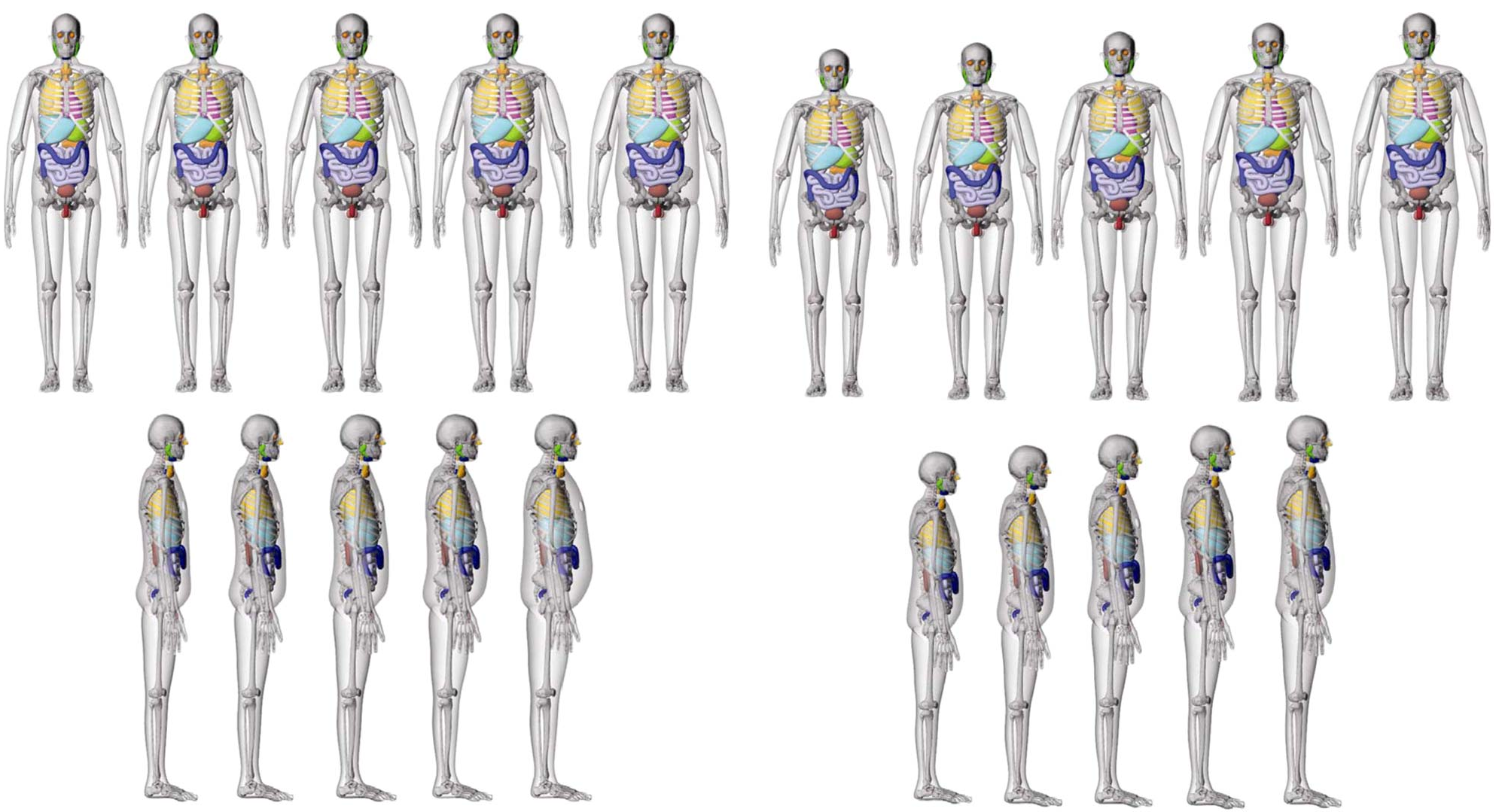 Figure 1: Frontal and lateral views of the adult male series, showing the transition from underweight (10th percentile) to obese (90th percentile) body types.
Validating the Internal "Engine"
A phantom is only as good as its internal organs. The authors compared their scaled organ masses against a French autopsy study of 684 cadavers.
Key Findings:
- Organ Mass Scaling: Organ masses (liver, spleen, kidney) demonstrated a gradual increase with both standing height and BMI.
- Statistical Alignment: The values generated by the hybrid modeling fell well within the standard deviations reported in real-world autopsy data.
- The "Church Pew" Effect: The models correctly captured the physiological reality that leg length varies more significantly than sitting height across a population.
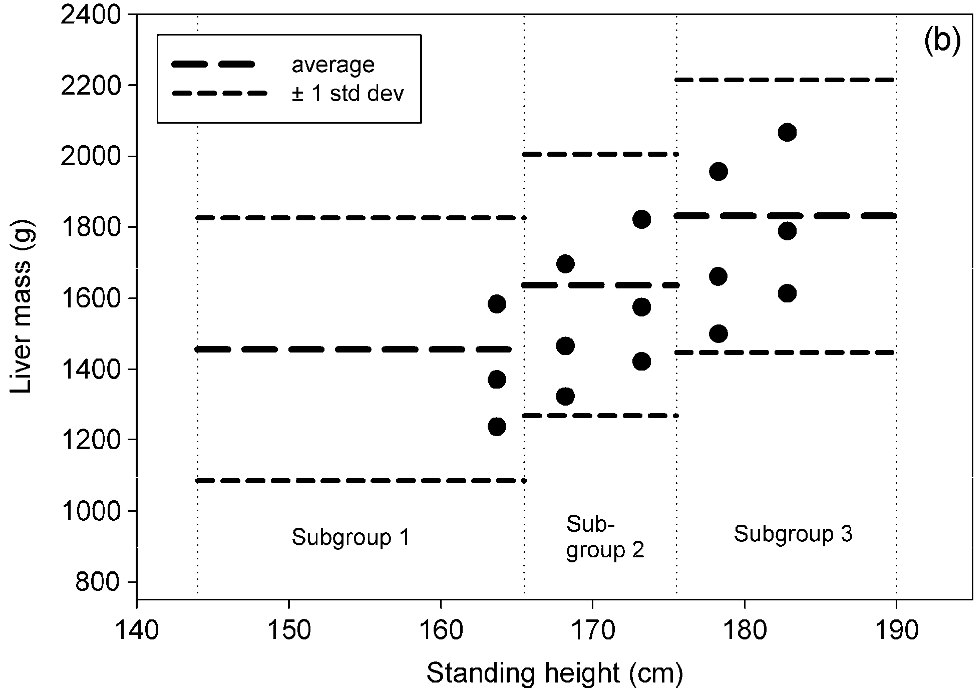 Figure 2: Correlation of liver mass with BMI. The UFHADM series (marked points) tracks the trend of the autopsy data (statistical bars), validating the anatomical logic of the scaling method.
Critical Insights & Future Horizons
The most striking takeaway is the balance between specificity and practicality. By creating a pre-defined library of 40 phantoms (25 adult, 15 pediatric), clinicians can "match" a patient to a phantom based on simple external measurements—height and weight—getting significantly closer to the true dose than a reference model ever could.
Limitations & Challenges:
- Visceral Fat: The current models focus on subcutaneous fat. Modeling internal (visceral) fat remains difficult because it is not easily predicted by external measurements.
- Intra-organ Variability: Even patients of the same height and weight have different size kidneys. Modeling this "internal noise" remains a future frontier.
Conclusion
This research provides the "missing middle" in medical dosimetry. By turning a static model into a flexible, statistically-grounded framework, the authors have paved the way for more accurate, retrospective, and prospective radiation dose assessments in a diverse global population.