
PNN-GMM Hybrid: Bridging Acoustic Intuition and Neural Probability in Emotion Recognition
A Hybrid PNN-GMM classification scheme for speech emotion recognition
This paper introduces a hybrid Speech Emotion Recognition (SER) framework that integrates Probabilistic Neural Networks (PNN) and Gaussian Mixture Models with Universal Background Models (UBM-GMM). The core innovation is a conditional-probability-based fusion algorithm using a Look-Up Table (LUT) to synergize individual classifier strengths, achieving an average accuracy of 80.75% across eight emotional states.
TL;DR
The paper proposes a novel hybrid classification architecture for Speech Emotion Recognition (SER). By combining the fast convergence of Probabilistic Neural Networks (PNN) with the robust background modeling of UBM-GMM, and tying them together with a conditional-probability fusion engine, the authors achieved an 8.25% improvement over the best standalone model on the LDC Emotional Prosody dataset.
Problem & Motivation
Human speech contains a massive amount of "paralinguistic" information. While we have made strides in what is being said (STT), determining how it is being said (Emotion) remains elusive.
The difficulty lies in the mismatch and vagueness of emotional boundaries. Single-model approaches, such as a lone GMM or SVM, often fall into local minima or fail to generalize across different speakers. The authors identified that PNNs are excellent at local pattern approximation, while UBM-GMM excels at handling acoustic "background" noise. The goal was to create a "best-of-both-worlds" ensemble.
Methodology: The Fusion Architecture
The system follows a three-stage pipeline: Feature Extraction, Base Classification, and Probabilistic Fusion.
1. Acoustic Real-Estate
The researchers extracted a multi-dimensional feature vector consisting of:
- Prosodic Features: Pitch and Intensity (including Low-passed Intensity).
- Spectral Features: 24-channel Mel-Frequency Cepstrum Coefficients (MFCC).
2. The Base Classifiers
- PNN: A Bayesian statistical classifier that uses Parzen estimators. Its strength lies in its speed and simplicity.
- UBM-GMM: This isn't just a standard GMM. It uses a Universal Background Model to calculate a log-likelihood ratio: This specifically addresses the "mismatch" problem by comparing the emotion model against a general background model.
3. Conditional Fusion (The Secret Sauce)
Instead of using a simple "majority vote" or a linear weighted average, the authors built a Look-Up Table (LUT).
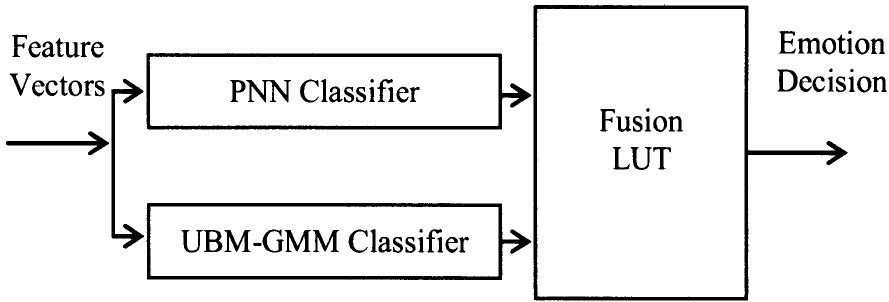
The fusion logic asks: "Historically, if the PNN says 'Angry' and the GMM says 'Panic', what is the actual probability that the speaker is 'Angry'?" This allows the system to learn the specific failure modes of each classifier and correct them dynamically.
Experiments & Results
The hybrid model was tested on the LDC Emotional Prosody Speech corpus, covering eight distinct states: Anxiety, Contempt, Despair, Disgust, Angry, Panic, Sadness, and Neutral.
Performance Gains
The results were conclusive. The hybrid model didn't just marginally improve performance; it dominated across all categories.
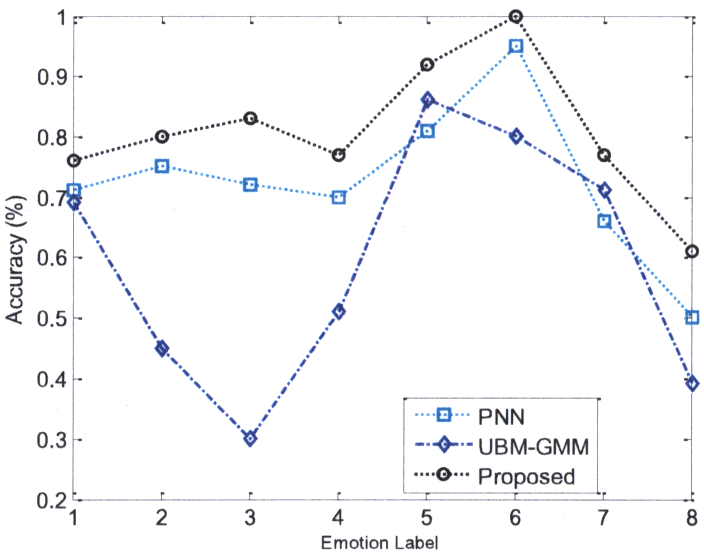
| Emotion | Hybrid (%) | PNN (%) | UBM-GMM (%) |
|---|---|---|---|
| Angry | 92 | 81 | 86 |
| Neutral | 100 | 95 | 80 |
| Average | 80.75 | 72.50 | 58.88 |
The hybrid approach is particularly effective in resolving "Despair" and "Sadness," where individual models previously struggled, reaching as low as 30% accuracy.
Critical Analysis & Conclusion
Takeaway
The beauty of this work lies in the Fusion LUT. By treating the outputs of primary classifiers as features for a secondary probabilistic decision, the authors created an "Expert Oversight" layer.
Limitations
The authors acknowledge a significant trade-off: Data Hunger. The Fusion LUT necessitates a "second training set" to populate the probability matrix. In scenarios with low-resource data, the LUT might become sparse, forcing the system to fall back on basic confusion matrices (Step 6 of the Testing process), which reduces the benefits of the fusion.
Future Outlook
While this paper uses traditional features like MFCCs, the logic of the conditional fusion is architecture-agnostic. Applying this "Fusion LUT" approach to modern SSL (Self-Supervised Learning) backbones like HuBERT or Wav2Vec could yield even higher SOTA results in the future of affective computing.