
Hybrid Privacy Protection in CPSNs: Balancing Utility and Security via Game-Based RL
8142_A Hybrid Privacy Protection Scheme in Cyber-Physical Social Networks.
This paper introduces a hybrid privacy protection scheme for Cyber-Physical Social Networks (CPSNs) that simultaneously preserves location and identity privacy. The authors model the interaction between users and dynamic adversaries as a Game-based Markov Decision Process (GMDP) and employ a modified SARSA reinforcement learning algorithm to find the optimal defense strategy.
TL;DR
As Cyber-Physical Social Networks (CPSNs) become ubiquitous, protecting user identity and location becomes a "cat-and-mouse" game. This paper proposes a Hybrid Privacy Protection Scheme using a Game-based Markov Decision Process (GMDP). By treating privacy as a dynamic zero-sum game and solving it with a high-speed modified SARSA algorithm, the authors achieve SOTA data utility while keeping adversaries at bay.
The Core Conflict: Privacy vs. Utility
In applications like Yelp or Groupon, users act as sensors, publishing data that includes their identity and location. Current solutions often suffer from two fatal flaws:
- Siloed Protection: They protect where you are or who you are, but rarely both at the same time.
- Static Defense: They assume the attacker doesn't adapt. In reality, adversaries are "intelligent" and adjust their eavesdropping strategies based on previous successes.
The authors argue that the best way to handle this is not through rigid rules, but through an optimized tradeoff modeled as a multi-stage game.
Methodology: The GMDP Framework
The researchers define the confrontation as a dynamic multistage zero-sum game.
- The User’s Action: Choosing the granularity of information release (from anonymity to full release).
- The Adversary’s Action: Deciding the probability of eavesdropping, constrained by finite computing power ().
Mathematical Intuition
The payoff function balances the Quality of Service (QoS) against Privacy Loss (PL): Where represents the cost of privacy. The goal is to reach a Nash Equilibrium (NE)—a state where neither the user nor the adversary can improve their position by changing strategies unilaterally.
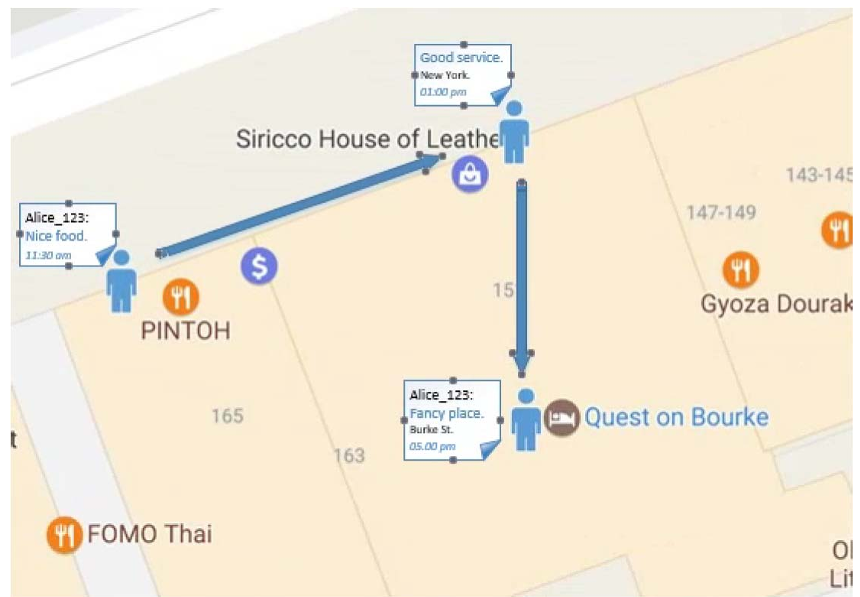
Speeding Up the Learning: Modified SARSA
Solving a standard Markov Decision Process (MDP) for large datasets is computationally expensive (high cardinality). The authors' "secret sauce" is reducing the state-space cardinality from to 2. By focusing on the Attack Result (AR) (Success vs. Failure) rather than every individual message type, the complexity drops from to a manageable .
Experimental Validation
Using the Yelp dataset (4.1M reviews across 11 cities), the team tested their algorithm against "Shortsighted" (focuses only on now) and "Static" (never changes) strategies.
Key Findings:
- Higher Payoff: The proposed GMDP approach consistently maintained a higher payoff than baselines, especially as the adversary's power increased.
- Convergence Speed: The modified SARSA converged in ~1,000 iterations, whereas the classic version required up to 1,000,000.
- Resilience: The system effectively adjusts the "mixing effectiveness" (noise) in unit regions to keep information entropy high for attackers.
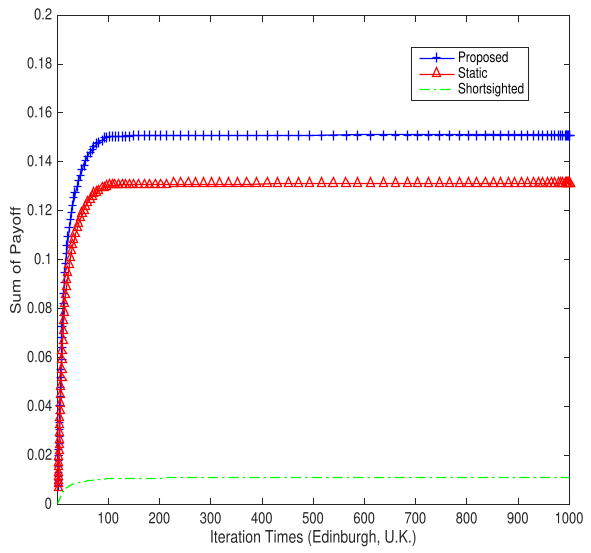 (Fig: Iteration times and convergence across different geographical datasets)
Critical Analysis & Future Outlook
This work is an "early bird" in combining location and identity privacy into a single long-term framework. Its strength lies in its computational efficiency—it is practical enough to run on standard hardware (Core i5) while handling massive social datasets.
Limitations: The model assumes a zero-sum game; however, in some real-world clouds, the service provider and user might have semi-cooperative goals. Future research could explore non-zero-sum dynamics and customized privacy levels where specific users value location more than identity (or vice versa).
Conclusion
By moving from static filters to a reinforcement-learning-driven game, this study provides a blueprint for the next generation of privacy-aware social applications. It proves that you don't have to sacrifice the "Social" in CPSN to keep your "Private" data secure.