
Hybrid Quantum-Classical Networks: Bridging the Gap Between NISQ Limitations and Realistic Data
Hybrid Quantum Network for classification of finance and MNIST data
This paper introduces a hybrid quantum-classical neural network ("QNet") designed for binary and multiclass classification tasks on realistic datasets, including Finance and MNIST. Utilizing Google’s TensorFlow Quantum, the author demonstrates that integrating a quantum variational circuit between classical layers can outperform pure classical networks of equivalent parameter size.
TL;DR
As we navigate the Noisy Intermediate-Scale Quantum (NISQ) era, a critical question remains: can quantum computers handle real-world data? This paper presents a Hybrid Quantum Network (QNet) that uses classical neural layers to "feed" complex data (like MNIST and financial credit scores) into a quantum circuit. The results show that this hybrid approach not only scales to high-dimensional inputs but also converges faster and achieves higher AUC scores than equivalent classical networks.
Problem & Motivation: The Qubit Bottleneck
In the world of Quantum Machine Learning (QML), most benchmarks look like "toy problems"—two features, twenty samples, and three qubits. However, real-world finance data involves thousands of features and highly unbalanced classes (e.g., 90% non-default vs. 10% default).
The main hurdle is scaling. If you use standard angle encoding, 1,000 features require 1,000 qubits—well beyond the 50-100 qubits available today. The author’s insight is to use a "Classical-Quantum-Classical" sandwich:
- Classical Pre-processor: Compresses 1,000+ features into a latent space (e.g., 8 dimensions).
- Quantum Core: Processes these dimensions using entanglement and rotation gates.
- Classical Post-processor: Interprets quantum measurements for final classification.
Methodology: The Hybrid Architecture
The core of the methodology is the integration of Data Re-uploading. Instead of feeding data into the quantum circuit once, the information is reintroduced across multiple layers of the Variational Quantum Circuit (VQC). This increases the "non-linearity" and expressivity of the model without needing more physical qubits.
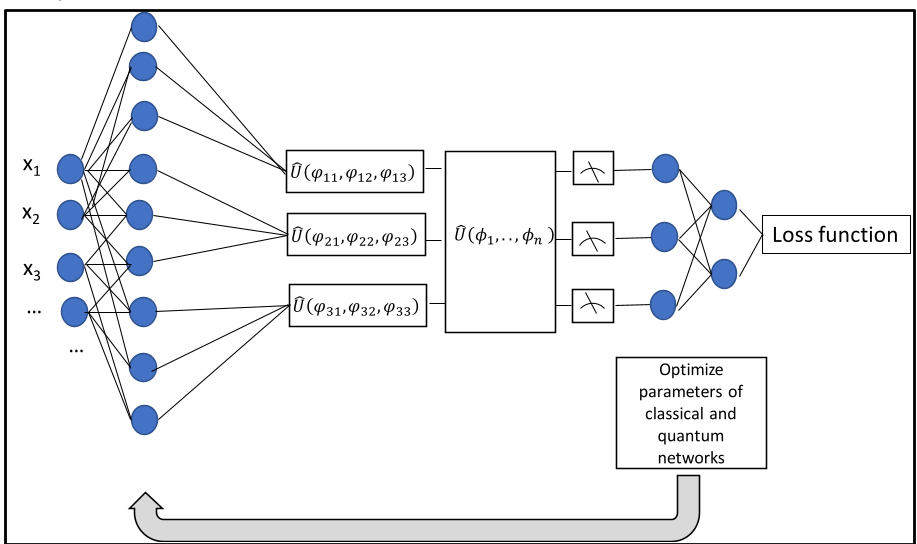 Fig 1: The hybrid pipeline showing the transition from classical features to quantum gates and back to classical loss functions.
The quantum part consists of:
- Encoding: and rotations driven by the classical layer output.
- Entanglement: CNOT gates to create quantum correlations.
- Variational Layers: Learnable parameters adjusted via the ADAM optimizer in a classical feedback loop.
Experiments & Results: Finance and MNIST
The author tested the QNet on two distinct domains: Credit Scoring (Tabular) and MNIST (Image).
1. Finance Data (Sample I & II)
When handling credit defaults, the Hybrid QNet with data re-uploading showed a clear advantage:
- QNet AUC: 0.72 (Test)
- Classical NNet AUC: 0.51 (Test)
The improvement in AUC (Area Under Curve) is vital here, as simple Accuracy (ACC) is often misleading for unbalanced datasets.
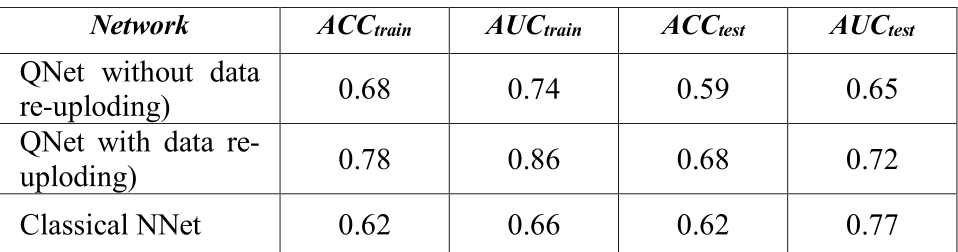 Table 1: Performance comparison on balanced finance data.
2. MNIST Digit Classification
MNIST involves 784 features ( pixels). By using the hybrid approach, the author successfully compressed these into a quantum-manageable size. The QNet reached high accuracy much faster than the classical baseline, suggesting that quantum circuits may navigate the loss landscape more efficiently.
Critical Analysis & Conclusion
Takeaway
The study proves that TensorFlow Quantum offers a viable software stack for deploying QML. The hybrid model effectively "hides" the qubit count limitation behind a classical bottleneck layer, allowing us to leverage quantum entanglement for the most critical part of the computation.
Limitations & Future Work
- Overfitting: Like their classical counterparts, QNets suffer from overfitting. The research highlights a desperate need for "Quantum Regularization" techniques.
- Simulator vs. Hardware: The results were obtained on simulators. Real-world NISQ hardware introduces "noise" (decoherence), which could degrade the performance advantages seen here.
- The "Why": While the performance is better, the theoretical reason why quantum entanglement provides this specific advantage in credit scoring remains a frontier for further mathematical proof.
In conclusion, this work moves QML from theoretical "toy" circuits toward practical industrial application, providing a blueprint for financial institutions to experiment with quantum-enhanced risk modeling.