
Efficient Social Network Discovery: Balancing Speed and Overhead with DW-DLC
Hybrid searching scheme supported by dynamic weighted distributed label clustering in social networks
The paper introduces a Hybrid Searching (HS) scheme integrated with a Dynamic Weighted Distributed Label Clustering (DW-DLC) structure for social networks. By combining random walkers with selective flooding triggered at optimized clusterheads, the method achieves efficient information retrieval in large-scale, dynamic topologies.
TL;DR
Information retrieval in massive social networks typically faces a trade-off between the "noise" of flooding and the "slowness" of random walks. This paper introduces the Hybrid Searching (HS) scheme powered by Dynamic Weighted Distributed Label Clustering (DW-DLC). By intelligently reducing the number of clusterheads and using them as selective flooding hubs, the authors achieved a 90% reduction in search delay while maintaining the lowest message overhead in the field.
Background: The Scalability Trap
In modern social networks, nodes (users) are constantly churning (joining/leaving), and information is scattered.
- Flooding is fast but creates a "broadcast storm," overwhelming the network.
- Random Walkers save bandwidth but often wander aimlessly, failing to find "unpopular" or rare resources.
The authors identify that the key to solving this is the Dominating Set (DS)—a subset of nodes that can "supervise" the entire network. However, existing DS and DLC methods aren't optimized for the dynamic density of social graphs.
Methodology: The DW-DLC Innovation
The core contribution is the DW-DLC structure. Unlike traditional DLC, which uses static weights, DW-DLC introduces an iterative weight re-calculation.
1. The Weighting Logic
A node's importance (Weight) is determined by its local degree and unique ID to prevent collisions. The original weight formula is:
2. Dynamic Optimization
The "Dynamic" part comes into play during the second phase of clustering. For nodes that haven't been assigned a role, the algorithm re-computes weights by subtracting the degrees of neighbors that are already ordinary nodes. This effectively prunes redundant clusters, leading to a more "elite" set of clusterheads that cover the same area with fewer messages.
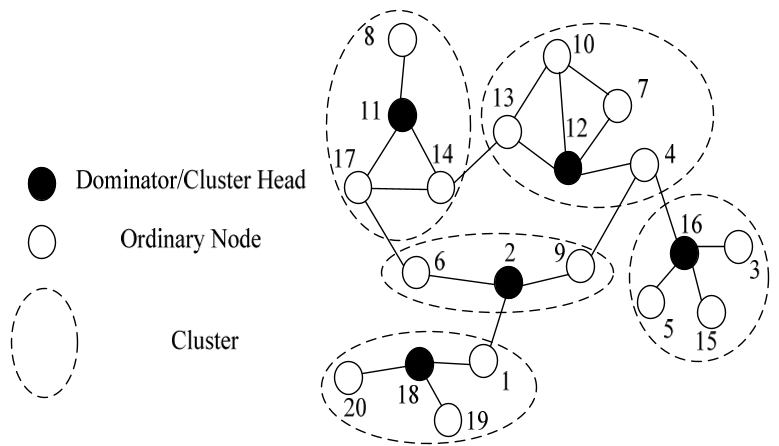 Figure: The DW-DLC scheme showing clusterheads (black) and ordinary nodes (white).
3. The Hybrid Search (HS) Protocol
The search starts as a Random Walker. When the walker hits a DW-DLC clusterhead, it switches to Flooding. To prevent loops, a DW-DLC_sent flag ensures each clusterhead only floods a specific query once.
Experiments & Results
The authors tested the scheme in a rigorous environment with 50,000 nodes using a power-law distribution to mimic real-world social structures.
- Message Overhead: HS+DW-DLC outperformed standard DLC and CDS (Connected Dominating Sets) significantly. By having fewer, more strategic clusterheads, the "selective flooding" phase produced far less redundant traffic.
- Latency: Even when only 8% of nodes contained the target information, the search delay was slashed by over 90% compared to pure random walks.
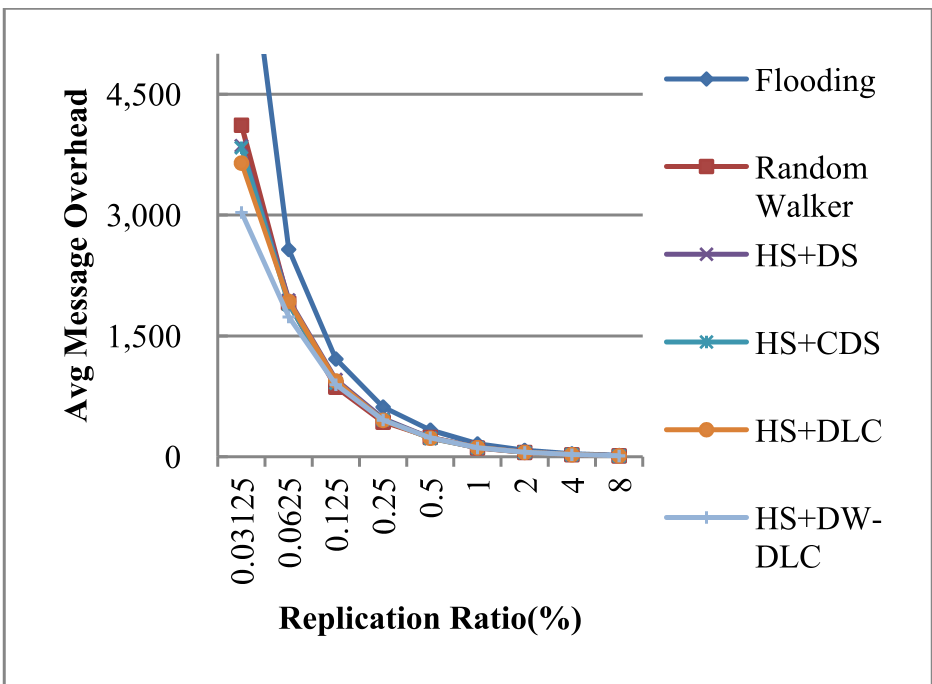 Figure: Performance comparison showing DW-DLC achieving the lowest overhead.
Critical Insight: Why it Works
The "magic" of this paper lies in the Inductive Bias of social networks. Because social networks follow a power-law (where a few nodes have many connections), DW-DLC naturally gravitates toward these "hubs" but prevents them from all becoming clusterheads simultaneously. This "sparsification" of the dominating set is what allows the hybrid search to remain lean while still being broad enough to catch rare data.
Conclusion
The HS+DW-DLC approach provides a robust framework for decentralized search. By focusing on clusterhead representative quality rather than just quantity, the authors have provided a blueprint for more efficient P2P protocols.
Future Outlook: While the paper excels in static snapshots, applying this to high-velocity streaming data where node "interests" change as fast as their "online status" remains an open challenge. The next step for this research would likely involve Node Dispersion metrics to ensure clusterheads are spatially optimized across the network manifold.