
Hybrid Social Search: Bridging Expertise and Trust in OSNs
A hybrid social search model based on the user's online social networks
The paper introduces a hybrid social search model designed to identify ranked "answerers" within a user's Online Social Network (OSN). It combines two primary metrics: Topic Relevance Rank (TRR), which assesses professional expertise, and Social Relation Rank (SRR), which measures interpersonal connection strength, achieving a Mean Average Precision (MAP) of 0.453.
TL;DR
In the era of information overload, we often trust a friend's recommendation more than a search engine's algorithm. This paper presents a hybrid social search model that finds the "right person" to answer a query. By combining Topic Relevance (TRR) and Social Relation (SRR) through a smart Topic Classifier, the model achieves a 76% improvement in precision over traditional keyword-based methods.
Context: Beyond the Keyword
Traditional search engines excel at finding documents but struggle with queries that require subjective trust or hyper-local expertise. Why ask Google "Who is a good babysitter?" when your social circle has the answer? However, social search is difficult because:
- Topic Diversity: Some questions need an expert (Professional Importance); others need a friend (Trusted Importance).
- Dynamic Activity: An expert who hasn't logged in for a year is useless.
- Network Influence: Not all friends are equally influential within the network.
The Hybrid Social Search Model
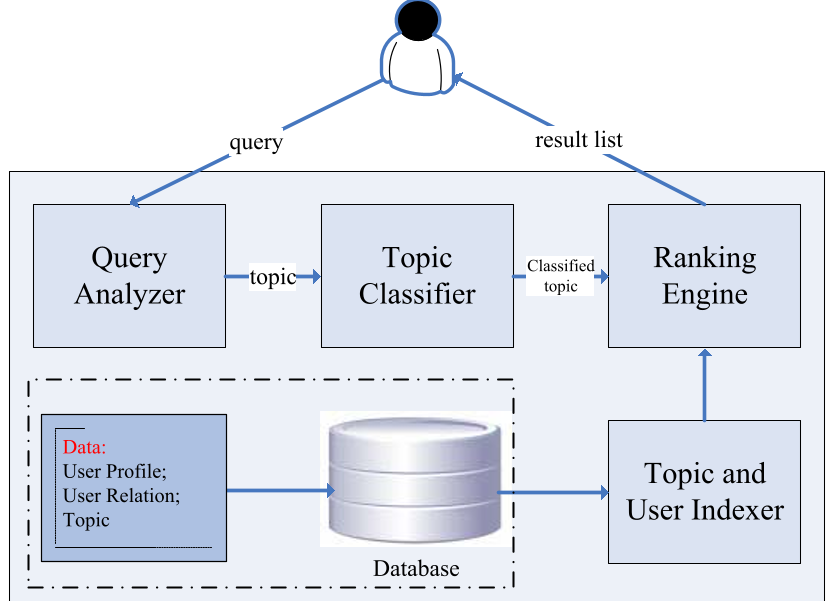
The authors propose a modular architecture to ingest OSN data and return a ranked list of potential answerers.
1. Topic Relevance Rank (TRR)
The TRR measures how much a user knows about a topic. It utilizes:
- Semantic Matching: Using a "Paoding Analysis" for term resolution.
- BM25 Scoring: Calculating proficiency based on user-generated content (blogs, status updates).
- Social Strengthening: If your friends are experts in AI, your own professional score in AI receives a boost.
2. Social Relation Rank (SRR)
This captures the "intimacy" and "influence" of the user:
- Temporal Decay: Users who are inactive are penalized using an exponential decay function .
- User Influence (): Implemented using a PageRank-style recursive algorithm to determine who the "hubs" of knowledge are in the network.
- Relation Strength: Weighted by contact frequency and social distance.
3. The Topic Classifier: The "Secret Sauce"
This is the most innovative part of the paper. Instead of a static blend, the model uses a weight to balance the two ranks:
- Professional Queries: (e.g., "Future of 6G") High (emphasize TRR).
- Social Queries: (e.g., "Best coffee shop") Low (emphasize SRR).
Experimental Validation
The model was tested on a massive dataset from 3G RenRen Network, China's largest student social network at the time.
Performance comparison (MAP)
The results confirm that adding social context () and query-type awareness () drastically improves accuracy.
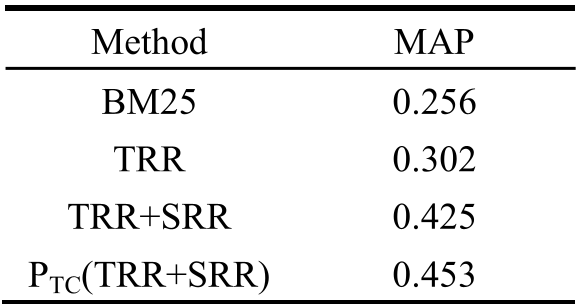
- Baseline (BM25): 0.256 MAP
- Hybrid with Topic Control: 0.453 MAP (Nearly double the baseline performance).
Critical Insight & Future Directions
The core takeaway is that human-centric search is not just about indexing text; it's about indexing relationships.
Limitations: The current model relies on explicit labels for topic classification. Future work could leverage Large Language Models (LLMs) to automatically determine the "Professional vs. Trusted" intent of a query with much higher granularity. Furthermore, the computational cost of calculating real-time PageRank-style influence on billion-scale graphs remains a challenge for production deployment.
Summary
This paper provides a robust blueprint for the next generation of "Social Engines," where the goal is not to find a webpage, but to facilitate a connection between a seeker and a knowledgeable peer.