
Hybrid Sourcing: Navigating the 2025 Digital Cliff through Crowdsourcing and Inner-sourcing
10504_Hybrid sourcing novel combination of crowdsourcing and inner-sourcing for software developments.
This paper introduces "Hybrid Sourcing," a novel software development framework that integrates crowdsourcing and inner-sourcing. By decomposing projects into microtasks, the authors successfully balanced external talent and internal organizational resources, achieving a 51% reduction in the workload of dedicated project members in a real-world industrial case study.
TL;DR
To combat a looming shortage of IT engineers, researchers from NTT Corporation have pioneered Hybrid Sourcing. This strategy breaks software projects into microtasks, distributing them between external crowd workers and internal "slack-time" employees. In their industrial pilot, they successfully offloaded 51% of the implementation workload from dedicated project staff, proving that full-time assignment is no longer the only path to project success.
Problem & Motivation: The "2025 Digital Cliff"
The software industry is facing a demographic crisis. In Japan, the "2025 Digital Cliff" refers to a predicted economic loss of $100 billion per year due to an aging population and a shortage of 430,000 IT engineers.
Current sourcing strategies are binary and flawed:
- Crowdsourcing: Great for on-demand scaling and niche skills, but a nightmare for security and intellectual property (IP).
- Inner-sourcing: Secure and efficient, but limited by the fixed "talent ceiling" of a single organization.
The authors argue that the bottleneck isn't just a lack of people, but a lack of flexibility in how we assign tasks to the people we already have.
Methodology: The Architecture of Hybrid Sourcing
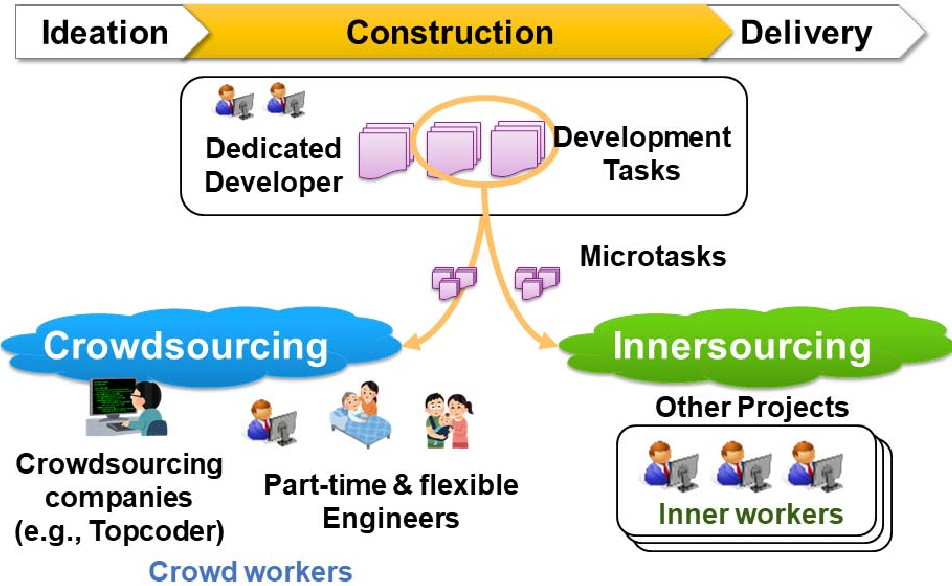
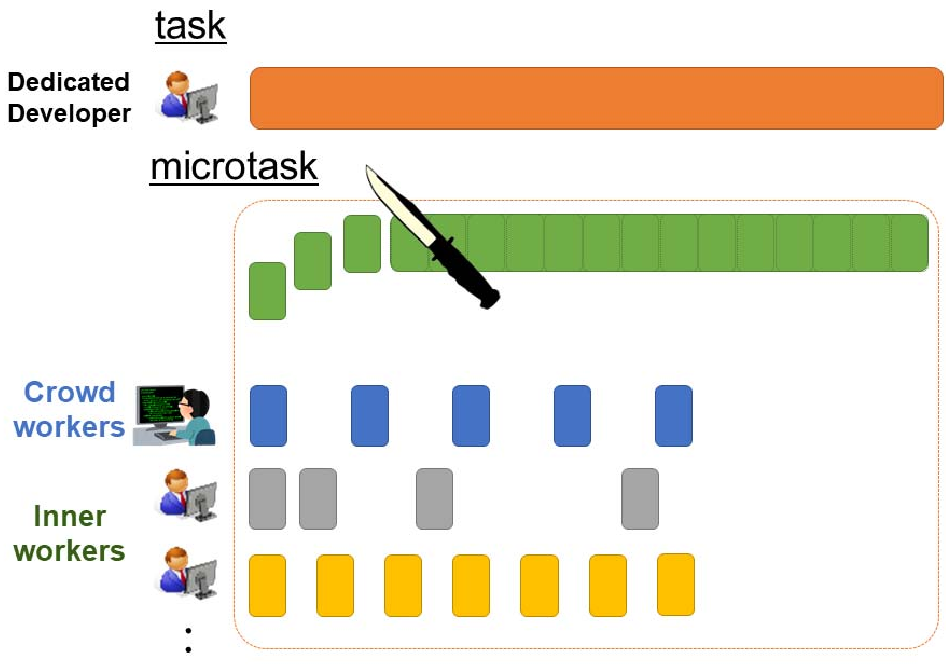
The core innovation lies in Task Decomposition (Microtasking). Instead of assigning a whole module to a developer, the project is sliced into short, self-contained microtasks.
The Distribution Logic:
- Dedicated Developers: Handle the "Brain" — system architecture, use case creation, and high-security persistence APIs.
- Inner Workers (Inner-sourcing): Handle the "Sensitive Muscle" — internal API implementation and UI components during their slack time.
- Crowd Workers (Crowdsourcing): Handle the "Specialized/Generic Muscle" — UI/UX design and complex but self-contained algorithms (e.g., bus route optimization).
Case Study: A Web App for Bus Advertising
The authors applied this to a Japanese bus company's web application. The system helps sponsors find the most effective bus routes for advertising based on population data.
- Crowdsourcing (External): Used for the combinatorial optimization algorithm and MarvelApp-based UI/UX prototypes.
- Inner-sourcing (Internal): Other NTT employees built the function APIs and UI screens based on the crowd's prototypes.
- Dedicated (In-project): Focused on the overall system transition logic and database integration.
Results: Breaking the 50% Barrier
The most striking result is the LOC (Lines of Code) Balance. Traditionally, we assume the dedicated team does 90-100% of the work. Here, the dedicated team was only responsible for 49%.
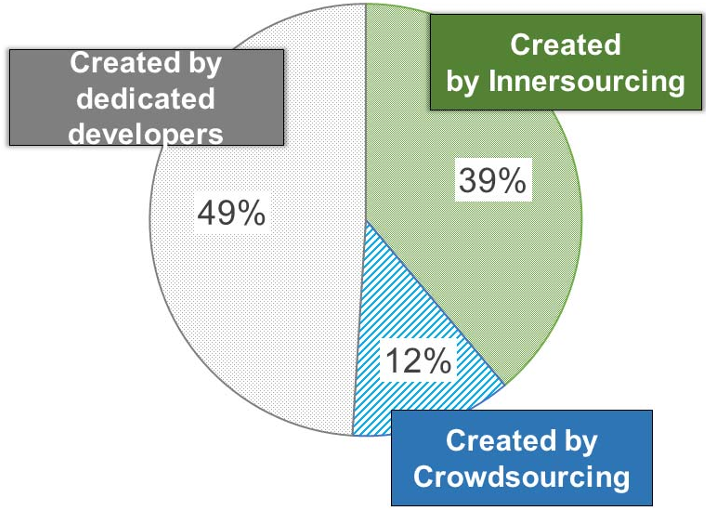
The project was delivered on schedule (4 months), proving that the overhead of managing microtasks did not derail the timeline.
Critical Analysis & Conclusion
While successful, the authors acknowledge a significant hurdle: Decomposition Overhead. The dedicated developers' workload spiked during the design phase because they had to manually "slice" the project into microtasks.
Future Outlook: The industry needs a "Hybrid Sourcing Framework" that automates microtask decomposition and provides better management infrastructure to re-integrate code from diverse sources. This paper marks a shift from viewing developers as "static assets" to viewing them as a "dynamic, global pool," potentially saving the industry from the talent shortages of the coming decade.
Takeaway: If your project is struggling with headcount, look at your architecture. Can it be microtasked? If so, half your work could be done by someone who isn't even in your building.