
Hybrid Emotion Mining: Bridging AI and Psycholinguistics for Suicide Prevention
A Hybrid System for Online Detection of Emotional Distress
The paper presents a hybrid system for the online detection of emotional distress in public blogs. It combines a supervised SVM classifier with an unsupervised, hand-crafted model to identify individuals at high risk of depression and suicide for timely public health intervention.
TL;DR
In an era where digital footprints often precede physical cries for help, researchers from The University of Hong Kong have developed a hybrid system to detect emotional distress in blogs. By merging the raw classification power of Support Vector Machines (SVM) with a Hand-Crafted Model based on clinical psychology, the system aims to provide a proactive "early warning" for public health organizations.
Background Positioning
This work sits at the intersection of Affective Computing and Public Health Informatics. While most sentiment analysis tools are built for marketing or product reviews, this system is a specialized intervention tool designed to find "needles in the digital haystack"—individuals exhibiting signs of severe depression or suicidal ideation.
Problem & Motivation: The Limits of "Keyword Matching"
Traditional suicide prevention measures in the digital space are crippled by two issues:
- Inefficiency: Social workers manually search for keywords, a process that cannot scale with the growth of the Web.
- Context Blindness: Simple machine learning models often treat a blog post as a "bag of words," missing the subtle shifts in tone or the significance of how a person refers to themselves.
The authors argue that emotional distress isn't just about "sad words"; it’s about disengagement and self-orientation, patterns that require a more nuanced, sentence-level analysis.
Methodology: The Hybrid Approach
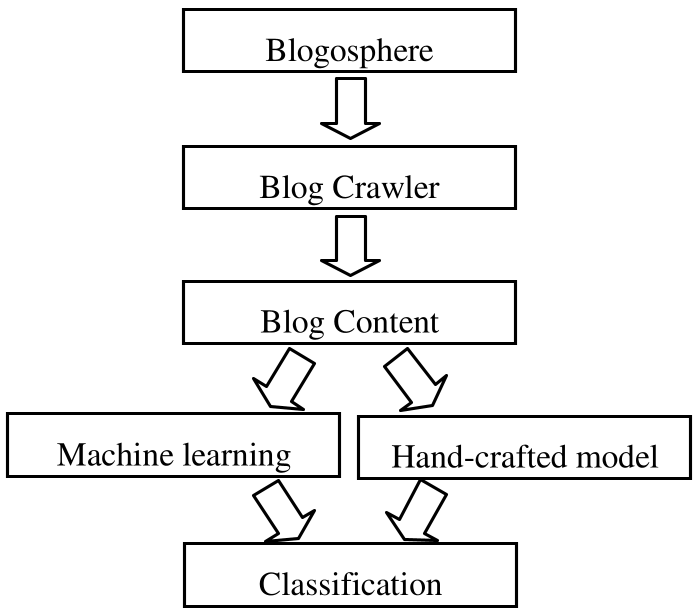
The system employs a dual-engine architecture to process information retrieved from blog search engines.
1. The Document-Level Engine (SVM)
The system uses SVMlight to perform supervised learning. SVM is renowned for its effectiveness in high-dimensional text classification, identifying global patterns that suggest distress.
2. The Sentence-Level Engine (Hand-Crafted Model)
This is the "expert" component of the system. It focuses on three unique pillars:
- Self-Referencing Bias: Based on psycholinguistic research, people in distress use significantly more words like "I," "me," and "myself." The model flags these as "Subjective Sentences."
- Disengagement Theory: It looks for the absence of social references (thanking others, encouragement), which often signals social withdrawal.
- Dynamic Positioning: Recognizing that the "theme" of a blog usually appears at the beginning and the end, the model applies a weighted algorithm to these segments while treating the middle "noise" (elaborations or anecdotes) with lower priority.
The Score Aggregation
The final decision is a weighted fusion. If the SVM predicts distress but the Hand-Crafted model detects a high number of "emotional transitions" or a lack of self-referencing, the system can correct a potential False Positive, ensuring that human intervention resources are directed toward the truly needy.
Evaluating Impact
The effectiveness of the system is measured using the standard F-measure (the harmonic mean of Precision and Recall). However, the real-world metric is far more profound: Time-to-Intervention.
By comparing the system's output against the manual search results of social workers, the researchers aim to prove that automated affect mining can free up scarce human resources to focus on the actual implementation of life-saving interventions.
Critical Analysis & Conclusion
Takeaway
The true innovation of this paper is not just the algorithm, but the integration of human judgment into the loop. By creating a custom lexicon and weighting specific linguistic styles (like self-referencing), the authors move beyond "Sentiment" into the realm of "Psychological State."
Limitations
- Language Specificity: The current model's lexicon is hand-crafted, making it difficult to scale across multiple languages without professional linguistic input for each.
- Platform Evolution: As users move from long-form blogs to short-form content (like Twitter/X or TikTok), the "beginning/ending" weighting logic may need to be restructured.
Future Outlook
The authors suggest that the next frontier is Social Network Analysis. By understanding not just what a person says, but who they interact with online, we can identify "at-risk communities" rather than just isolated individuals, creating a more holistic digital safety net.