HYChat: Bridging the Gap Between Physical Proximity and Digital Continuity
HYChat: A Hybrid Interactive Chat System for Mobile Social Networking in Proximity
This paper introduces HYChat, a hybrid mobile social networking system that integrates Device-to-Device (D2D) via WiFi Direct and Over-The-Top (OTT) via centralized servers. It enables seamless, proximity-based interactive chatting that automatically switches to cellular/online modes when users move out of radio range.
TL;DR
HYChat is a hybrid interactive chat system designed for the "Mobile Social Networks in Proximity" (MSNP) era. By combining WiFi Direct (D2D) for local, energy-efficient interaction and Centralized Servers (OTT) for wide-area continuity, it ensures that your face-to-face digital interaction doesn't die just because someone walked toward a different bus stop.
Problem context: The Proximity Dilemma
In the world of proximity-based social apps, we've traditionally had two choices, both with significant baggage:
- Over-the-Top (OTT): Think Apps like "People Nearby." These rely on constant GPS updates to a server. The Fail? Massive battery drain and the "creepy" factor of sending your location to a cloud 24/7.
- Device-to-Device (D2D): Using WiFi or Bluetooth to talk directly. The Fail? The moment you move 50 meters away, the connection drops, and the conversation is lost.
HYChat addresses this by asking: Why not both?
Methodology: The Secret Sauce of HYChat
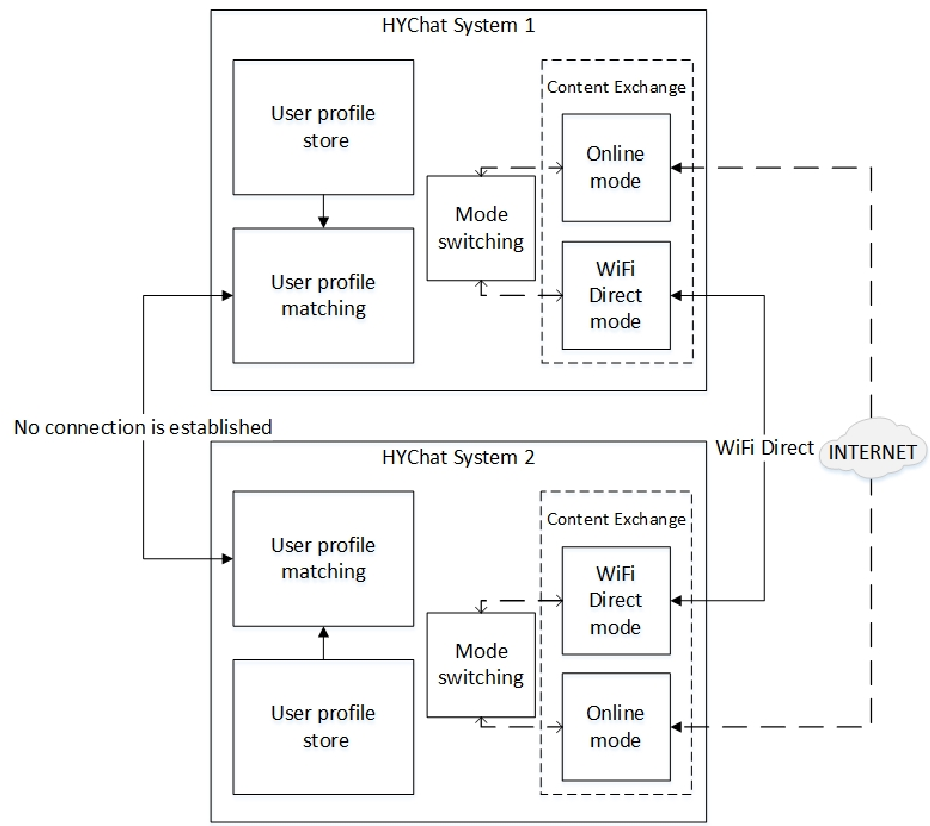
The system relies on four pillars: a profile store, a matching engine, a mode switcher, and a content exchanger. However, the true innovation lies in how it handles the pre-connection and post-disconnection phases.
1. Layer 2 Profile Matching (The "Handshake-less" Hello)
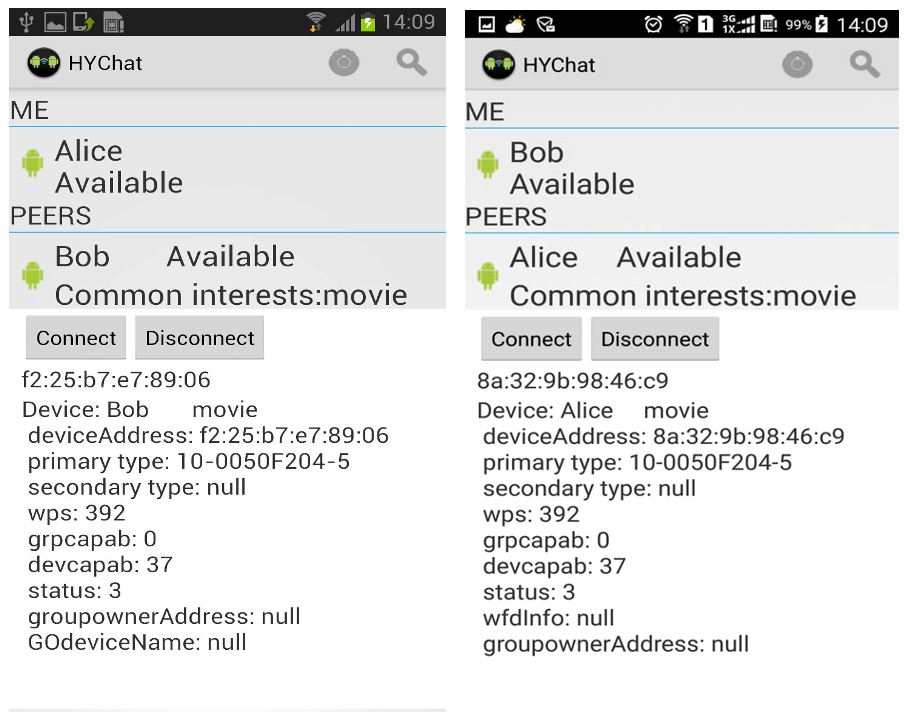
Usually, to see if someone shares your interests, you have to pair, establish a TCP connection, and exchange data. This is a waste of energy if you're not a match. The authors "abuse" the WiFi Direct Device Name. By embedding profile data directly into the device name (up to 32 bytes), HYChat allows devices to "read" each other's interests (e.g., "Alice:Movie") during the discovery phase—before any formal connection is even made.
2. Seamless Mode Switching
The system monitors the D2D link. Using Android’s WIFI_P2P_CONNECTION_CHANGED_ACTION broadcast, the app realizes the moment a signal drops. It then immediately routes the chat through a central server. This "handoff" is designed to be asynchronous and transparent to the user.
Experiments & Real-World Interaction
The prototype implementation on Android shows a clear walk-through of a social encounter:
- Discovery: Alice and Bob find a common interest ("Movies") through the customized device labels.
- D2D Chat: They start talking for free over WiFi Direct.
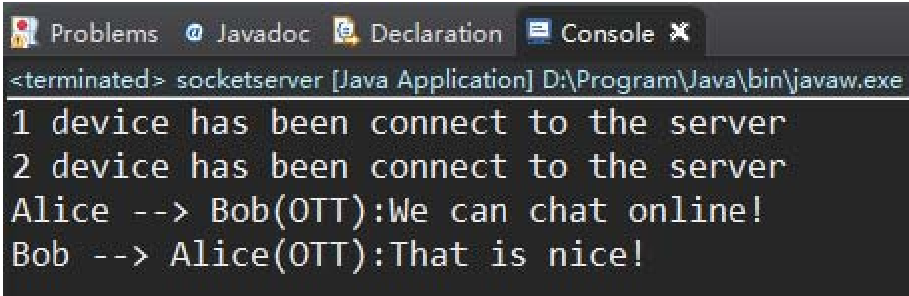
- The Transition: Alice leaves to catch a bus. As the D2D signal fades, the top-right corner of the chat bubble changes from "D2D" to "OTT" (Over-The-Top).
As shown in the screenshot, the system cleverly labels the transport layer (D2D or OTT) next to the message, giving users awareness of their connectivity status.
Critical Insights & Future Outlook
Strengths: The hybrid approach significantly mitigates the privacy and power issues of OTT while fixing the range issues of D2D. The use of Layer 2 discovery is a clever hack for energy efficiency.
Limitations:
- Data Bottleneck: The 32-byte device name limit is extremely restrictive. Modern apps would need more robust encoding (like Bloom Filters) to represent complex user interests.
- Reactive, not Proactive: The current system switches after the connection drops. A more sophisticated version would use Signal Strength (RSSI) to predict a drop and start buffering data beforehand to prevent any packet loss.
Conclusion
HYChat serves as a foundational blueprint for location-aware social apps. It proves that by treating D2D and Cloud services not as rivals, but as complementary layers, we can build a much more resilient social experience.