
Hydro-IDP: Predicting Social Information Floods with Fluid Dynamics
Information diffusion prediction in mobile social networks with hydrodynamic model
The paper introduces Hydro-IDP, the first hydrodynamic-based model for predicting information diffusion in Mobile Social Networks (MSNs). By treating information flow as a fluid, it captures the spatio-temporal dynamics of content spreading across friendship hops on platforms like Sina Weibo.
TL;DR
Researchers have developed Hydro-IDP, a novel framework that treats the viral spread of information in mobile social networks (MSNs) like a physical fluid. By leveraging hydrodynamic conservation laws, the model predicts how information "flows" through friendship hops over time. Tested on massive datasets from Sina Weibo, it achieves nearly 77% accuracy in predicting the spatio-temporal density of influenced users.
Probing the "Flow": Why Fluid Dynamics?
Traditional models of information diffusion usually fall into two traps: they are either too granular (trying to model every single "repost" action) or too static (viewing the network as a fixed graph). However, in the era of 5G and massive MSNs, information behaves less like a sequence of discrete events and more like a continuous wave or a fluid entering a system.
The authors' core insight is that by ignoring the chaotic details of individual interactions and focusing on the macroscopic "energy density" of the information, we can use the mathematics of physics—specifically hydrodynamics—to predict where and when a tweet will go viral.
Methodology: Mapping Social Vigor to Physical Energy
The Hydro-IDP model rests on an elegant mapping of social network parameters to physical counterparts:
| Symbol | Physical Meaning | Social Network Definition |
|---|---|---|
| E(T) | Energy Density | Information Popularity |
| R | Source Radius | Publisher's Influence |
| v | Flow Velocity | Platform Diffusivity |
| r | Space Distance | Friendship Hops |
At the heart of the model is the Energy-Momentum Tensor conservation law:
u} = 0$$ Assuming an isotropic diffusion (spreading equally in all social "directions"), the authors simplify this into spherical symmetry equations that track how "momentum density" ($M$) and "energy density" ($E$) evolve over time ($t$) and social distance ($r$). 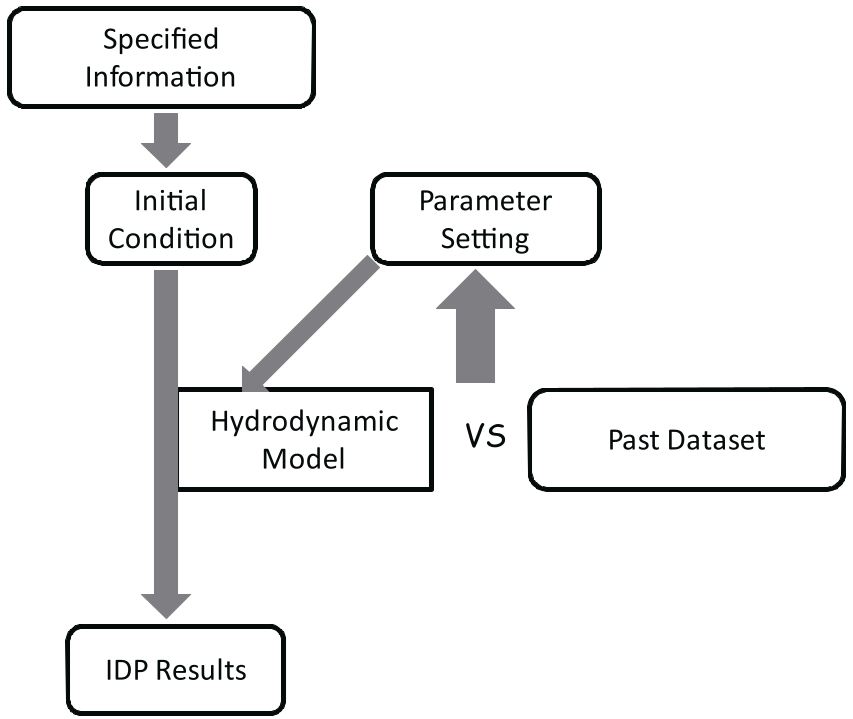 *The Hydro-IDP framework includes data acquisition, parameter mapping, and solving hydrodynamic equations using the Godunov method.* ## Real-World Validation: Sina Weibo Analysis To prove the model's worth, the authors analyzed **6,500 video tweets** involving over **200 million user records**. Their empirical findings confirmed two critical "social horizons": 1. **Temporal Horizon**: 95% of information diffusion happens within **8 days**. 2. **Spatial Horizon**: 98% of spreading occurs within **6 friendship hops**. The Hydro-IDP model was able to replicate the actual density decay observed in the data. As information moves further from the source (larger $r$), its density drops, much like the pressure of a fluid dissipates as it expands. 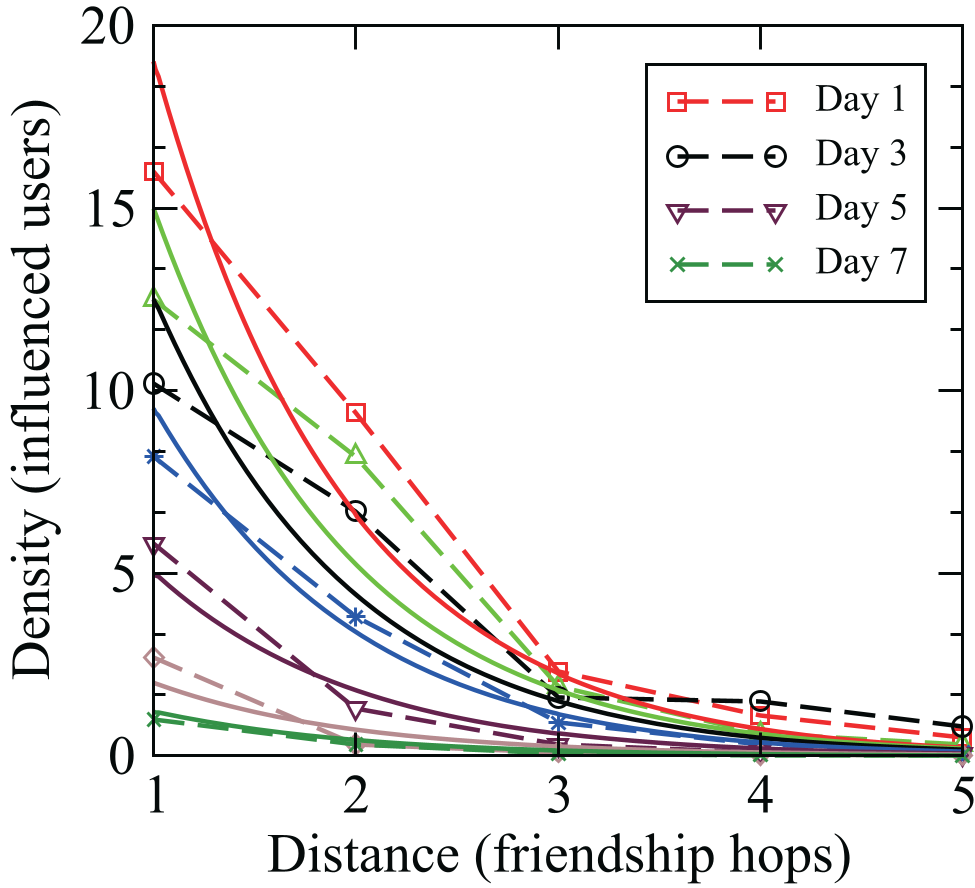 *Comparison between actual Sina Weibo data (dashed) and Hydro-IDP results (solid). The model closely captures the decay of user influence over both time and social distance.* ## Critical Insight: The Role of Influencers The paper highlights an interesting "anomaly" in the fluid model: **Tweet 2**. In most cases, influence is strongest at hop 1 and decays. However, for some tweets, the density at hop 2 is *higher* than hop 1. In fluid terms, this is like a secondary explosion. In social terms, this happens when an **Influencer** (someone with >100,000 followers) reposts the content at hop 1, effectively acting as a secondary pump that amplifies the flow further into the network. ## Conclusion and Future Outlook Hydro-IDP marks a significant shift from empirical data mining to **model-driven physical simulation** in social science. While the 76.7% accuracy is impressive, the authors acknowledge limitations, such as the need to better model the "superimposed effect" of multiple simultaneous influencers. Future work aims to explore **cross-platform diffusion**—how a "fluid" might flow from Twitter to Facebook—and how "social temperature" varies as information becomes "stale." This research paves the way for more robust tools in digital marketing, public opinion monitoring, and epidemic control.