
Urban Agriculture 2.0: Scaling Rooftop Farming with Cost-Effective IoT
A Hydroponic Planter System to enable an Urban Agriculture Service Industry
The paper introduces a compact, cost-effective IoT-based hydroponic system designed to facilitate urban agriculture as a service industry. By integrating Arduino and Raspberry Pi with custom sensor modules, the system enables remote monitoring of electrical conductivity (EC), water levels, and environmental conditions via the MQTT protocol.
TL;DR
Agriculture is moving from rural fields to urban rooftops. This paper presents a specialized, low-cost hydroponic planter system designed for the "sixth industry"—turning consumers into producers. By leveraging Arduino/ESP32, Raspberry Pi, and the MQTT protocol, the system provides a robust remote management platform that allows beginners to grow fruit and vegetables in vacant urban spaces with minimal technical friction.
Background: Moving from Production to Recreation
In urban "recreational" agriculture, the primary goal isn't massive yield but ease of use and space utility. Existing industrial solutions are "over-engineered" for this purpose. The author identifies a critical gap: urban farmers need a system that is cheap enough for personal use but reliable enough for service providers to manage remotely across a city.
Problem & Motivation: The Barrier to Entry
Professional agricultural sensors for parameters like Electrical Conductivity (EC) and water levels are expensive. Furthermore, providing remote access to these devices often leads to networking headaches involving Static IPs and costly data plans.
The author's insight was to simplify the hardware to the bare essentials (measuring frequency/voltage) and move the computational "heavy lifting" (data conversion and image processing) to a centralized local server or the cloud.
Methodology: The Architecture of a Smart Planter
The system is split into a sensing layer and a management layer.
1. The Sensor Module (The "Nerves")
The module measures EC, water temperature, water level, luminance, and humidity.
- EC Measurement: Instead of expensive industrial probes, a custom oscillator circuit was designed where frequency changes with solution concentration.
- Longevity Trick: A 3-state buffer was integrated to cut DC flow when the sensor is inactive, preventing the buildup of deposits on electrodes—a common failure point in cheap hydroponic setups.
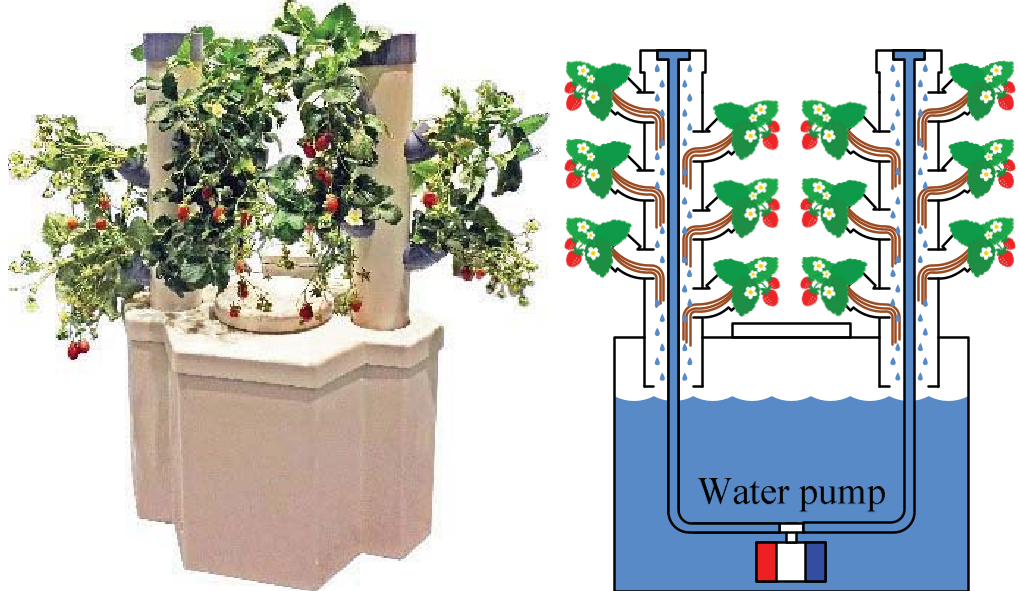 Fig 1: The compact planter structure and its strawberry cultivation application.
2. Remote Management (The "Brain")
The system utilizes MQTT (Message Queuing Telemetry Transport). Unlike HTTP, MQTT maintains a constant TCP session, making it:
- Low Bandwidth: Ideal for cheap MVNO SIM cards.
- Bi-directional: Easily sends data up (sensor readings) and commands down (pump control) without needing a global IP for the planter.
- Secure: TLS/SSL encryption is added to protect the user's private environmental data and prevent unauthorized pump hijacking.
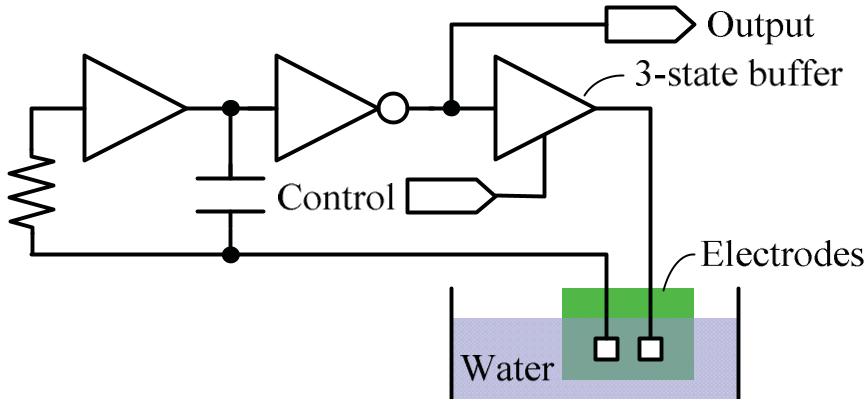 Fig 2: Simplified EC measurement circuit designed for cost reduction.
Experiments & Results
The system was deployed in real-world urban settings, including rooftop tomato cultivation.
- Control Reliability: By utilizing QoS (Quality of Service) Level 3 for the water pump, the system ensures that critical commands are acknowledged, preventing plant death due to pump failure.
- Data Visualization: Using Node-RED Dashboard, users can monitor trends (temperature, nutrient levels) via a web browser or smartphone.
- Motion-Triggered Imaging: Since plants grow slowly, regular video is overkill. The system uses inter-frame difference calculations to detect "events" (like a person or an animal) and takes high-res stills only when necessary, saving significant bandwidth.
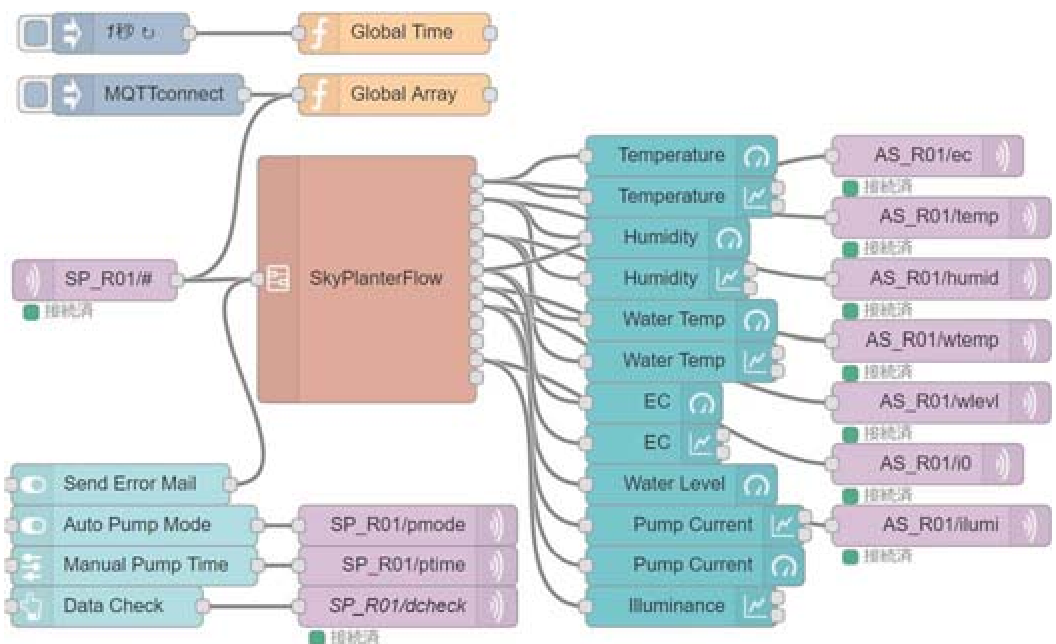 Fig 3: The Node-RED Dashboard used for real-time monitoring and remote pump toggling.
Critical Insight & Conclusion
This paper serves as a blueprint for Urban Smart Agriculture. Its value lies not in groundbreaking sensor technology, but in system integration. By combining open-source software (Node-RED) with affordable hardware (ESP32/Raspberry Pi), the author has lowered the barrier to entry for the agricultural service industry.
Future Outlook: The inclusion of AI speakers (Julius/Open JTalk) hints at a future where we "talk" to our gardens. However, the system currently lacks automated nutrient dosing (only monitoring). The next logical step would be closed-loop feedback systems that use the data to automatically adjust fertilizer levels, making urban farming truly "set and forget."
Takeaway: Effective IoT is about right-sizing the technology for the context. For urban agriculture, reliability and cost-efficiency through smart protocol choice (MQTT) outperform raw sensor precision.