
CHS-Soar: Reimagining Hyper-Heuristics via Cognitive Architectures
Learning and using hyper-heuristics for variable and value ordering in constraint satisfaction problems
This paper introduces a novel hyper-heuristic framework for variable and value ordering in binary Constraint Satisfaction Problems (CSP) by integrating the Soar cognitive architecture with Constrained Heuristic Search (CHS). The method, termed CHS-Soar, achieves SOTA efficiency by learning from fine-grained "textures" (structural features) rather than just switching between high-level heuristics.
TL;DR
The efficiency of solving Constraint Satisfaction Problems (CSPs)—from scheduling to circuit design—depends heavily on the order in which variables and values are chosen. This paper introduces CHS-Soar, a framework that doesn't just choose between existing heuristics but learns to build new ones by analyzing the fine-grained "textures" (structural features) of the constraint graph. By using the Soar cognitive architecture, the system learns strategic preferences that generalize across entirely different problem types, like Map Coloring and Job Shop Scheduling.
The Generality vs. Effectiveness Tradeoff
In the world of CSPs, heuristics like Minimum Remaining Values (MRV) or the Degree Heuristic (DEG) are the bread and butter of search. However, they are often brittle. A heuristic that works for scheduling might fail miserably for graph coloring.
The authors identify a major flaw in existing "Hyper-heuristics" (heuristics that choose heuristics): most frameworks treat low-level heuristics as atomic units. This "black-box" approach discards the rich, structural detail (the textures) that actually drives the decision-making process.
Methodology: Doing More with Less
The core insight of this work is to "deconstruct" heuristics. Instead of learning "When should I use MRV?", the system asks "What does an MRV value of 0.2 tell me about the search space?"
1. Textures as Building Blocks
Textures are the constituent measures of a heuristic. For instance:
- MRV Texture: The number of remaining values in a domain.
- DEG Texture: The number of constraints linked to a variable.
2. The Soar Advantage
By integrating these textures into the Soar cognitive architecture, the system utilizes two powerful mechanisms:
- Subgoaling: When the system is unsure of a move, it creates a "subgoal" to simulate the outcome of different choices.
- Chunking: Once a successful path is found in the subgoal, Soar "chunks" that experience into a permanent production rule (Condition → Action).
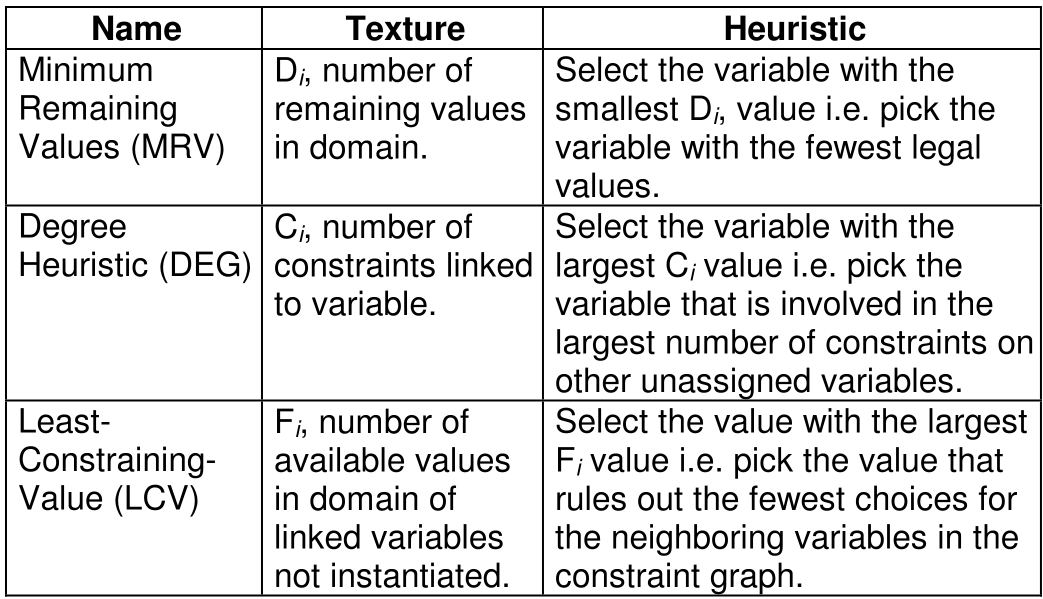 Table 1: The low-level textures used as the basis for the hyper-heuristic learning.
Experimental Results: Performance and Transferability
The authors tested their approach on two classic benchmarks: Map Coloring Problems (MCP) and Job Shop Scheduling (JSP).
Intra-Problem Performance (Custom Tuning)
As shown in the figures below, the "Custom Hyper-Heuristic" (tailored to the specific problem) significantly reduced the number of consistency checks compared to the standard benchmark. Notably, the performance advantage grew more pronounced as the problems became larger and more complex.
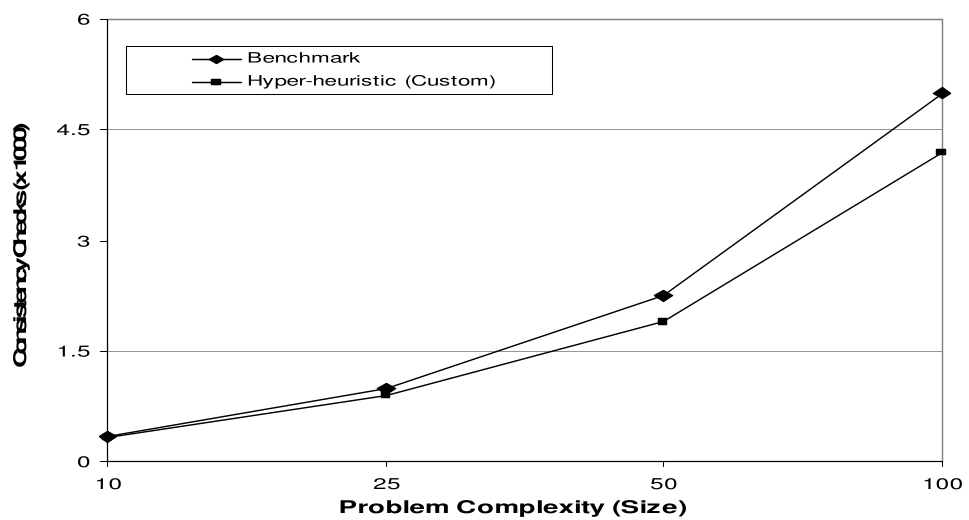 Figure 2: Custom Hyper-Heuristic vs. Benchmark for Map Coloring. Lower consistency checks indicate higher efficiency.
Inter-Problem Performance (The "Cross-over" Test)
The most impressive result was the system's ability to transfer knowledge. A hyper-heuristic learned on a simple Map Coloring problem could be applied to a complex Job Shop Scheduling problem and still outperform the standard human-designed heuristics. This demonstrates a level of "effective generality" that traditional meta-heuristics struggle to achieve.
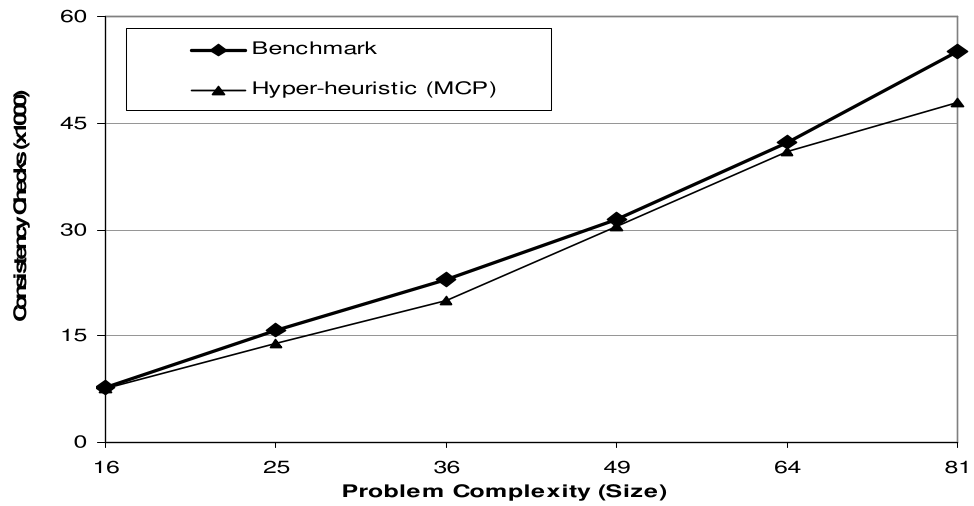 Figure 5: A hyper-heuristic trained on Map Coloring being used to solve Job Shop Scheduling—still beating the benchmark.
Critical Insight & Conclusion
The success of CHS-Soar suggests that the "atom" of search strategy is not the heuristic itself, but the underlying state textures. By normalizing these textures and using a symbolic architecture to learn preferences, we can move away from "trial and error" heuristic selection toward a more principled, machine-learned approach to search.
Limitations: While powerful, the "subgoaling" process involves a look-ahead search that can be computationally expensive during the training phase. However, once the "chunks" (rules) are learned, the execution is near-instantaneous.
Future Outlook: This research paves the way for "General Problem Solvers" that don't need to be redesigned for every new industrial constraint problem. By focusing on the geometry of the constraint graph (textures) rather than the labels of the problem, we get closer to truly general AI for optimization.