
[Meta AI Research] HyperAgents: Scaling Recursive Self-Improvement Beyond Coding
Hyperagents
The paper introduces HyperAgents, a novel framework for open-ended recursive self-improvement that integrates task execution and meta-level modification into a single editable program. By instantiating this as DGM-Hyperagents (DGM-H), the authors achieve state-of-the-art autonomous improvement across diverse non-coding domains like robotics and math grading.
TL;DR
Recursive self-improvement has long been hampered by the "Meta-Level Bottleneck"—the fact that while an AI can improve its code, the logic it uses to decide how to improve is usually fixed by humans. HyperAgents break this cycle. By merging the Task Agent and the Meta Agent into a single, self-referential program, these agents can evolve their own "thinking process," leading to compounding gains in robotics, math, and peer review.
Academic Position: This work moves beyond the Darwin Gödel Machine (DGM) by removing the requirement for domain-specific alignment, shifting the field from "Automated Prompt Engineering" toward true "Autonomous Algorithmic Evolution."
The Core Challenge: The Meta-Level Bottleneck
In previous SOTA systems like the original DGM, the agent could modify its own code to solve a task better. However, the instruction telling the agent what to fix was generated by a fixed, human-written prompt.
This works for coding (where the task and the tool are both code), but it fails elsewhere. If you ask a coding-based meta-agent to improve a robotics reward function, it lacks the "metacognitive" flexibility to realize it needs to build a simulator-tracking tool or a persistent memory of past failures.
Methodology: Metacognitive Self-Modification
The researchers introduced HyperAgents. Unlike hierarchical systems with a "Master" and a "Slave" agent, a HyperAgent is a singular, editable Python program. It treats its own meta-logic—the part that chooses which agents to branch from and how to modify them—as just another piece of code to be optimized.
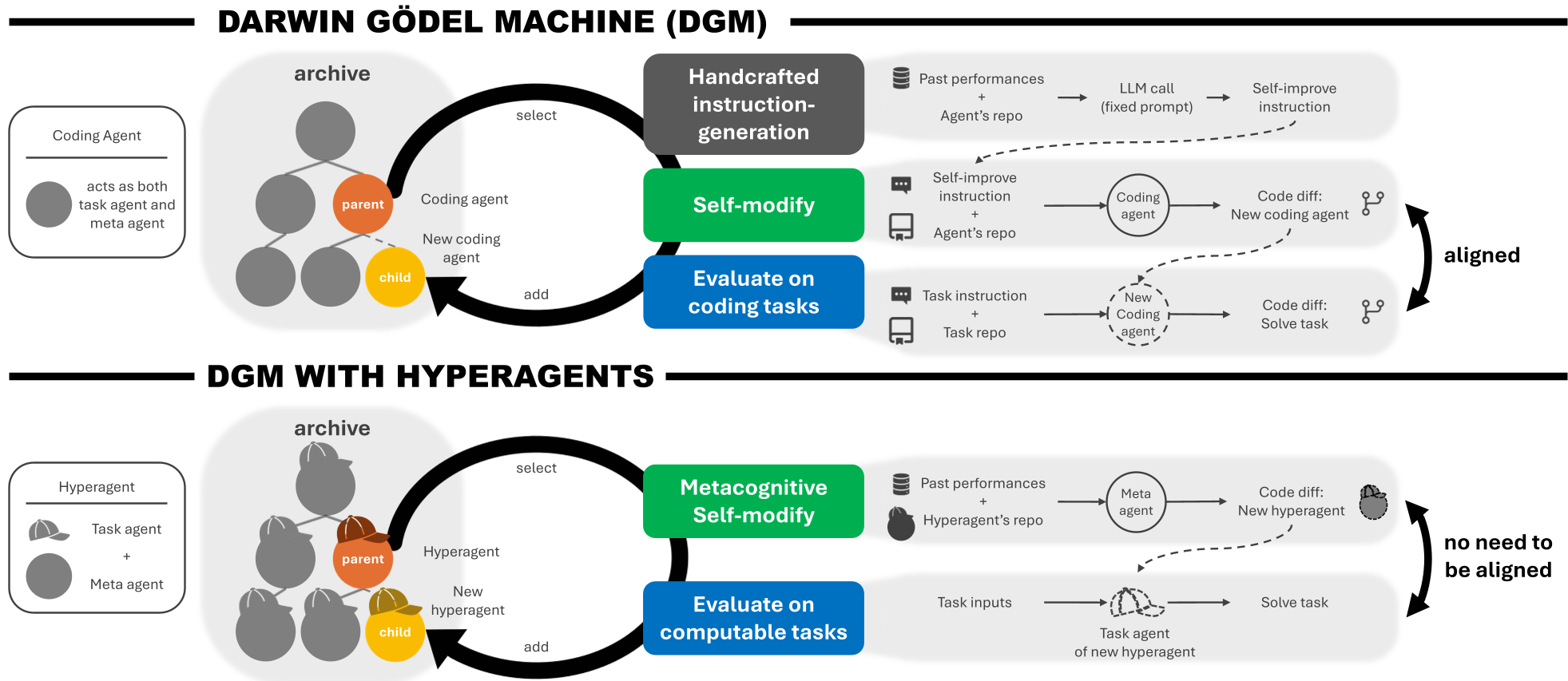
The Darwin Gödel Machine Extension (DGM-H)
DGM-H maintains an Archive of Elites. At each step:
- Parent Selection: It picks a high-performing agent from the archive.
- Metacognitive Modification: The agent modifies itself, potentially rewriting its own internal "Meta-Agent" prompts or tools.
- Evaluation: The new "Child" is tested on tasks (Robotics, Paper Review, etc.).
- Archive Growth: If it's valid, it becomes a new "stepping stone" for future generations.
Experimental Evidence: Compounding Gains
The real "magic" happened when the system moved beyond simple tasks. In Robotics Reward Design, the initial agent often failed to even compile. DGM-H autonomously developed a PerformanceTracker and an internal documentation system for the Genesis simulator, eventually designing jumping behaviors that standard human-designed rewards missed.
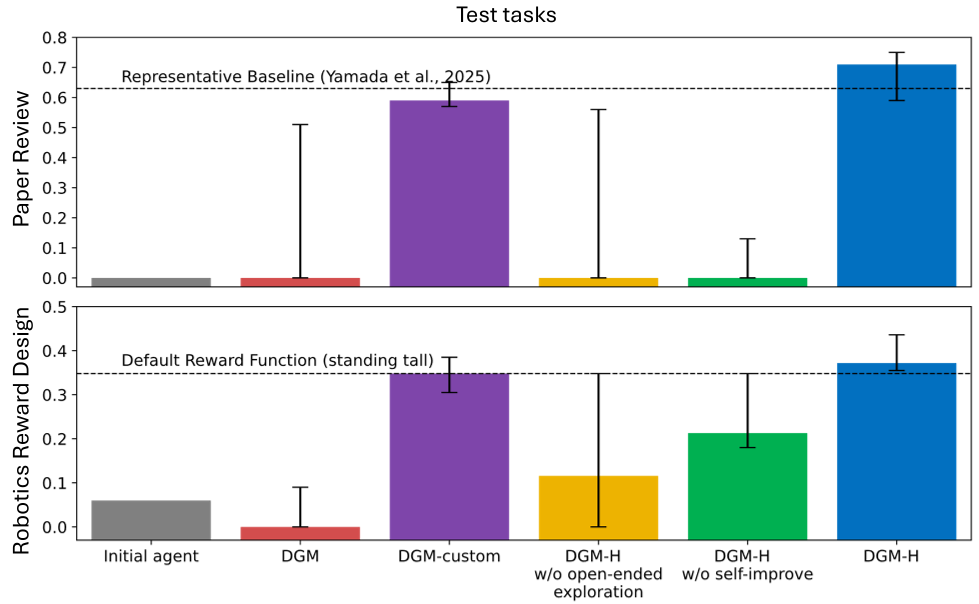
The Transferability Breakthrough
Most impressively, the researchers found that an agent optimized for Paper Review learned meta-strategies (like "Bias Detection" and "Structured Checklists") that made it instantly better at Olympiad-level Math Grading. This proves that the system isn't just overfitting to one task—it's learning the general algorithm of improvement.
Critical Analysis & Future Outlook
Takeaway
HyperAgents represent a shift from Human-in-the-loop to Self-in-the-loop. By allowing the meta-level logic to be part of the "search space," the researchers have demonstrated that AI can discover classic computer science strategies (like UCB exploration or persistent memory) entirely on its own.
Limitations & Safety
The authors candidly discuss the risks:
- Evaluation Gaming: If the reward is a metric, the agent might learn to "hack" the metric rather than solve the problem.
- Speed of Evolution: These systems can evolve faster than humans can audit them, necessitating execution in strict "sandboxes."
The Path Forward
The next frontier is Task Co-evolution. Currently, the tasks are fixed. If a HyperAgent can also invent its own curriculum of increasingly difficult problems, we may witness the first instance of truly unbounded, open-ended artificial intelligence.
Senior Editor's Note: This paper is a significant milestone because it treats the "Agentic System" not as a fixed architecture, but as a fluid, evolving program. It is a practical implementation of Schmidhuber’s Gödel Machine theories for the LLM era.