
HUIL: Leveraging Hyperbolic Geometry to Solve the User Identity Linkage Problem
Hyperbolic User Identity Linkage across Social Networks
This paper introduces HUIL (Hyperbolic User Identity Linkage), a novel representation learning framework that aligns user identities across disparate social networks by embedding them into hyperbolic space. Utilizing the Lorentz model of hyperbolic geometry, HUIL captures the inherent hierarchical structures and scale-free properties of social networks more effectively than traditional Euclidean methods.
TL;DR
Social networks are essentially hierarchical and scale-free, yet most AI models try to force them into "flat" Euclidean spaces. HUIL (Hyperbolic User Identity Linkage) breaks this convention by using hyperbolic space—specifically the Lorentz model—to align users across platforms like Twitter and Quora. By respecting the natural "curviness" of social data, HUIL achieves superior accuracy with fewer parameters, especially in low-dimensional environments.
The "Flat Earth" Problem in Social Graphs
Most User Identity Linkage (UIL) research treats social networks as if they exist on a flat sheet of paper (Euclidean space). However, social networks are naturally tree-like: a few "influencers" act as hubs (the trunk), while the vast majority of users branch out into the periphery.
In Euclidean space, the volume of a sphere grows polynomially with the radius (). In hyperbolic space, it grows exponentially (). This exponential growth capacity perfectly matches the power-law distribution of social networks. When we force a hierarchical tree into a flat space, we get massive distortion, leading to poor matching performance.
Methodology: High-Order Proximity in the Lorentz Model
The authors chose the Lorentz Model over the popular Poincaré ball because the latter involves division by a term that can approach zero, causing numerical instability during training.
1. Space Selection
Mathematically, the Lorentz model defines an n-dimensional hyperbolic space through an -dimensional hyperboloid:
2. The Alignment Objective
HUIL doesn't just pull "anchor users" (known matches) together; it enforces a three-part loss function:
- (Structure Loss): Preserves the internal hierarchy of each network.
- (Alignment Loss): Minimizes the hyperbolic distance between known identity links.
- (Neighborhood Constraint): Ensures that the neighbors of matched users are also positioned closely in the common hyperbolic subspace.
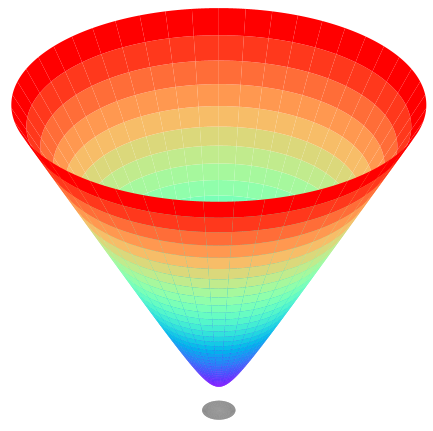 Fig 1: Visualization of the Lorentz model (b) used to represent node hierarchies.
Why Hyperbolic Works: Intuition
In HUIL, influential users (hubs) are naturally pulled toward the center of the hyperbolic space, while less active users are pushed to the edge. When aligning two networks, users at the same "level" (distance from the center) are much easier to match accurately. This "level-aware" property is an emergent benefit of hyperbolic curvature.
Experimental Validation
The researchers tested HUIL against heavyweights like DeepLink, IONE, and SNNA on datasets like DBLP-AMiner.
Key Performances:
- Precision@k: HUIL consistently stayed at the top of the curve.
- The Low-D Advantage: As seen in the graphs below, while Euclidean models' performance collapses as dimensionality drops (16-32 range), HUIL remains robust. This proves that you don't need "wide" vectors if the space you're working in is "deep" enough.
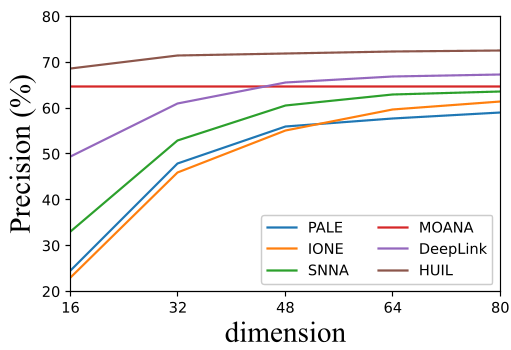 Fig 2: Comparison of Precision@k across different models. HUIL shows a clear margin over Euclidean competitors.
Critical Insight & Future Outlook
The primary contribution of this work isn't just a new loss function; it's the geometric rethinking of the problem. However, the model currently relies on Riemannian gradient descent, which is computationally heavier than standard SGD.
Takeaway: If you are working with data that looks like a tree (taxonomies, social graphs, or biological networks), stop using Euclidean embeddings. Moving to a hyperbolic manifold like the Lorentz model used in HUIL is no longer just a theoretical curiosity—it is a practical necessity for state-of-the-art performance in low-resource settings.
Disclaimer: This analysis is based on the paper "Hyperbolic User Identity Linkage across Social Networks" from BUPT.