
Hypergraph-Based Link Prediction: Beyond Simple Pairwise Relations
Link prediction in social networks based on hypergraph
This paper introduces a novel approach for Link Prediction in social networks utilizing hypergraph modeling. By representing entities as nodes and complex relations as hyperedges, the method achieves superior ranking performance on the Sina-Weibo dataset compared to traditional graph-based baselines.
TL;DR
Link prediction is the backbone of social media recommendations. While most systems treat social networks as simple graphs of "who follows whom," this paper from researchers at the Harbin Institute of Technology argues that we are losing vital context. By adopting Hypergraphs, they capture complex, high-order relations (like tripartite user-hashtag-tweet interactions), leading to significant gains in prediction accuracy and recall on real-world datasets like Sina-Weibo.
The Problem: The "Pairwise" Blind Spot
Most link prediction algorithms—ranging from the classic Common Neighbors to modern random-walk based LINKREC—suffer from a fundamental limitation: they view the world in pairs.
In a real social network, interactions are rarely just . Consider a user posting a tweet with a specific hashtag. In a traditional graph, this is "squeezed" into multiple binary edges (User-Tweet, Tweet-Hashtag, User-Hashtag). This process is lossy. As the authors put it, "squeezing complex relationships into pairwise ones inevitably leads to loss of information."
Methodology: The Power of the Hyperedge
Instead of an ordinary graph , the authors use a Hypergraph. In this model, an edge (a "hyperedge") can connect any number of nodes simultaneously.
1. Modeling High-Order Relations
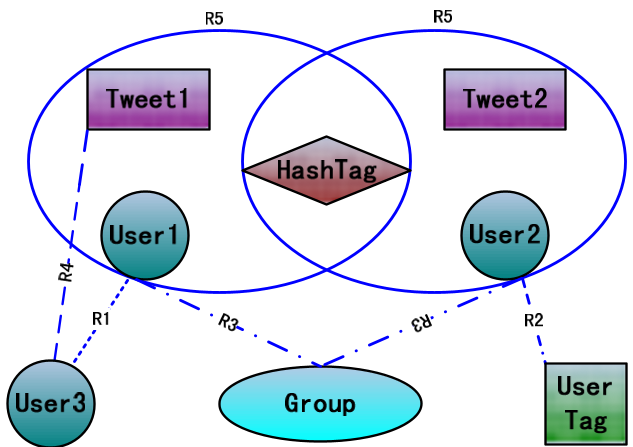
The paper identifies five key types of relations in micro-blogs ( to ):
- Binary: User follows User ().
- High-Order: A user releasing a tweet containing a specific hashtag (). This is a ternary relation that a single hyperedge can describe perfectly.
2. Link Prediction as a Ranking Problem
The authors don't just look for "missing links"; they treat the task as a ranking problem. They define a cost function that measures the "smoothness" of a ranking score across the hypergraph. The goal is to find a score vector that:
- Minimizes the difference between nodes within the same hyperedge (if you share many hyperedges, you should rank higher).
- Stays reasonably close to the initial known values .
The optimization yields a closed-form solution: This allows for efficient computation of proximities between a target user and all potential new friends.
Experiments: Real-World Evidence
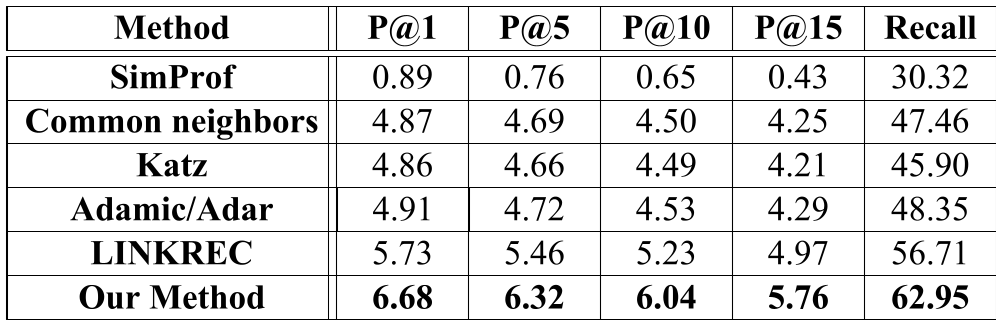
The authors tested their method against the Sina-Weibo dataset, involving nearly 4,000 users and over 235,000 tweets.
| Method | P@1 | P@10 | Recall |
|---|---|---|---|
| Common Neighbors | 4.87 | 4.50 | 47.46 |
| LINKREC | 5.73 | 5.23 | 56.71 |
| Our Method | 6.68 | 6.04 | 62.95 |
Critical Findings:
- Structure Over Content: The experiment showed that graph-based methods (counting neighbors, paths) far outperformed SimProf (which only looked at tweet text). Network topology is a stronger signal for friendship than content similarity.
- Superiority of Hypergraphs: By capturing groups () and complex tweet behaviors (), the hypergraph model outperformed by more than 6% in total recall.
Deep Insight & Takeaways
The core value of this work lies in its Inductive Bias. By switching from a graph to a hypergraph, the researchers changed the fundamental assumption of the model from "relations are binary" to "relations are contextual and group-based."
Limitations & Future Work
While effective, the paper relies on a closed-form solution that requires inverting a large matrix , which can be computationally expensive as the network grows to millions of nodes. Future iterations would likely benefit from Hypergraph Neural Networks (HGNNs) that use message passing to achieve similar goals with better scalability.
Conclusion
This paper serves as a seminal reminder that for complex data like social media, the choice of representation is often more important than the choice of a specific algorithm. Hypergraphs offer a more "truthful" representation of human interaction than the simple lines and dots of traditional graphs.