
EQHyperpart: Leveraging Scale-Free Entropy for Scalable Social Network Partitioning
Hypergraph partitioning for social networks based on information entropy modularity
This paper introduces EQHyperpart, a novel hypergraph partitioning method tailored for social networks modeled as scale-free systems. By utilizing a new Information-Entropy-based Modularity (EQ), the approach achieves high-fidelity partitioning and superior scalability compared to traditional min-cut tools like hMETIS and khMETIS.
TL;DR
Social networks are not random; they follow a scale-free power-law distribution where "hub" nodes dominate. Traditional hypergraph partitioning tools like hMETIS often fail because they force equal-sized partitions, breaking the natural community structures. EQHyperpart solves this by replacing rigid balance constraints with an Information-Entropy-based Modularity (EQ), allowing for "natural" imbalance that preserves communities and boosts query efficiency as the network grows.
The "Scale-Free" Dilemma in Network Partitioning
Most social networks are modeled as graphs to help distribute user data across servers. However, standard graph partitioning is dyadic (2-way relations only), whereas a hypergraph can model multi-user interactions (e.g., a single group chat or shared wall post) as a single hyperedge.
The prevailing pain points in current hypergraph tools are:
- Indiscriminate Balancing: Tools like hMETIS prioritize making every server store the same number of users, which splits tight-knit communities.
- Degree Blindness: Existing entropy-based solutions (like hyperpart) treat a celebrity node with 1 million followers the same as a new user with 1, making them ineffective for power-law distributions.
Methodology: Entropy Meets Power-Law
The core innovation is the Entropy-based Modularity (EQ). The authors redefine modularity by looking at "Energy Distribution."
1. Scale-Free Information Entropy
Instead of using node counts, the authors use Vertex Degrees () to calculate importance (). The entropy measures how "ordered" or "uniform" the network energy is. In an ordered scale-free network, energy is concentrated in communities.
2. Architecture & Optimization
The authors propose two refined partitioners:
- EQHyperpart-SA: Uses Simulated Annealing. If a move doesn't immediately improve the EQ value, the algorithm might still accept it with a certain probability to jump out of local optima.
- EQHyperpart-MC: Introduces the Micro Cut. Traditional gains are 0 if a hyperedge spans many partitions and one node move doesn't immediately reduce the cut count. Micro Cut provides "hints" by rewarding moves that consolidate pins into parts that already have many pins of that same hyperedge.
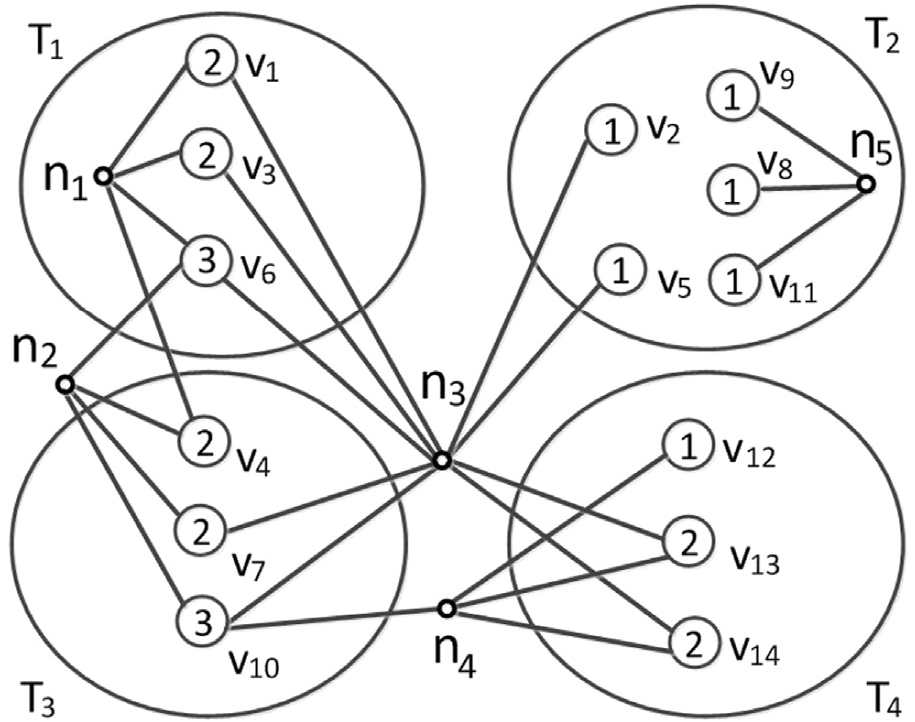 Fig 1: Example of hypergraph partitioning showing hyperedges spanning multiple vertices.
Experimental Insights
The researchers tested their method against classical datasets (Karate Club, Dolphins) and a large (4039-node) Facebook dataset.
Scalability and Trade-offs
Unlike khMETIS, which loses efficiency as the network grows, EQHyperpart stays scalable. By allowing "natural" imbalance (matching how social circles actually form), the query cost saving rate is significantly higher.
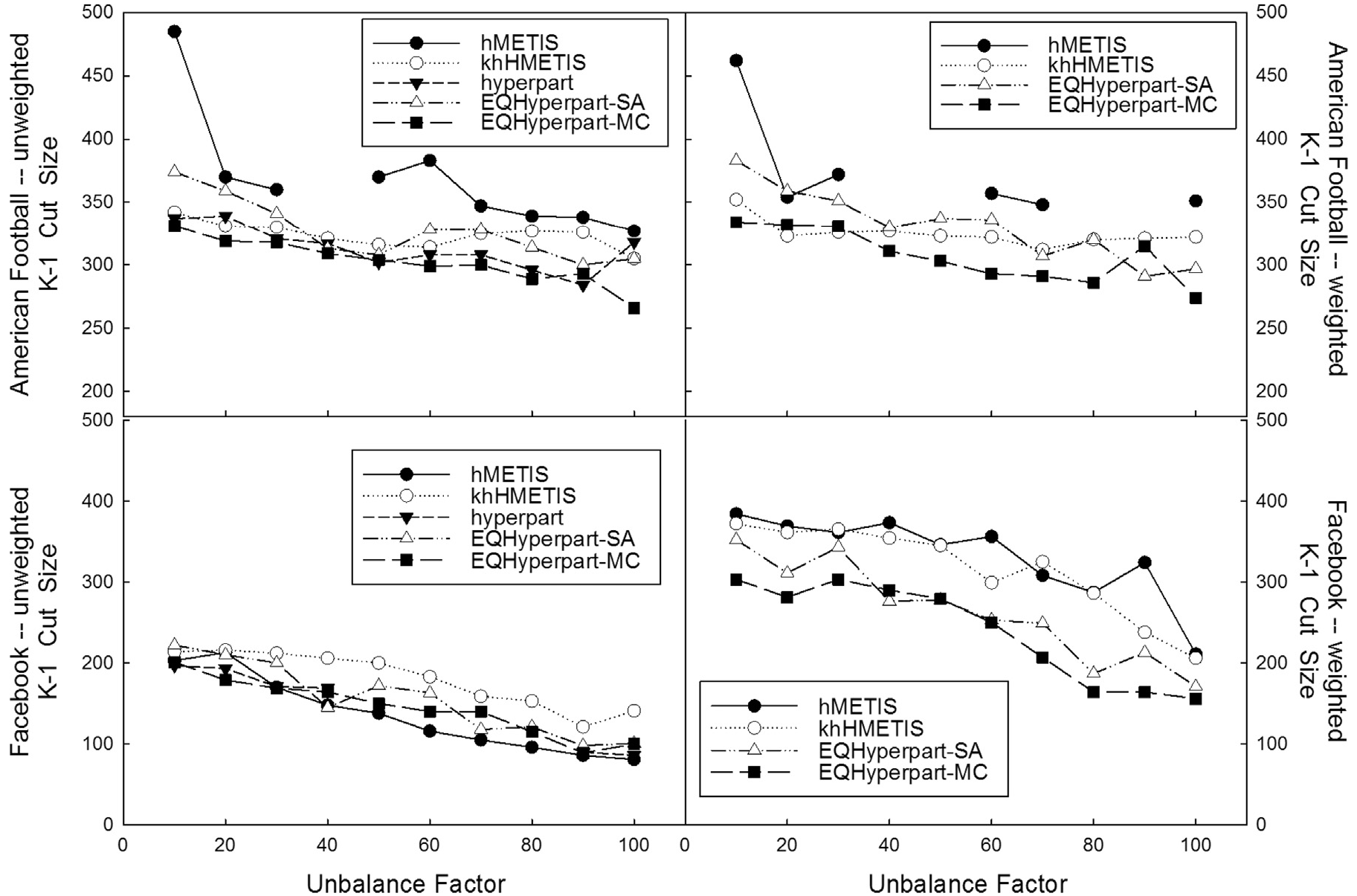 Fig 2: Comparison of K-1 cut size logic. EQHyperpart-MC (Micro Cut) consistently achieves lower cut sizes in weighted scenarios.
The "Auto-Tradeoff" Feature
One of the most impressive results is the Auto-Tradeoff. By removing balance constraints entirely, EQHyperpart automatically finds a partitioning scheme that perfectly balances:
- Cut Size (Minimizing inter-server communication).
- Modularity (Keeping friends together).
- Balance (Avoiding overloading a single server).
Critical Analysis & Conclusion
EQHyperpart represents a shift from "structural partitioning" (geometry) to "semantic partitioning" (utility). By embedding the physical intuition of scale-free energy into information theory, it overcomes the "nearsightedness" of FM-based algorithms.
Limitations: The algorithm currently struggles with overlapping communities (users belonging to multiple distinct groups), which is common in real-world professional vs. personal social circles.
Future Work: Integrating "Temporal Awareness"—how social networks change over time—into the entropy calculation could make this the go-to algorithm for dynamic cloud-hosted social databases.