
Hyperloop Transformers: Pushing the Pareto Frontier of Parameter-Efficiency
Hyperloop Transformers
The paper introduces Hyperloop Transformers, a parameter-efficient architecture that integrates looped Transformer layers with a modified version of hyper-connections. By recurrently applying a middle block of layers across depth and expanding the residual stream into a matrix-valued representation, the model achieves better perplexity and downstream accuracy than standard depth-matched Transformers while using approximately 50% fewer parameters.
TL;DR
Hyperloop Transformers are a new class of parameter-efficient models that use weight-looping and "hyper-connections" to achieve the performance of large models with half the weights. By adding a matrix-valued residual stream that updates only between loops, Hyperloop outperforms standard Transformers at the 1B-2B scale while maintaining near-identical training speeds.
Background: The Memory Wall in Edge AI
As LLMs move from massive cloud clusters to smartphones and edge devices, the primary bottleneck isn't just Flops—it's VRAM. Parameter-efficient architectures like Looped Transformers (which reuse weights across depth) are promising but have historically suffered from a "performance tax": they simply don't reach the same perplexity as their depth-matched, unlooped counterparts.
The authors of Hyperloop Transformers ask a critical question: How can we make looped layers more expressive without losing their parameter-saving benefits?
Methodology: Looping with Matrix-Valued Streams
The Hyperloop architecture is built on two core pillars: Middle-Cycle Looping and Loop-Level Hyper-Connections.
1. The Strategy
Instead of looping the entire model, the architecture is partitioned into three blocks:
- Begin Block: Standard layers to process initial features.
- Middle Block: The compute engine that is looped multiple times (parameter shared).
- End Block: Standard layers to refine the final output.
2. Hyper-connections (The "Secret Sauce")
Standard Transformers use a vector-valued residual stream (). Hyperloop expands this into parallel streams (). Unlike previous manifold-constrained hyper-connection (mHC) methods that apply complex logic at every layer, Hyperloop only applies these transitions after each loop. This minimizes compute overhead while allowing the model to "project" its state into a broader latent space between iterations.
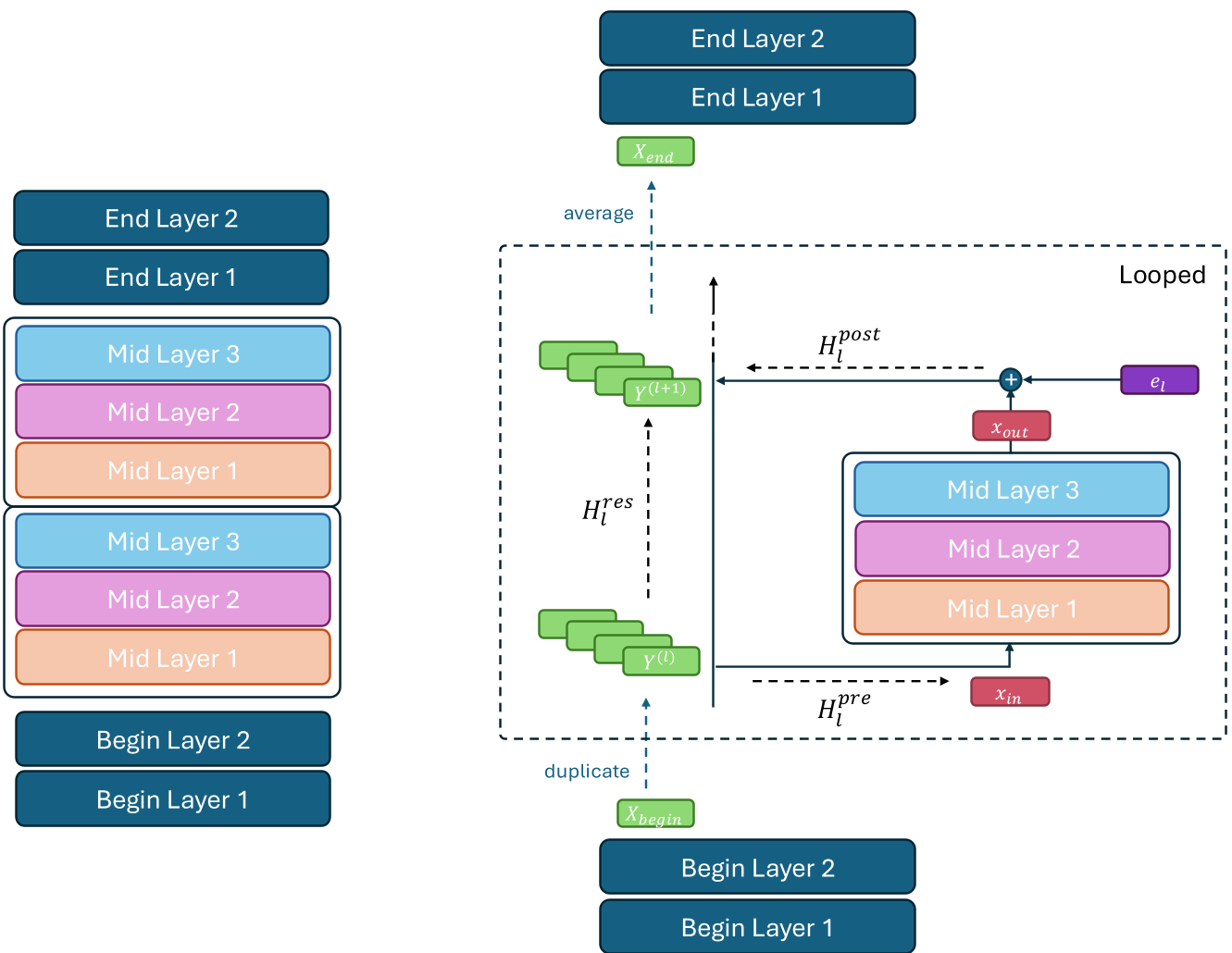 Figure 1: Comparison between vanilla looped Transformers (left) and the Hyperloop Transformer (right) featuring parallel residual streams.
Experiments: More for Less
The authors tested the model against several baselines, including vanilla Transformers and mHC-augmented models.
- Parameter Efficiency: A 136M parameter Hyperloop model achieved a perplexity of 14.40, outperforming a 238M parameter standard Transformer (14.65).
- Quantization Resilience: Hyperloop models hold up exceptionally well under INT4 quantization, a crucial requirement for deployment on consumer hardware.
- Speed: Despite the added matrix operations, the training throughput (tokens/sec) for Hyperloop is nearly identical to standard models, whereas the original mHC method saw significant slowdowns.
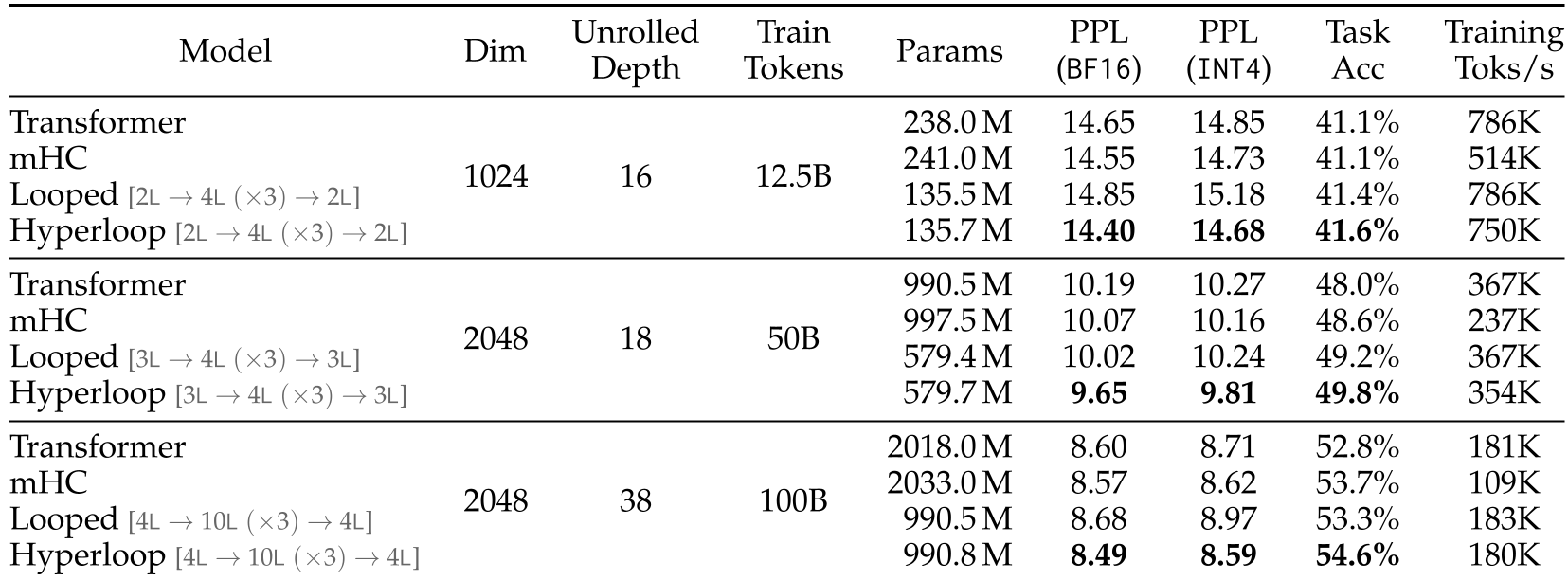 Table 1: Main performance metrics across various scales. Note Hyperloop's superior PPL and task accuracy vs weight-heavy baselines.
Deep Insight: The Logit Lens Analysis
One of the most fascinating findings in the paper is the "Logit Lens" analysis. By projecting the internal residual streams back into vocabulary space, the authors discovered that Hyperloop models align with the final output token distribution much earlier and more sharply at loop boundaries than standard models. This suggests that the looping mechanism forces the model to refine its "thoughts" in a more structured, cyclic manner.
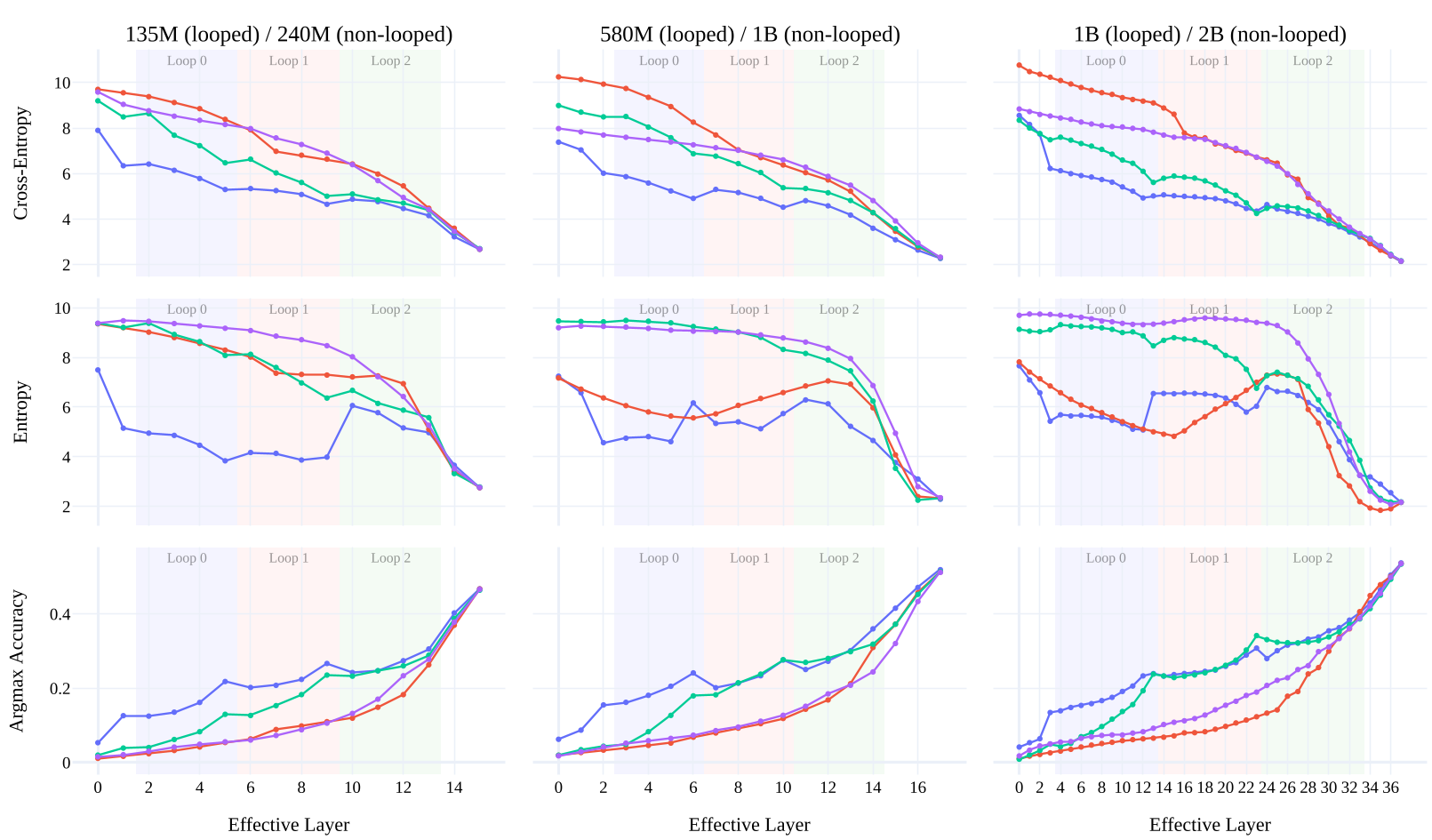 Figure 2: Evolution of cross-entropy and accuracy across depth. Hyperloop models show distinct "rhythms" corresponding to loop iterations.
Conclusion & Future Outlook
Hyperloop Transformers prove that parameter sharing doesn't have to come at the cost of intelligence. By strategically expanding the residual stream and applying hyper-connections only where they matter most, we can build models that are lightweight enough for a phone but powerful enough for complex reasoning.
Future Work: The authors suggest that Hyperloop Transformers could be a prime candidate for "test-time scaling," where a model is trained on a few loops but run for many more during inference to solve harder problems—effectively "thinking" longer without needing more parameters.
Takeaway: If your deployment is memory-bound, Hyperloop is currently one of the most attractive architectures on the horizon.