
HySoN: Revolutionizing Social Group Formation via Decentralized Agent Overlays
HySoN: A Distributed Agent-Based Protocol for Group Formation in Online Social Networks
This paper introduces HySoN (Hyperspace Social Network), a distributed agent-based protocol designed for automated group formation in Online Social Networks (OSNs). By utilizing an overlay network of software agents and a gossip-based dissemination strategy, it achieves efficient peer discovery while maintaining Small-World topological properties.
TL;DR
In the era of data privacy, HySoN proposes a paradigm shift: instead of uploading your life to a server to find a community, your personal software agent builds a "Hyperspace" overlay. By utilizing a gossip protocol and a unique clustering algorithm, HySoN enables users to find groups with high affinity while keeping sensitive data strictly on their local machines.
Background: The Privacy-Utility Tradeoff
Current Online Social Networks (OSNs) like Facebook or LinkedIn operate on a "Data for Service" model. To find groups with specific affinities—such as a niche hobby or professional interest—users must expose their data to the central cloud. This creates a massive privacy bottleneck.
The authors position HySoN as a middleware layer that operates on a Peer-to-Peer (P2P) basis. It treats the social network not as a central database, but as a distributed graph where intelligence resides at the edges (the users' local machines).
Methodology: Mapping Interests into a Hyperspace
The core innovation of HySoN lies in its three-phase execution:
- Gossip-based Dissemination: When a user wants to form a group, their agent initiates a gossip message. This message travels through the existing friendship links (the base graph).
- Overlay Construction: Reached agents analyze local data to generate coordinates in a multidimensional space (the Hyperspace). Agents then "rewire" their social connections to favor nodes that are geographically close in this hyperspace (Euclidean distance), while maintaining long-range "essentially critical" links.
- Small-World Navigation: The resulting topology mimics a Small-World Network. This means it has high local clustering (groups of similar users) and low average path lengths (shortcuts between different interest groups).
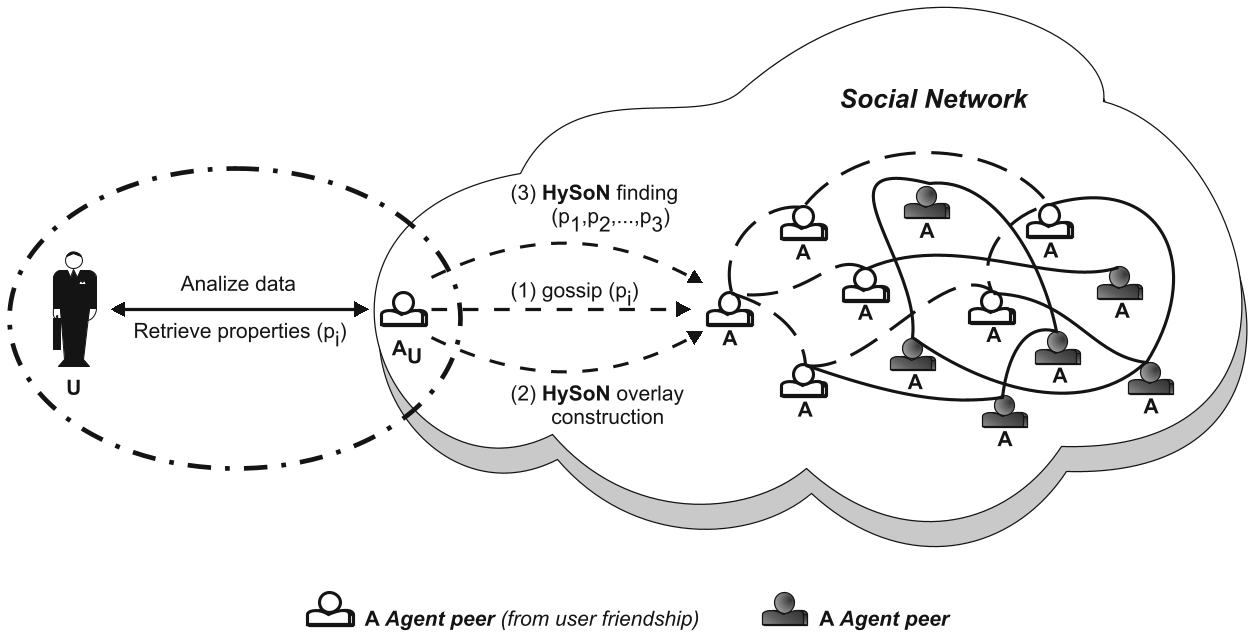 Figure 1: The overlay construction process where nodes reorganize based on property similarity.
Why the "Small-World" Effect Matters
The technical brilliance of HySoN is its reliance on the Small-World property (). In a standard social graph, finding a specific subset of people might take many "hops." In a HySoN overlay:
- Intra-cluster links allow for fine-tuned searching within a specific interest area.
- Inter-cluster (Long) links allow a search request to "jump" across the network to reach the "Admissible Region" (the target demographic) rapidly.
Experimental Results: Efficiency and Scalability
The authors tested HySoN using the ComplexSim platform on a scale-free network.
- Reachability: With a probabilistic threshold , they reached nearly the entire network with minimal message overhead ().
- Search Speed: Even when the "target" population was as small as 10% of the total network, the decentralized search algorithm found suitable members in just a few time-steps.
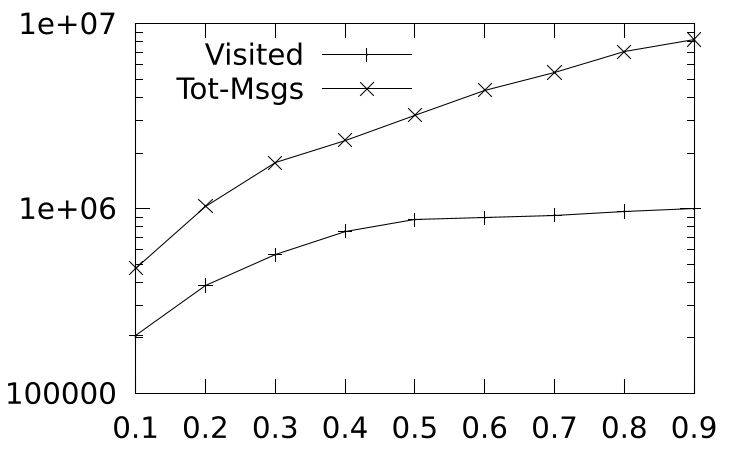 Figure 2: Performance of the finding algorithm across different ratios of suitable nodes.
Critical Insight: The Future of "Edge-Native" Socializing
HySoN belongs to a growing body of work that seeks to dismantle the centralized "Silo" model of the internet. By proving that distributed clustering can be both efficient and privacy-preserving, the authors show that we don't need a central authority to curate our social lives.
Limitations: The paper assumes that agents are "trusted" by their users and that nodes remain online long enough for the gossip to propagate. In a real-world mobile environment, high churn (nodes going offline) might destabilize the overlay construction.
Conclusion
HySoN is a sophisticated marriage of Multi-Agent Systems and Graph Theory. It successfully demonstrates that we can achieve the benefits of social grouping without the "privacy tax" levied by modern social media giants. The next logical step for this research is the integration of Trust Metrics to filter out malicious agents or fake identities.