
I-SEP: Re-engineering the Stable Election Protocol for the IoT Era
I-SEP: An Improved Routing Protocol for Heterogeneous WSN for IoT-Based Environmental Monitoring
This paper introduces I-SEP (Improved Stable Election Protocol), a threshold-based routing protocol designed for heterogeneous Wireless Sensor Networks (WSNs) in IoT environmental monitoring. It utilizes a three-tier energy hierarchy (normal, intermediate, and advanced nodes) and a dynamic cluster head (CH) replacement strategy to maximize network longevity and data throughput.
TL;DR
Energy efficiency is the "hard wall" of IoT-based environmental monitoring. I-SEP (Improved Stable Election Protocol) breaks through this barrier by introducing a three-tier energy hierarchy and a dynamic threshold-based Cluster Head (CH) replacement mechanism. By avoiding the overhead of "round-robin" elections, it extends network life by a staggering 300% compared to traditional benchmarks.
Background: The Cost of Indecision
In the world of Wireless Sensor Networks (WSNs), the "Base Station" (BS) is often far away. To save power, nodes form clusters, send data to a local Cluster Head (CH), and let the CH bear the burden of long-distance transmission.
However, existing protocols like SEP (Stable Election Protocol) suffer from a design flaw: they often force a new election every single round. This creates massive "routing overhead"—a storm of advertisement packets (ADV) and acknowledgments (ACK) that drains batteries faster than the actual data sensing.
Motivation: Why Three Tiers and Thresholds?
The authors identified two critical gaps in prior SOTA (State of the Art) such as LEACH and DEEC:
- Coarse Heterogeneity: Most protocols only categorize nodes as "Normal" or "Advanced." I-SEP introduces "Intermediate" nodes to create a smoother energy gradient across the network.
- Unnecessary Elections: If a Cluster Head still has 90% of its energy, why force a new election? I-SEP introduces a residual energy threshold (). If the CH is healthy, it stays. This preserves the "stability period"—the time until the very first node dies.
Methodology: The Core Mechanics
The heart of I-SEP lies in its three-level probability model. The network total energy is defined by: Where and are the fractions of advanced and intermediate nodes, and are their respective energy boost factors.
The Threshold Strategy
Unlike previous methods, the CH evaluates its residual energy at the end of every round.
- Condition: If , the CH retains its role.
- Benefit: No new cluster formation messages. The network enters a "steady state," maximizing data throughput.
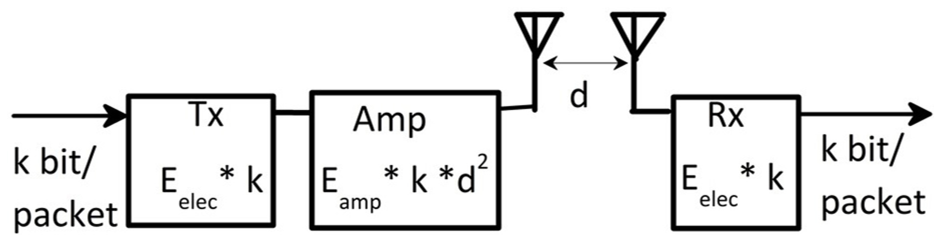 Figure: The energy dissipation model for heterogeneous IoT environmental monitoring.
Experimental Performance
The researchers tested I-SEP against SEP and DEEC using MATLAB simulations with 100 nodes.
1. Massive Improvements in Lifetime
The metrics for First Node Dead (FND) and Last Node Dead (LND) are the gold standards for WSNs. I-SEP keeps the network alive for over 7,000 rounds in high-heterogeneity scenarios, whereas SEP and DEEC often collapse before 4,000 rounds.
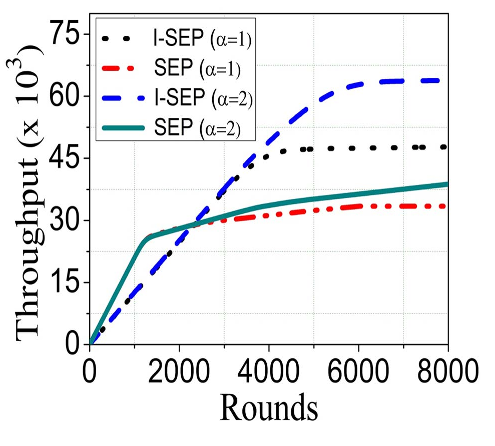 Figure: Throughput comparison showing I-SEP sending significantly more packets to the Base Station over its lifetime.
2. Throughput Dominance
By reducing the energy spent on "management" (routing overhead), I-SEP frees up "budget" for actual sensing data. This leads to a throughput increase of up to 56% compared to SEP and a whopping 300% against DEEC.
Critical Insights & Conclusion
I-SEP proves that heterogeneity is a feature, not a bug. By intentionally deploying nodes with three different energy levels, the network becomes more resilient to "energy holes" (areas where nodes die quickly due to high traffic).
Takeaways for the Industry:
- Adaptive Roles: I-SEP assigns a "High Energy Level" to any node acting as a CH, then reverts it to a "Low Energy Level" when it becomes a normal sensing node. This physical-layer awareness is key for IoT devices.
- Scalability: The threshold-based replacement makes this protocol ideal for large-scale deployments where constant re-clustering would flood the bandwidth.
Limitations: The current model assumes static nodes. In mobile IoT scenarios (e.g., drone-based sensing), the Euclidean distances would change constantly, requiring a more dynamic distance-aware threshold.
Future Outlook: Integrating I-SEP with Machine Learning to predict node failure before it happens could lead to even more efficient "proactive" routing.