
IARank: Capturing Influence in the Speed of a Tweet
IARank: Ranking Users on Twitter in Near Real-time, Based on their Information Amplification Potential
2016-01-15
Summary
Problem
Method
Results
Takeaways
Abstract
This paper introduces IARank, a novel non-iterative model designed to rank influential Twitter users in near real-time by measuring their information amplification potential. Evaluated against events like the London Olympics 2012, IARank achieves performance comparable to PageRank but with significantly lower latency, identifying top-k relevant users more effectively.
## TL;DR
In the chaotic environment of live events like the Olympics, influence is fleeting. **IARank** is a lightweight, near real-time ranking algorithm that identifies influential Twitter users by their "Information Amplification" potential. Unlike the classic PageRank—which is too slow to keep up with the rapid churn of a live feed—IARank updates almost instantaneously (0.03s), accurately identifying "rising stars" and established authorities.
## The Latency Trap: Why PageRank Fails Live Events
The academic gold standard for ranking, PageRank, relies on an iterative process of convergence. In a static web graph, this is fine. However, during the London Olympics 2012, the authors observed that the Top 10 rankings changed as quickly as every **0.282 seconds**.
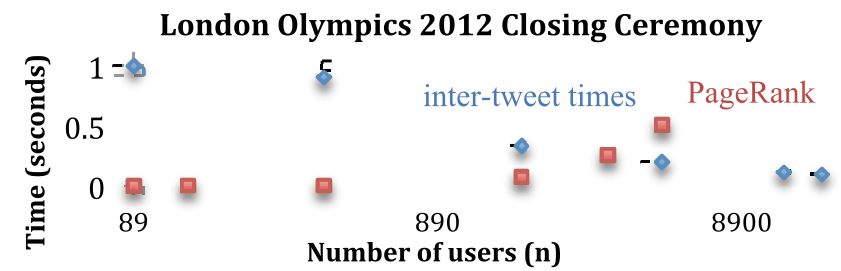
As shown in the researchers' benchmark, PageRank took about **0.725 seconds** to converge for a subset of ~7,000 users. By the time PageRank finish its math, the conversation has already moved on. This "convergence lag" creates a significant bottleneck for real-time event monitoring.
## Methodology: The Physics of Information Amplification
IARank moves away from iterative graph traversal and instead adopts a "potential vs. kinetic" energy analogy. Influence is split into two measurable factors:
1. **Buzz (The Kinetic Factor):** Calculated as `Mentions / Event Activity`. This captures how much attention a user is currently generating. High buzz means your content is "loud" enough to be amplified by others.
2. **Structural Advantage (The Potential Factor):** Calculated as `Followers / (Followers + Following)`. This represents your reach. A high ratio indicates you are an information *provider* rather than an information *seeker*.
### Instantaneous vs. Cumulative Influence
A key insight of the paper is that even a "nobody" can become an influencer for 15 minutes if they post a viral tweet. IARank handles this with an **Instantaneous Influence** model that uses a time-decay parameter ($\alpha$). When a high-ranking user retweets a low-ranking one, they "transfer" their influence momentarily, which then decays as the event progresses.
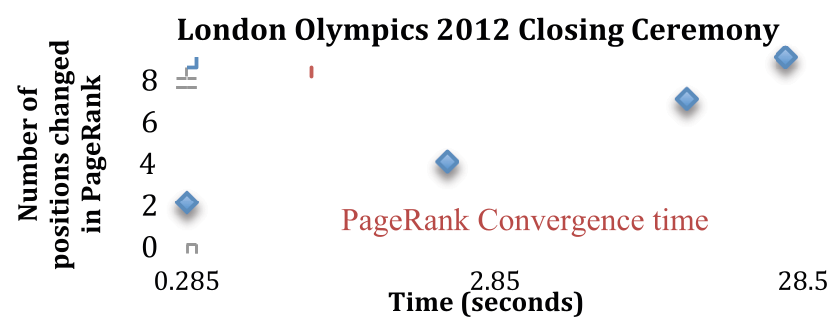
*Figure: Ranks change faster than PageRank can converge, necessitating a faster approach.*
## Experiments: Beating the Baseline
The authors conducted a user study during London Fashion Week 2012, comparing IARank against PageRank and a human-generated "ground truth" reference rank.
### Key Findings:
* **Top-K Precision:** For the Top 5 users, IARank achieved **80% relevance**, noticeably higher than PageRank's **60%**.
* **Discoverability:** IARank was 6.3% better at finding "unknown but relevant" users, making it a superior tool for discovery.
* **Processing Speed:** IARank updated in just **0.0326 seconds**, easily keeping pace with the highest-velocity Twitter streams.
However, the study noted a trade-off: while IARank excels at the very top of the list (k=3 to 5), PageRank tends to correlate better with human rankings as the list gets longer (k > 10).
## Critical Analysis & Conclusion
IARank proves that **simplicity is a feature, not a bug**, in real-time systems. By focusing on local node features (Buzz and Structural Advantage) rather than global graph convergence, it sidesteps the computational heavy lifting that hobbles PageRank in live scenarios.
**Limitations:** The model heavily relies on the "Mentions" and "Follower" counts, which can be gamed by sophisticated botnets, though the Structural Advantage ratio acts as a basic anti-spam filter.
**Future Outlook:** The next frontier for IARank is **Personalization**. As the user study revealed, "influence" is subjective; a fashion student values a magazine's insight differently than a brand's hype. Integrating NLP to understand the *quality* and *sentiment* of those mentions would likely push IARank's precision even higher.