
IBeH: Unmasking Covert Networks Through Semantic Community Detection
IBeH: Naïve Community Detection Methodology for Dark Social Network
The paper introduces IBeH (I Belong Here), a naïve community detection methodology specifically designed for dark (covert) social networks. It utilizes a novel reciprocating factor and actor weight metric, based on profile similarity and relation semantics, to identify egocentric communities with minimal overlap.
TL;DR
Detecting communities in "Dark Networks" (like terrorist cells) is notoriously difficult because members actively hide their links. The paper IBeH breaks away from traditional distance-based algorithms by using a semantic-heavy approach. It identifies "Pivot Actors" based on the quality and weight of their relationships rather than just the frequency of interactions, successfully mapping the 9/11 operative network with high precision and minimal overlap.
Background: The Challenge of the Shadows
In a typical social network, community detection is a matter of finding "clusters" where people talk to each other frequently. In a Dark Social Network, however, density is a poor signal. Operatives often limit communication to avoid detection (the "need to know" basis), leading to sparse graphs where conventional algorithms like DBSCAN or original modularity-based methods struggle.
The authors argue that the identity and role of the actor—what they represent and the specific nature of their ties—are more important than the mere existence of a link.
Methodology: Beyond the Distance Metric
The authors propose two algorithms: DensCommun (a density-based baseline) and IBeH (the core contribution).
1. The DensCommun Baseline
DensCommun is an extension of density-based clustering. It uses a local neighborhood threshold () and a distance function to find clusters. While effective for traditional data, the paper shows it leads to strong inter-community coupling, making it hard to tell where one cell ends and another begins.
2. The IBeH Innovation
IBeH stands for "I Belong Here." Its logic is governed by a simple yet powerful equation:
- Reciprocating Factor: This calculates how much an actor gives back to the network, weighted by path length and the significance of the relation.
- Actor Weight: Not all nodes are equal. Relations like "Kith and Kin" (family/close ties) or "Skill Set" are weighted highly, while "Communication" (simple pings) is weighted lowly. This creates a Signature Profile for each actor.
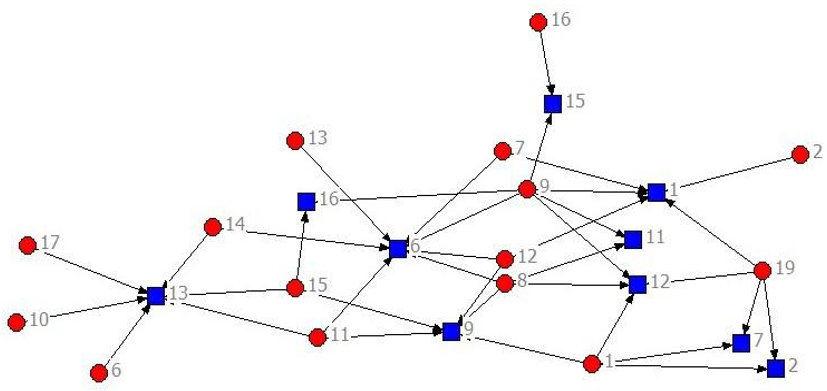 Figure 1: Identification of pivot actors within the covert network.
Experiments: The 9/11 Dataset
The researchers applied IBeH to the infamous 9/11 dataset, involving 19 primary hijackers and 42 documented relations.
Key Findings:
- Pivot Actors: IBeH identified actors 1, 3, and 19 as the primary pivots due to their high influential signature profiles.
- Community Structure: Unlike density-based methods that created a "hairball" of overlapping nodes, IBeH generated three distinct egocentric communities.
- Bridge Detection: The algorithm successfully identified "bridging actors"—the rare individuals who connect different cells, which is critical for intelligence disruption.
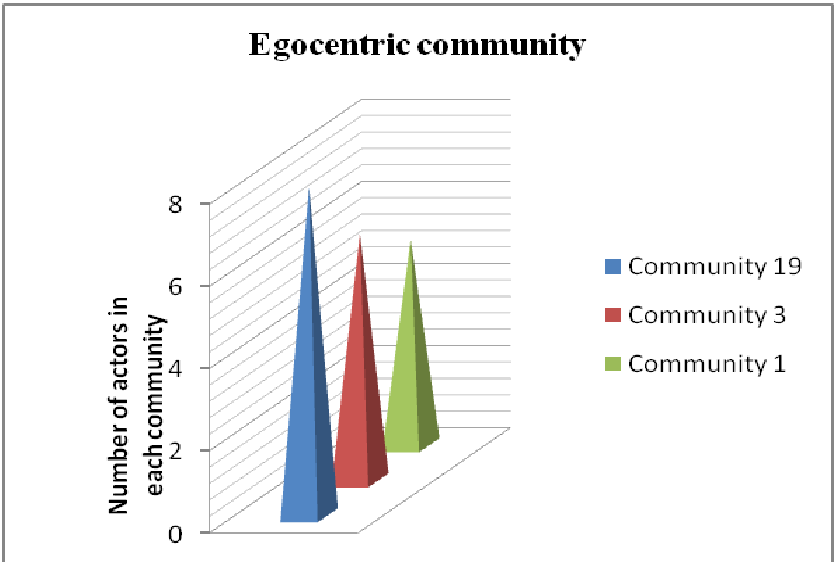 Figure 2: The resulting egocentric communities showing clear structural separation.
Comparison: IBeH vs. DensCommun
The superiority of IBeH is evident in its handling of overlap. As shown in the table below, DensCommun fluctuates wildly with different values, often resulting in too many neighbors or messy clusters.
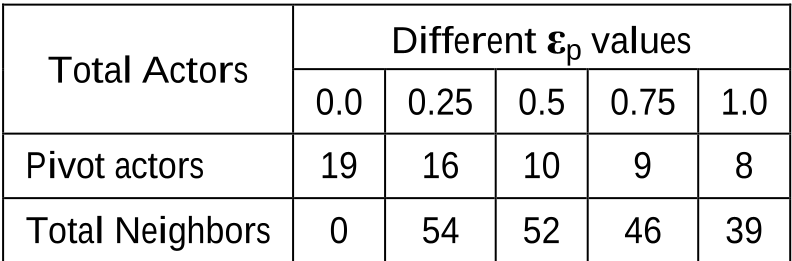 Table 1: Overlapped community counts for different density thresholds.
In contrast, IBeH maintains a "Minimal degree of overlap" because it looks at the semantics of the relations. It doesn't care just that Actor A and Actor B are "close" in a graph; it cares why they are close.
Critical Insight & Conclusion
This work demonstrates that for heterogeneous and covert networks, topology is not destiny. By incorporating domain knowledge (the weight of specific relation types), we can see through the "noise" created by covert behavior.
Limitations: The current model relies on manually assigned weights for relations (High, Medium, Low). Future iterations could use Machine Learning to learn these weights dynamically from historical behavioral data.
Takeaway: Effective dark network analysis requires shifting from "how many links" to "what kind of links." IBeH provides a specialized framework for exactly that.