
Advancing Speech Emotion Recognition: The ICEKF-NOEC Framework
Iterative Conditional Entropy Kalman filter (ICEKF) for noise reduction and Neuro Optimized Emotional Classifier (NOEC)
This paper introduces the Iterative Conditional Entropy Kalman Filter (ICEKF) for noise reduction and the Neuro Optimized Emotional Classifier (NOEC) to advance Speech Emotion Recognition (SER). By combining ICEKF for speech enhancement with an Improved Artificial Bee Colony (IABC) for feature selection, the method achieves a state-of-the-art accuracy of 92.18% on a Tamil news speech dataset.
TL;DR
Recognizing human emotions from speech is a cornerstone of next-generation Human-Machine Interaction (HMI). This paper introduces a robust pipeline featuring Iterative Conditional Entropy Kalman Filtering (ICEKF) for denoising and a Neuro Optimized Emotional Classifier (NOEC). Tested on a real-time Tamil news dataset, the system achieves a remarkable 92.18% accuracy, significantly outperforming traditional evolutionary algorithms and standard neural networks.
Problem & Motivation: The "Noise" in Human Emotion
Modern AI systems often fail to recognize subtle emotional cues due to two primary hurdles:
- Environmental Noise: Raw speech is often corrupted, making it difficult for classifiers to distinguish between emotional variance and background artifacts.
- Feature Redundancy: While features like MFCC and Pitch are standard, including irrelevant features increases computational load and decreases precision.
Previous attempts, such as the Enhanced Bat Algorithm (EBSA), lacked the granularity to handle non-linear noise and didn't utilize a comprehensive feature set (intensity, formants), leading to subpar performance in "real-world" scenarios like news broadcasts.
Methodology: A Multi-Stage Optimization Strategy
1. Denoising with ICEKF
The authors reinvent the classic Kalman Filter. By introducing Conditional Entropy into the state update phase, the system can more accurately predict clean speech samples from noisy inputs. This is crucial for non-linear speech signals where traditional Gaussian assumptions fall short.
2. Feature Selection via IABC
Not all acoustic features are created equal. The Improved Artificial Bee Colony (IABC) algorithm is used to select the most significant features from a pool of MFCC, pitch, energy, intensity, and formants.
- The Insight: The IABC balances "exploration" (finding new feature subsets) and "exploitation" (refining current best subsets) by adjusting the step size based on the fitness of the solution.
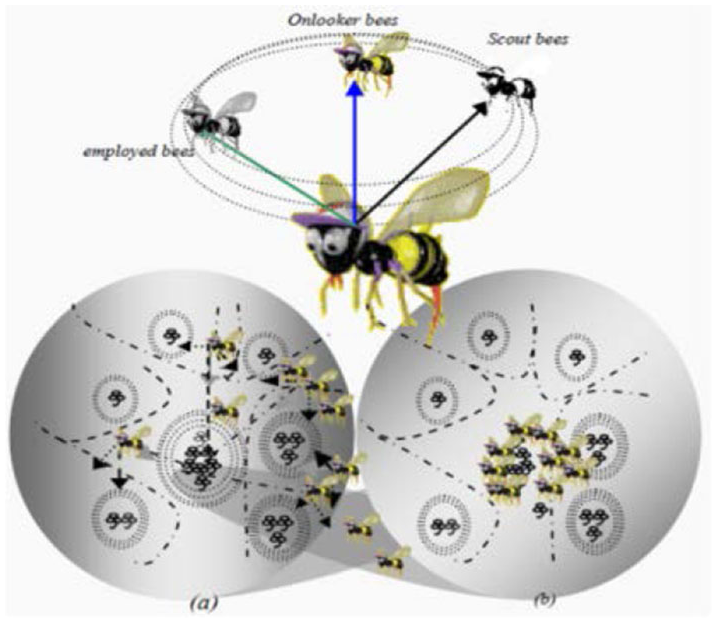 Fig 1: The general flow of the Artificial Bee Colony algorithm used for feature selection.
3. The NOEC Classifier
The Neuro Optimized Emotional Classifier (NOEC) is the heart of the system. It’s an Artificial Neural Network (ANN) whose weights and architecture (hidden neurons) are optimized using Particle Swarm Optimization (PSO). This hybrid approach prevents the network from getting stuck in local minima (common in backpropagation) and speeds up convergence.
Experimental Results: SOTA Performance
The system was rigorously tested against a dataset of Tamil speech recordings containing emotions such as Happy, Sad, Anger, Fear, and Neutral.
- Denoising Excellence: ICEKF achieved a PSNR of 40.95 dB, far superior to the 35.63 dB of standard Kalman Filtering (KF).
- Classification Accuracy: The NOEC reached an accuracy of 92.18%, compared to only 88.95% for EBSA.
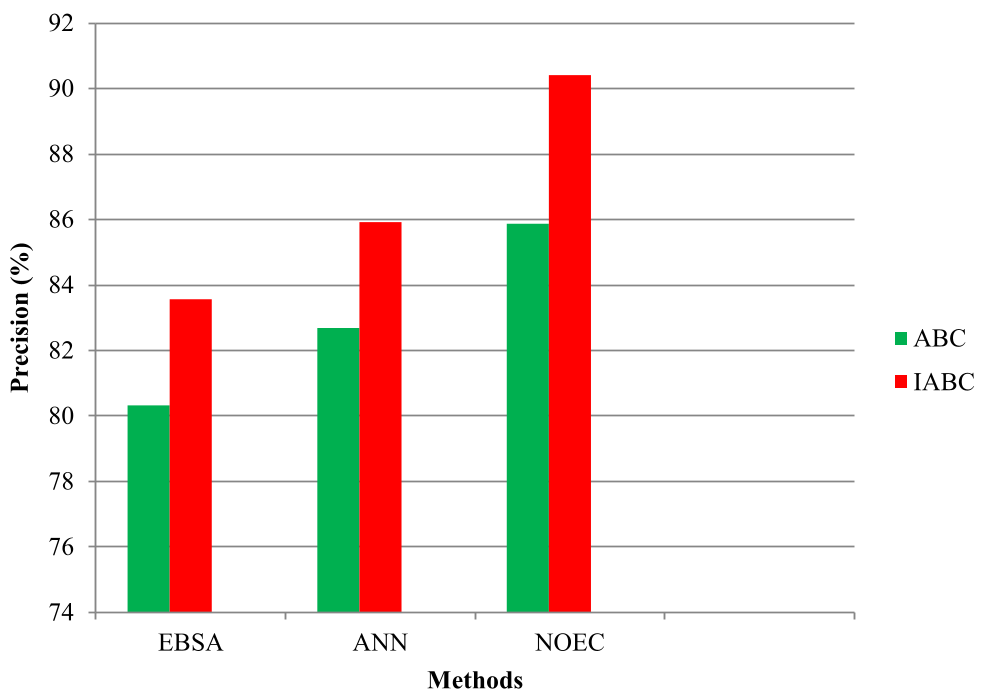 Fig 2: Comparative analysis of accuracy between the proposed NOEC and existing EBSA/ANN baselines.
Critical Analysis & Conclusion
Key Takeaways
The marriage of Signal Processing (ICEKF) and Heuristic Optimization (IABC/PSO) provides a powerful toolset for SER. By treating feature selection and classifier training as optimization problems, the authors have created a system that is both accurate and adaptable to specific linguistic contexts (e.g., Tamil).
Limitations & Future Work
While the results are impressive, the dataset is relatively small (100-150 samples). Future research should explore:
- Scalability: How does NOEC perform on larger, more diverse multicontinental datasets?
- Real-time Latency: While faster than EBSA, the iterative nature of IABC and PSO may still pose challenges for low-latency edge computing.
In conclusion, the ICEKF-NOEC framework sets a high bar for emotional intelligence in speech processing, proving that optimized feature selection is just as vital as the classifier itself.