
Silver ICT Innovation: Rescuing the Super-Aging Society Through Digital Empowerment
Innovative applications and strategy on ICT applications for aging society: case study of Japan for silver ICT innovations
This paper explores the integration of Information and Communications Technology (ICT) within Japan's "super-aging society," proposing the concept of "Silver ICT Innovation." It outlines a comprehensive strategy for using digital tools to enhance elderly participation in governance (Silver Democracy), healthcare, and disaster management.
TL;DR
As the world's first "super-aging society," Japan is pioneering a digital revolution not just for the youth, but for the "silver" generation. This paper introduces the strategy of Silver ICT Innovation, moving beyond simple nursing care to empower seniors through e-government, social media, and universal design. By solving the usability gap, ICT becomes a tool for "Silver Democracy," ensuring that the elderly remain active participants in the modern information society.
Background: The Crisis of the "Population Decrease"
Japan faces a unique socio-economic challenge: by 2050, 40% of its population will be over 65. The traditional systems of social security and labor are under immense pressure. The authors argue that ICT is the only viable policy tool to bridge the gap between a shrinking workforce and a growing elderly demographic.
However, the "Digital Divide" remains a significant hurdle. High-income seniors are well-connected, but those in lower-income brackets or living alone face higher risks of "lonely death" and social exclusion.
Methodology: The 8-Pillar Strategy for Silver Innovation
The core of the paper's proposal is a cross-cutting solution that integrates five paradigms: Informatization, Aging, Environment, Urbanization, and Globalization.
The 8 Priority Agendas:
- e-Government: Tailoring administrative services for elderly comfort.
- Healthcare Computerization: Expanding efficient e-health systems.
- e-Mobility: Elderly-friendly traffic and smart city planning.
- Disaster Prevention: Mobile/GPS networks for safe remote supervision.
- Smart Homes: Ubiquitous computing in housing and nursing homes.
- Lifelong Education: Integrating ICT training into senior education.
- Social Participation: Utilizing SNS to foster a community volunteering culture.
- Pro-elderly Employment: Enabling teleworking for the "3-day per week" work model.
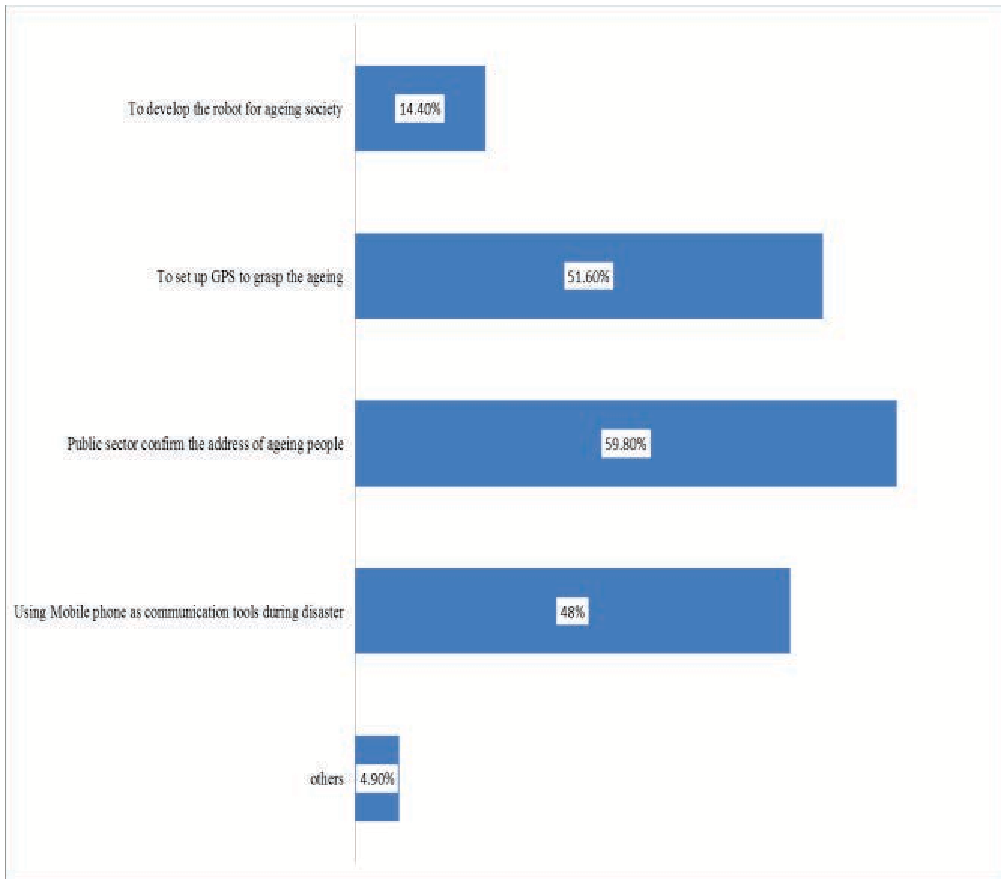
Insights: From Raku-Raku Phones to Silver Democracy
A key takeaway from the authors' research is the success of Universal Design. The "Raku-Raku" (Easy-to-use) phone by NTT DoCoMo set a gold standard by focusing on:
- Easy to read: High contrast and adjustable font sizes.
- Easy to hear: Enhanced voice recognition and clear audio outputs.
- Easy to operate: Intuitive touch panels and voice-activated calling.
When these barriers are removed, seniors transition from "Negative Aging" (victims of technology) to "Active Aging" (empowered users).
Resilience in Disasters
The survey conducted by the Institute of e-Government showed that during the 3.11 Tohoku Earthquake, social media (specifically Twitter) emerged as a vital lifeline. While traditional municipal websites often lacked accessibility, the real-time, lightweight nature of social media allowed citizens—including seniors—to coordinate and confirm safety.
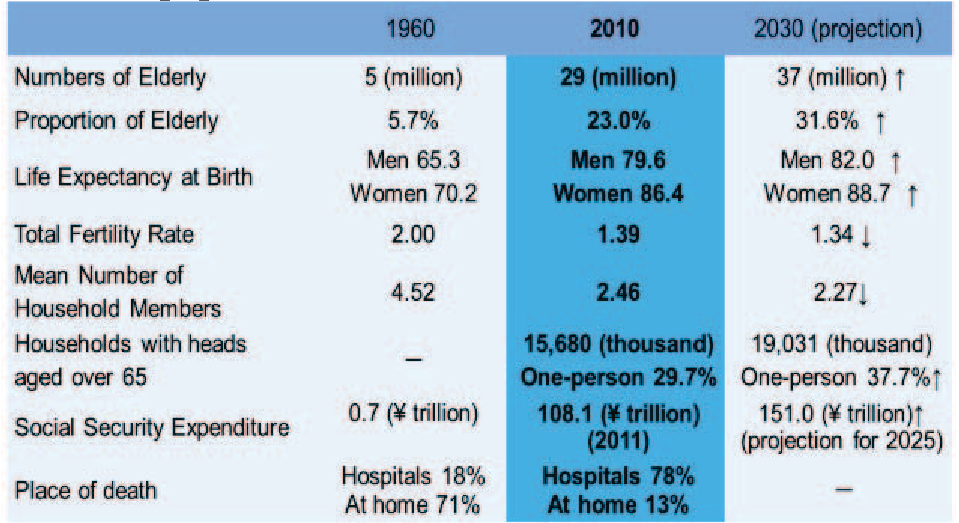 Snapshot of Japan's rapidly changing demographics influencing the need for digital solutions.
Critical Analysis & Conclusion
The paper's strength lies in its holistic view of the aging society. It correctly identifies that the problem isn't the elderly's willingness to use technology, but rather the design of the technology and the spirit of the governance system.
Takeaway: Future digital infrastructure must be "Aging-Inclusive." As silver citizens become the largest voting bloc, "Silver Democracy" will demand that government portals move from simple information delivery to active, two-way e-participation platforms.
Limitations: The study acknowledges that while the framework is robust, many pilot projects were in their early stages at the time of writing (2013). Further quantitative analysis of the "35 PPP (Public-Private Partnership) projects" would be necessary to prove long-term economic efficacy.
Future Outlook: Japan's model serves as a "test bed" for the rest of the world. As Europe, China, and South Korea approach similar demographic cliffs, "Silver ICT Innovation" will likely become a global standard for social sustainability.