
Social Media: A Catalyst or Hindrance for Collaboration? Unpacking the PISA 2015 Asian Data
The influence of ICT-based social media on Asian students’ collaborative problem-solving performance
This study investigates the impact of ICT-based social media usage—categorized by type (email, IM, SNS) and purpose (recreational vs. academic)—on the Collaborative Problem-Solving (CPS) performance of 15-year-old students across five Asian countries. Utilizing Hierarchical Linear Modeling (HLM) on PISA 2015 data from 46,268 participants, it identifies significant correlations between digital engagement patterns and cognitive outcomes.
TL;DR
Is social media making students smarter collaborators or just distracted gamers? This study analyzes over 46,000 students across five Asian regions to find that how and with whom students interact online determines their collaborative problem-solving (CPS) success. While peer-to-peer academic talk and hobby-based browsing boost scores, excessive gaming and "direct-answer" interactions with teachers may actually hinder cognitive growth.
The "Double-Edged Sword" of Digital Literacy
In the modern educational landscape, collaborative problem solving is no longer a soft skill—it is an essential human behavior for work performance. While Information and Communication Technology (ICT) provides the infrastructure for this, researchers have long debated its impact. The core of this study's motivation stems from the inconsistency of prior work: Does Facebook help or hurt? The authors argue the answer lies in the granularity—distinguishing between recreational use, academic use, and student attitudes.
Methodology: The Power of Hierarchical Linear Modeling (HLM)
To analyze the complex PISA 2015 dataset, the researchers moved beyond traditional regression. They recognized that a student's performance isn't just an individual trait; it's nested within school cultures and national economies.
The Multi-Level Equation
The study uses a three-level HLM to decompose the variance:
- Student Level: Usage frequency (Email, Chat, News, Games) and Attitudes.
- School Level: Median frequency of ICT use and school environment.
- Country Level: National GDP (LnGDP).

Key Insights: What Works and What Fails?
1. Peer vs. Teacher Dynamics
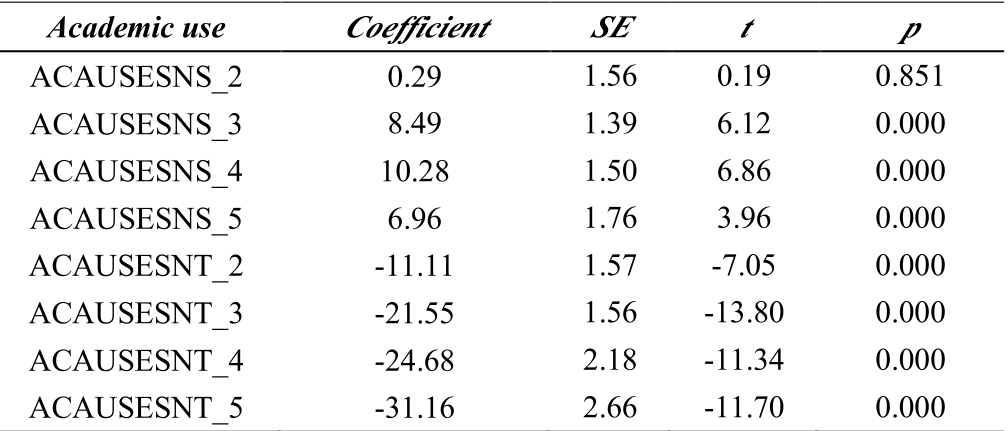
One of the most striking findings is the divergence in academic use.
- Peer Communication (ACAUSESNS): Positively correlated with CPS. Engaging with peers requires negotiation, explanation, and shared discovery.
- Teacher Communication (ACAUSESNT): Negatively correlated. The authors suggest that when students ask teachers for help via social media, they often receive "plausible and direct" answers. This bypasses the independent thinking process essential for solving complex problems.
2. Recreational "Fertile Ground"
Contrary to the "Internet is a distraction" narrative, several recreational activities showed a positive correlation with problem-solving:
- Reading news online and browsing for fun expands a student's knowledge base.
- Checking email and chatting online outside of school correlates with higher CPS scores, likely due to the mastery of asynchronous and synchronous communication nuances.
3. The Gaming Penalty
Consistently across the data, playing games via social networks (RECUSEPG) showed a negative impact. As gaming frequency increases, the CPS coefficient drops significantly (e.g., a coefficient of -20.62 for high-frequency users).
Deep Insight & Conclusion
This research confirms that ICT Interest (ATTUSE) is perhaps the strongest predictor of success. Students who find social networks "useful" tend to engage in more interactions, creating a self-reinforcing loop of collaborative learning (Self-Determination Theory).
Takeaways for Educators:
- Encourage Peer Networks: Schools should facilitate online spaces where students can discuss schoolwork with each other.
- Rethink Teacher-Student Digital Interaction: Teachers should focus on "scaffolding" (asking guiding questions) rather than providing direct solutions in digital chats.
- Monitor Gaming: While digital literacy is key, specific "distractor" behaviors like social network gaming need careful monitoring.
Final Thought: The study proves that in the Asian context, social media is not a monolith. When used as a tool for information seeking and peer negotiation, it is a powerful engine for 21st-century skills.