
ICT in SEN Schools: Bridging the Digital Divide for Special Education
ICT in Special Educational Needs Schools from Teachers’ Perspective: A Survey
This research presents a comprehensive survey of Information and Communication Technology (ICT) integration in all 273 Special Educational Needs (SEN) schools in the Czech Republic. Utilizing a representative sample of 882 educators, the study evaluates hardware availability, teacher digital literacy, and the alignment of current technologies with the national Framework Educational Programme (FEP).
TL;DR
This study provides a nationwide diagnostic of ICT usage in Czech Special Educational Needs (SEN) schools. It reveals a high level of hardware saturation—particularly in PCs and tablets—but highlights a critical tension between the benefits of multimediality and the risks of technology addiction. While tablets have emerged as the favorite tool for both teachers and students, a pedagogical gap remains in how these tools are utilized within official educational frameworks.
Problem & Motivation: The Invisible Learners
In the rush toward a global "e-society," learners with physical, developmental, or behavioral disabilities are often left in the periphery of EdTech research. The core challenge is not just providing hardware, but ensuring that the technology compensates for specific learner deficits (such as motor impairments or communication disorders).
The authors identify a significant "Why": Most teachers use ICT as a substitute for missing traditional materials, but do they have the skills and the right framework to move from replacing content to enhancing cognitive development?
Methodology: A Nationwide Audit
The research sample is impressively robust, covering 882 respondents representing nearly every SEN institution in the Czech Republic. The authors categorize pedagogical participation across teachers, class teachers, and assistants, ensuring the data reflects the entire support ecosystem.
The study utilized a refined 28-item questionnaire that moved from printed to electronic formats to ensure data integrity. Key to their approach was the classification of learners into four groups, ranging from independent users to those requiring full support or showing no interest in ICT.
 Figure 1: The research reached a representative sample across all Czech regions, predominantly involving veteran teachers with 16+ years of experience.
Methodology Details: The Skill-Hardware Gap
The authors analyzed three specific technology domains:
- Personal Computers/Notebooks: The traditional backbone of IT.
- Tablets: Preferred for their portability and intuitive touch interfaces.
- Interactive Boards (IAB): Powerful for classroom engagement but requiring the highest learning curve.
Key Results: Hardware is Present, but Skills Vary
The data suggests that "lack of equipment" is no longer the primary hurdle. 97.6% of teachers have access to PCs, and nearly 86% have interactive boards in their schools.
However, the Skills Gap is telling:
- PC Proficiency: 97% of teachers are non-beginners.
- Tablet Proficiency: 87% are comfortable.
- Interactive Boards: A staggering 25% still consider themselves beginners.
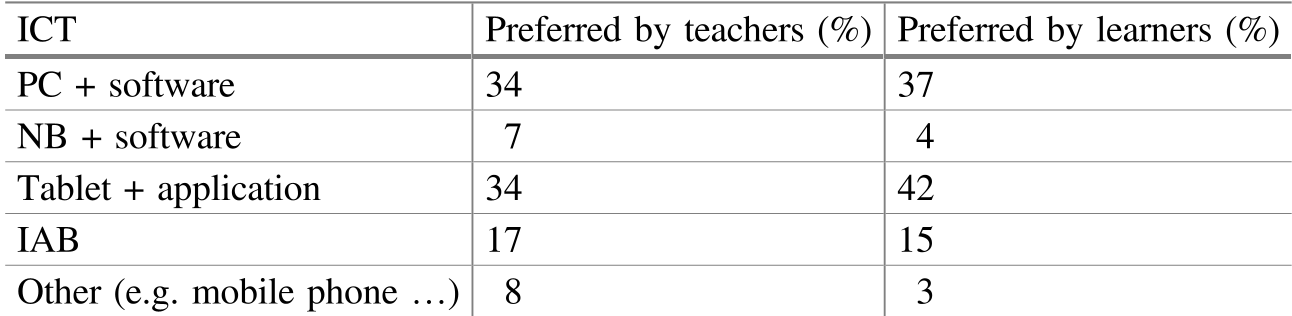 Figure 2: Comparative preference between teachers and learners. Note the strong lean toward tablets and software solutions.
The Paradox of Progress: Advantages vs. Risks
The survey highlights a fascinating duality in the perception of ICT:
- The Pro-ICT View: 92% value "multi-mediality" and 85% see ICT as a vital tool for compensating for student deficits (Functional substitution).
- The Skeptical View: 45% of educators fear addiction to devices, and 43% worry about physical damage to expensive hardware.
Interestingly, 20% of respondents explicitly stated that the current Framework Educational Programme (FEP) does not reflect the modern needs of SEN learners, suggesting that policy is lagging behind current classroom capabilities.
Critical Insight: From Entertainment to Individualization
As a Senior Editor, I find the 5% "entertainment" metric particularly insightful. It suggests that despite fears of addiction, teachers are successfully moving ICT away from being a "distraction" or "reward" and toward being a standard didactic tool for literacy.
However, the transition to Interactive Boards remains a bottleneck. While learners benefit from the large-scale visual feedback, teachers' lack of proficiency and physical issues (like standard visual obstruction when standing in front of the board) present ongoing barriers.
Conclusion & Future Outlook
The study concludes that Czech SEN schools are no longer just "medical institutions" but are "equal partners" in the e-society. To maximize the 85% efficiency in "compensatory functions," future work must focus on:
- Updating national frameworks (FEP) to include more dynamic ICT standards.
- Inclusion of psychologists to manage the 45% risk of technology addiction.
- Moving beyond "finding materials on the Internet" toward creating customized apps for specific disabilities.
ICT is no longer a luxury in SEN education; it is a fundamental accessibility right.