
Securing the Pulse: An Integrated Fog-Blockchain Model for Healthcare IoT
Identification and Authentication in Healthcare Internet-of-Things Using Integrated Fog Computing Based Blockchain Model
This paper proposes an integrated Fog Computing (FC) and Blockchain framework for the healthcare Internet-of-Things (IoT). It introduces the Advanced Signature-Based Encryption (ASE) algorithm to provide secure, real-time Patient Health Data (PHD) transmission and achieves SOTA performance in malicious node detection and reliability.
TL;DR
As healthcare IoT (HIoT) devices like ECG monitors and glucose meters become ubiquitous, the risk of life-threatening data breaches increases. This paper introduces a three-tier Fog Computing-based Blockchain architecture and a novel Advanced Signature-Based Encryption (ASE) algorithm. By moving authentication to the edge, the system achieves 91% detection accuracy for malicious nodes and 95% reliability, significantly outperforming traditional cloud-only models.
The "Edge" of Security: Why Cloud isn't Enough
Healthcare data is uniquely sensitive—it is both high-priority and intolerant of loss or latency. Traditional cloud-based IoT systems face three critical bottlenecks:
- Single Point of Failure: A central server hack compromises all patients.
- Latency: Sending raw EEG/ECG data to the cloud for verification creates delays that risk patient lives during real-time monitoring.
- Authentication Gaps: Many existing HIoT devices lack the computational power to perform the complex verification required to stop sophisticated "Man-in-the-Middle" attacks.
The authors argue that the only way to solve this is to bring the "intelligence" closer to the source—using Fog Computing to handle transactions and Blockchain to ensure those transactions are immutable.
Methodology: The ASE Algorithm & Three-Tier Architecture
The proposed system treats Fog nodes as decentralized miners. Instead of one massive cloud server, local hospitals or medical agencies deploy Fog nodes that act as high-speed, local verification points.
The Core Mechanism: ASE
The Advanced Signature-Based Encryption (ASE) algorithm operates in three distinct phases:
- Key Generation: Uses Diffie-Hellman for secure symmetric key exchange between heterogeneous HIoT devices.
- Ring Signatures: To ensure patient anonymity while maintaining accountability, signatures are mixed into a "Ring" structure.
- Verification: A joint probability mathematical framework is used to identify and authenticate devices across fog clusters.
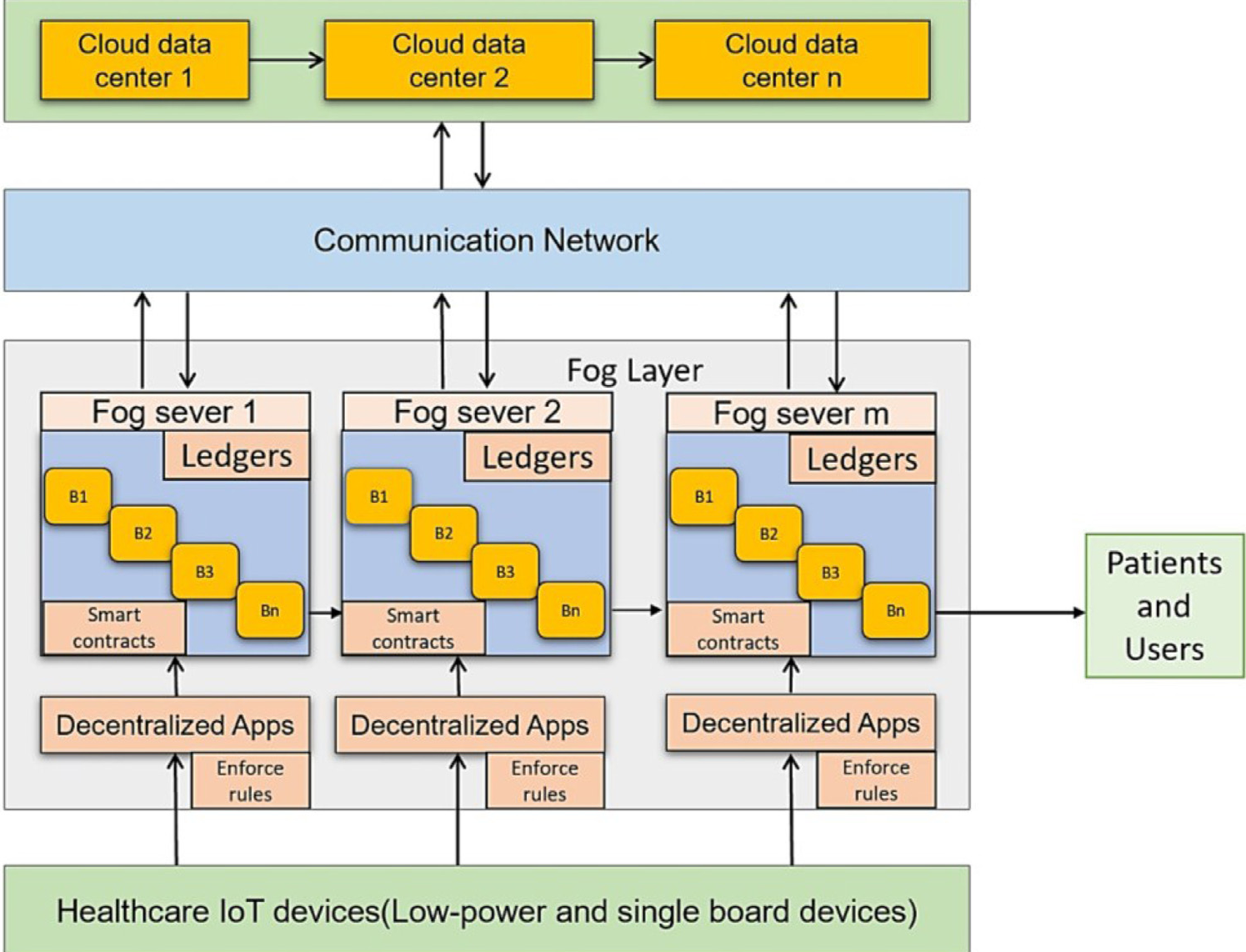 Fig. 1: The proposed Three-tier FC-based blockchain architecture bridging the gap between devices and the cloud.
Battle-Tested Performance
The framework was evaluated using iFogSim and SimBlock simulators, comparing it against established SOTA models like FogBus, BeeKeeper, and BFAN.
1. Superior Malicious Node Detection
In a hostile network environment, the ability to identify compromised nodes is paramount. The ASE algorithm reached a 91% accuracy rate, far exceeding the 83% seen in cloud-based counterparts.
2. Efficiency and Throughput
By adopting a single hop-count communication model at the edge, throughput was dramatically increased while energy consumption decreased significantly compared to the cloud.
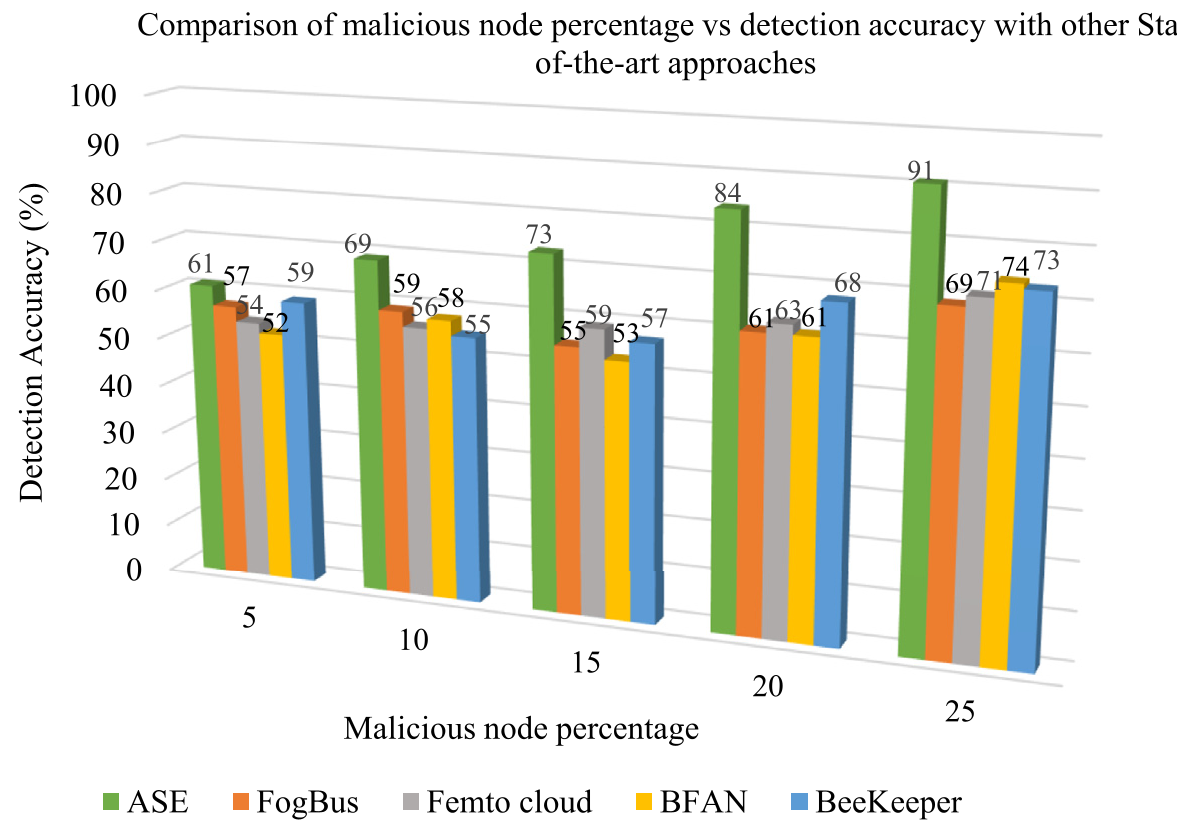 Fig. 2: Reliability Comparison showing the ASE algorithm (95%) consistently outperforming BeeKeeper, BFAN, and FogBus.
Critical Insight: The Value of Fog Miners
The true genius of this work lies in how it repurposes Fog nodes as Blockchain miners. In standard Blockchain (like Ethereum), mining is resource-heavy. Here, the authors optimized the Proof-of-Work (PoW) specifically for the Fog layer. This results in a system where:
- Non-sensitive data is sent to the Cloud for long-term storage.
- Sensitive/Time-critical data is processed and authenticated via Fog-resident Smart Contracts in milliseconds.
Conclusion and Future Outlook
This paper presents a robust blueprint for future "Smart Hospitals." By successfully integrating the Decentralization of Blockchain with the Low Latency of Fog Computing, the authors have created a framework that is both secure and scalable.
Future Work: The authors suggest exploring Augmented Reality (AR) surgical visualizations and testing the scalability of these fog clusters as the number of devices reaches the thousands. For now, the ASE algorithm stands as a high-water mark for reliability in decentralized healthcare systems.