
Decoding Digital Identities: A Multi-Dimensional Approach to Distinguishing Organizations from Individuals
8665_On Identification of Organizational and Individual Users Based on Social Content Measurements.
This paper introduces a multi-dimensional framework for identifying social network users as either organizational or individual entities using social content measurements. By leveraging text complexity, structural normalization, multimedia features, and temporal posting patterns, the authors achieve high-accuracy classification on Sina Weibo data.
TL;DR
In the vast expanse of social media, distinguishing a real human from a corporate entity or organization is crucial for everything from targeted marketing to social regulation. Researchers from Renmin University of China have developed a framework that uses "behavioral fingerprints"—such as post-regularity, content complexity, and even facial recurrence in photos—to identify users with up to 97.8% accuracy, far surpassing traditional text-based models.
Context: Beyond the Username
Usernames are often cryptic, and official "verified" badges cover less than 1% of the user base. While previous attempts at identification relied heavily on Naive Bayes models to analyze what people say, this paper argues that how and when they say it is far more revealing. Organizations have specific goals—marketing, notification, or public relations—which result in distinct content patterns compared to the sporadic, emotional, and diverse posts of an individual.
Methodology: The Four Pillars of Identity
The authors move beyond simple word counts, proposing four sophisticated measurement vectors:
1. Content Complexness (CCI)
By applying Information Entropy, the researchers measure the "uncertainty" or diversity of topics. Individuals live varied lives, leading to higher entropy, while organizations tend to stick to specific professional themes.
2. Content Normalization (CNI)
This is the "killer feature" of the study. It measures Structural Entropy—how consistent a user is with their formatting (e.g., use of brackets, post length, specific symbols). Organizations value branding and consistency; individuals are random and messy.
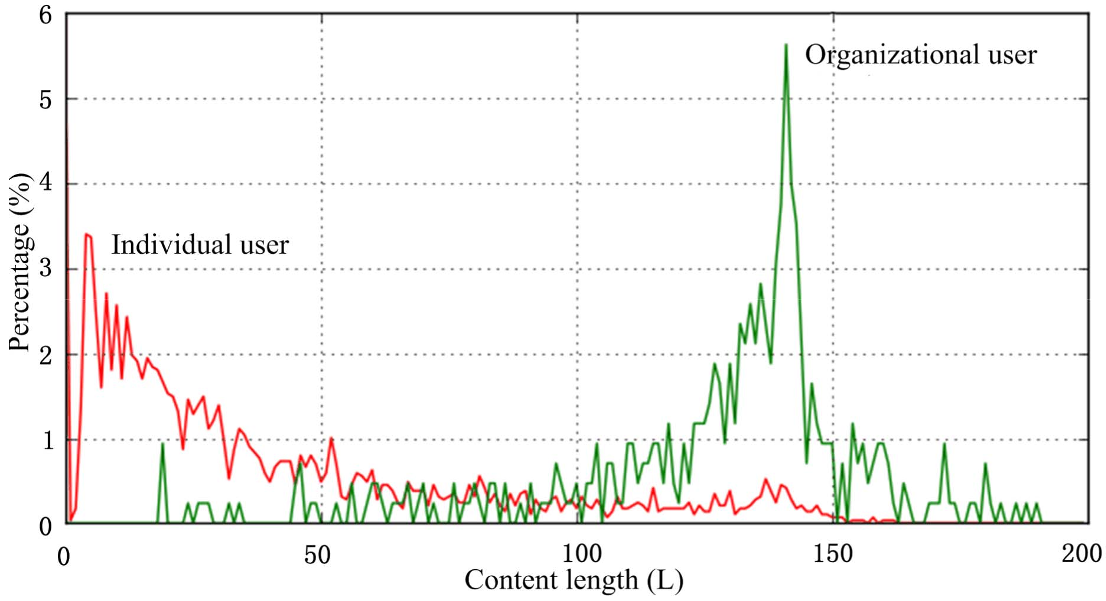 Figure 1: Comparison of content length distribution between Individual and Organizational users.
3. Multimedia Content (MCI)
Using PCA-based Face Recognition, the system looks for the "Same Person" (SP) across multiple uploads. A high recurrence of the same face typically signals a personal account, whereas an organization's feed features a broad variety of faces or strictly promotional graphics.
4. Time-Series Dynamics (TSCI)
Organizations operate on a clock (peaks at 10:00 and 16:00). Individuals are "night owls," with activity surging during rest hours (21:00–23:00). The paper converts these patterns into "Letter Series" (e.g., 'a' for stable, 'b' for decrease, 'c' for increase) to calculate similarity against a standard identity template.
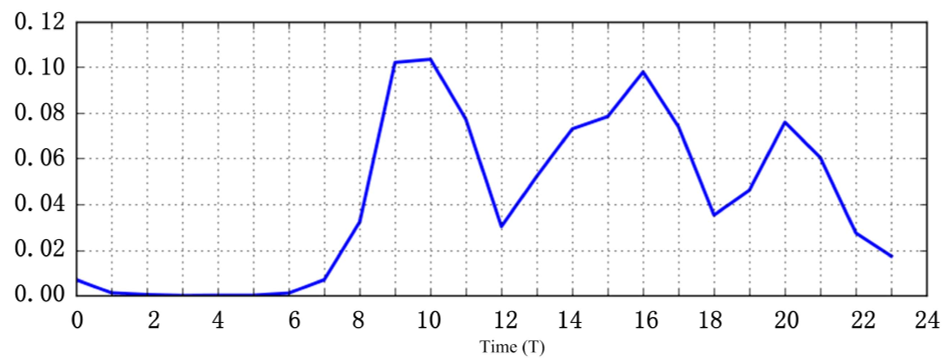 Figure 2: Diurnal activity patterns for various "grain" sizes in time-series analysis.
Experiments & SOTA Results
Testing on a dataset of 32 million posts from Sina Weibo, the results were clear. While the standard Probability Model (PM) barely performed better than a coin flip (59.4% accuracy), the structural analysis (CNI) was nearly perfect.
| Method | Accuracy | F1-Score (Ind/Org) |
|---|---|---|
| Probability Model (Baseline) | 59.4% | 66.9% / 47.5% |
| CCI (Complexity) | 89.1% | 92.4% / 80.7% |
| CNI (Normalization) | 97.87% | 98.5% / 96.2% |
| TSCI (Time-Series) | 80.85% | 85.8% / 70.8% |
Academic Insight: Why it Works
The success of the CNI (Content Normalization) method (97.87%) suggests that "Institutional Inductive Bias" is a powerful signal. Organizations rarely deviate from their "voice" or "template" because their content is often generated or filtered through professional management tools. In contrast, the high variance in individual content acts as a natural separator in the Latent User Space.
Conclusion & Future Outlook
This work demonstrates that identity is encoded in behavior. While the authors achieved SOTA results, they acknowledge limitations: identity can be fluid, and sophisticated bots might eventually learn to mimic the "entropy" of a human. The next frontier involves cross-platform identity linkage, where these behavioral fingerprints are used to track the same entity across different social networks.
Keywords: Sina Weibo, Social Content Measurement, User Identification, Information Entropy, Time-Series Analysis.