
Identifying At-Risk Youth: Turning School Data into a Shield with Machine Learning
Identification of School-Aged Children with High Probability of Risk Behavior on the Basis of Easily Measurable Variables
This paper explores the application of Knowledge Discovery in Databases (KDD) to identify school-aged children at high risk of behaviors like smoking, drinking, and bullying. By utilizing Support Vector Machines (SVM), Naïve Bayes, and J48 algorithms on the Slovak HBSC dataset, the authors demonstrate that high-accuracy classification is possible using only "easily measurable" variables accessible to educators.
TL;DR
Researchers have developed a way to predict risky behaviors in children—such as substance abuse and bullying—using simple, non-invasive data like grades and social habits. By applying machine learning (SVM, Naïve Bayes, J48) to the Slovak national HBSC dataset, they proved that we can identify high-risk individuals with up to 87% accuracy without needing complex psychological evaluations.
Academic Positioning: This work bridges the gap between public health epidemiology and KDD (Knowledge Discovery in Databases), moving from descriptive statistics to predictive screening tools.
The "Liar's Paradox" in Public Health
The biggest hurdle in juvenile public health is social desirability bias. If you ask a 13-year-old if they smoke or bully others, they are likely to lie. This makes traditional surveys unreliable for targeted prevention.
The authors' insight was to stop relying on the "hard" questions as inputs. Instead, they asked: Can we predict the hidden risky behavior by looking only at "easily measurable" and "hard-to-fake" variables? By using variables like academic achievement, age compared to classmates, and the frequency of evening social outings, they created a proxy for risk that is much harder for a student to manipulate.
Methodology: Tiered Contextual Learning
The study utilized a sample of 8,491 students and organized data into three hierarchical levels:
- Individual: Personal habits, physical health, and social frequency.
- Class: Class size, average age, and prevalence of learning disorders.
- School: Location, ethnic makeup, and gender ratios.
Model Architecture and Data Flow
The researchers tested three distinct inductive biases:
- SVM (Support Vector Machine): Finding the optimal hyperplane to separate at-risk vs. non-risk.
- Naïve Bayes (NBC): A probabilistic approach assuming feature independence.
- J48 (Decision Tree): A logic-based approach that creates a transparent "flowchart" for risk.
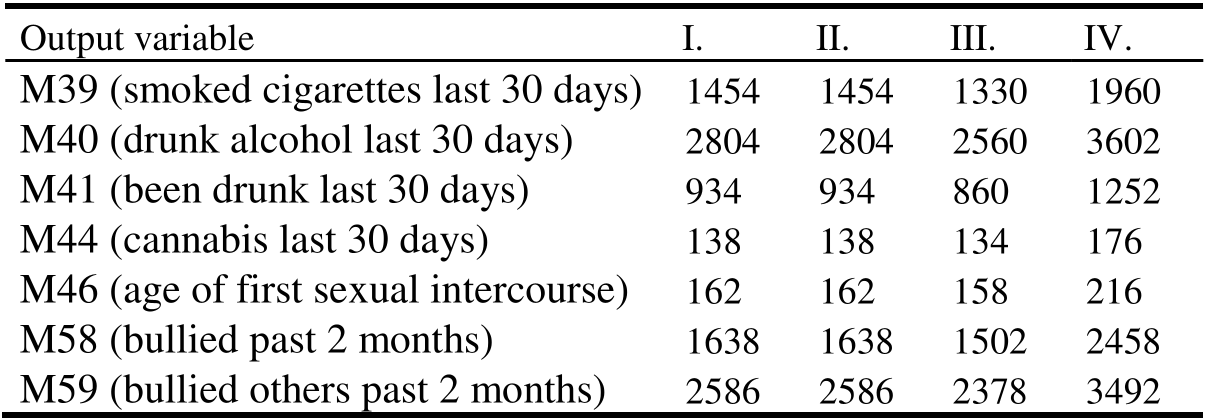 Table 1: The distribution of risky behavior instances across the dataset.
Experimental Results: Complexity vs. Utility
The results revealed a fascinating trend: Adding more data doesn't always help.
While class-level variables (like being older than the class average) often boosted accuracy, school-level variables sometimes introduced noise, causing a slight dip in SVM performance. However, the "Set IV" experiment—using only the most basic variables—was a resounding success.
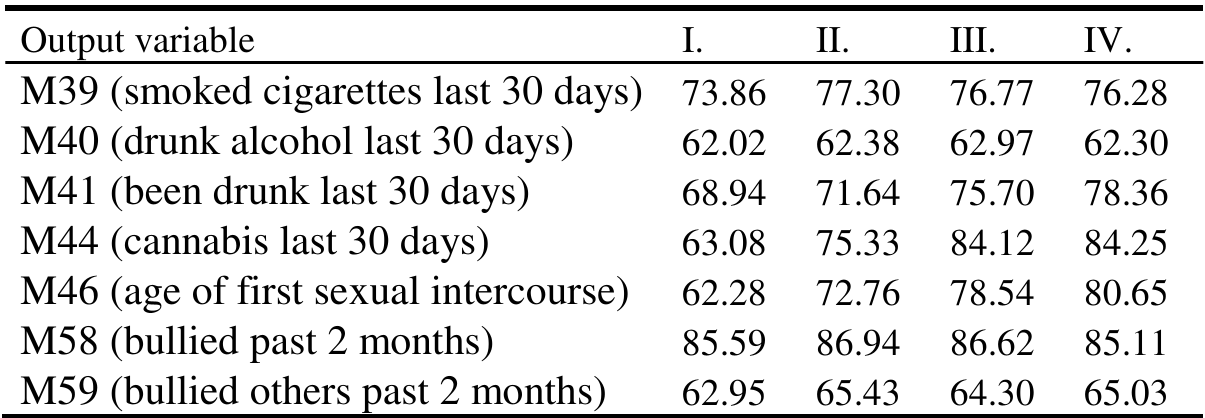 Table 4: J48 proved to be highly robust, particularly for predicting bullying and early sexual intercourse.
Key Findings:
- Bullying (M58): Consistently high accuracy (~86%) across all models.
- Substance Abuse: Cigarette and alcohol use were predictable with ~75% and ~62% accuracy, respectively.
- Model Parsimony: The fact that easily accessible records (grades, gender, age) performed so well means these models are ready for "field use" by school consultants today.
Critical Insight & Future Outlook
The performance of the J48 algorithm is particularly important for public health. Unlike "black-box" models, decision trees provide a clear rationale for why a child is flagged. For an educator, knowing that "Low Academic Achievement + High Frequency of Evenings Out = High Risk" is far more actionable than a raw probability score.
Limitations: The study notes a higher rate of "false negatives" than "false positives." In a prevention context, this is a "safe" error (missing a few at-risk kids is better than falsely accusing many), but for a comprehensive safety net, the sensitivity needs improvement.
Takeaway: This research moves us toward a future where "prevention programs" aren't just generic lectures given at assemblies, but targeted support systems triggered by data-driven insights.