
Beyond Greedy Search: Building Expert Teams with Cultural Algorithms
Identifying a Team of Experts in Social Networks using a Cultural Algorithm
The paper introduces a knowledge-based Cultural Algorithm (CA) to solve the "Team of Experts" discovery problem in social networks. It aims to select a set of experts covering all required project skills while minimizing human communication costs, achieving results very close to the optimal exhaustive search.
TL;DR
Finding the "dream team" in a professional social network isn't just about collecting skills—it's about minimizing the friction of collaboration. This paper presents a Cultural Algorithm (CA) that outperforms traditional greedy and genetic methods in identifying expert teams. By leveraging a "Belief Space" to guide the search and using 2-hop indexing for lightning-fast network calculations, the authors provide a scalable solution to an NP-hard problem.
Background: The Hidden Cost of Collaboration
In an expert network like LinkedIn or DBLP, nodes are professionals and edges represent past collaborations. When a project requires a specific set of skills (e.g., AI, Databases, Graphics), we can't just pick the top expert in each field. If the AI expert has never worked with the Database expert, the "Communication Cost" (ComC) is high.
The goal is to find a team that covers all skills while minimizing:
- Diameter: The largest shortest distance between any two team members.
- Sum of Distances: The total weight of shortest paths between all pairs (considered a "fairer" metric).
The Bottleneck: Why Greedy Fails
Previous SOTA methods relied on greedy heuristics—building trees around potential "root" experts. However, these methods suffer from two fatal flaws:
- Optimality Gap: They often get stuck in local optima, missing the most cohesive teams.
- Scalability: As the number of people with a specific skill (skill frequency) increases, greedy algorithms must check exponentially more combinations, leading to massive runtime spikes.
Methodology: The Cultural Algorithm (CA) Framework
The authors propose a CA that mimics how human culture evolves via the "Dual Inheritance Theory."
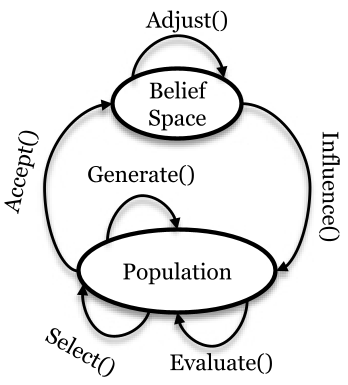
1. The Dual-Space Architecture
The system consists of two evolving components:
- Population Space: A pool of candidate teams (individuals) that undergo crossover and mutation.
- Belief Space: The "Cultural Memory." It acts as a transposed matrix of the elite performers, guiding the creation of the next generation toward high-potential expert clusters.
2. High-Speed Graph Traversal
Calculating the distance between experts in a 200,000-node graph for every iteration is computationally suicidal. To solve this, the authors utilize 2-hop cover indexing. This allows the algorithm to retrieve the shortest path distance between any two nodes in under 10 microseconds, a middle ground between slow on-the-fly calculation and massive distance matrices.
Experimental Showdown: CA vs. The World
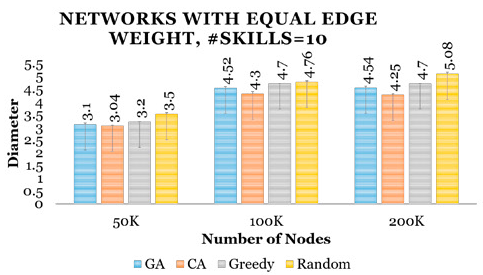
The authors tested their approach on three versions of the DBLP graph (50K, 100K, and 200K nodes) with different edge weightings (Equal, Logarithmic, and Semantic).
Performance Accuracy
In tests against an exhaustive search (limited to 4 skills due to complexity), the Cultural Algorithm consistently reached the near-optimal solution, significantly beating the Greedy and Genetic Algorithm (GA) baselines.
The Scalability Winner
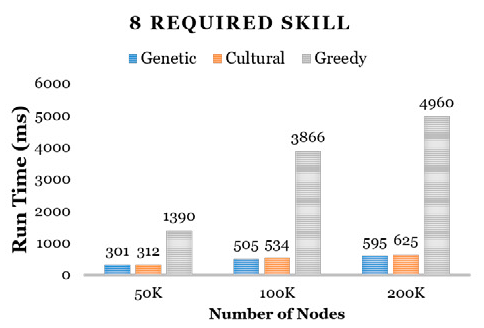
The most striking result is the runtime stability. As shown below, while the Greedy algorithm's runtime grows exponentially with skill frequency, the CA (and GA) remains virtually flat, making it the only viable choice for massive industrial social networks.
Critical Insight & Conclusion
The true power of this paper lies in the Belief Space. Unlike a standard Genetic Algorithm which relies on "blind" evolution, the CA uses the transpose matrix to focus the search on the "neighborhoods" of experts that have historically yielded good results.
Takeaway: If you are building a recommendation engine for team formation or spatial crowdsourcing, skip the greedy heuristics. Combining a knowledge-driven evolutionary algorithm with a 2-hop index provides the best balance of accuracy and industrial scalability.
Future Work: The authors aim to incorporate "Personnel Cost" and "Expertise Level" into the fitness function, moving from a single-objective to a multi-objective Pareto optimization model.