
Criminal Code: Why Everything We Know About Monitoring Mobsters is Mathematically Wasteful
Identifying individuals associated with organized criminal networks: A social network analysis
This paper introduces a novel criminal network surveillance strategy based on the mathematical theory of Identifying Codes. By optimizing the selection of suspects for direct monitoring, the method ensures that every individual in an organized crime network (Drug Trafficking or Terrorist Organizations) can be uniquely identified when they become "active," even if they are not the ones being directly watched.
TL;DR
High-stakes surveillance is a resource trap. While Interpol and police agencies focus on "Kingpins" using Social Network Analysis (SNA), this paper proves that monitoring "important" individuals is actually wasteful. By using Identifying Codes—a concept from coding theory—researchers found they could uniquely track every member of a terror cell or drug cartel while using 50% fewer agents than traditional methods.
The "Key Player" Fallacy
In the world of counter-terrorism and narcotics, the list of suspects grows faster than the number of field agents. Historically, agencies used centrality metrics (Degree, Betweenness, etc.) to pick who to tail. The logic seemed sound: watch the guy with the most connections.
However, this paper points out a fatal flaw: visibility is not identity. Just because you watch the "most important" people doesn't mean you can distinguish who is doing what when a signal (a drug deal or a bomb plot) emerges from the shadows. The authors argue that current strategies lead to Resource Wastage—policing a few "hubs" while leaving "rim" suspects in the dark until it’s too late.
Methodology: The "Seepage" Intuition
The authors treat a criminal network like a graph where info "seeps" through edges. They use Identifying Codes, a subset of nodes that, when monitored, give every node in the graph a unique "signature."
The Graph Coloring with Seepage (GCS) Model
Imagine injecting a unique color into a monitored suspect. This color "seeps" to all their neighbors. If every suspect ends up with a unique combination of colors from their neighbors, they are uniquely identified.
- Logic: If Suspect A and Suspect B both talk to Agent-Monitored Suspect C, but only Suspect A talks to Monitored Suspect D, then a "blip" at both C and D uniquely points to A.
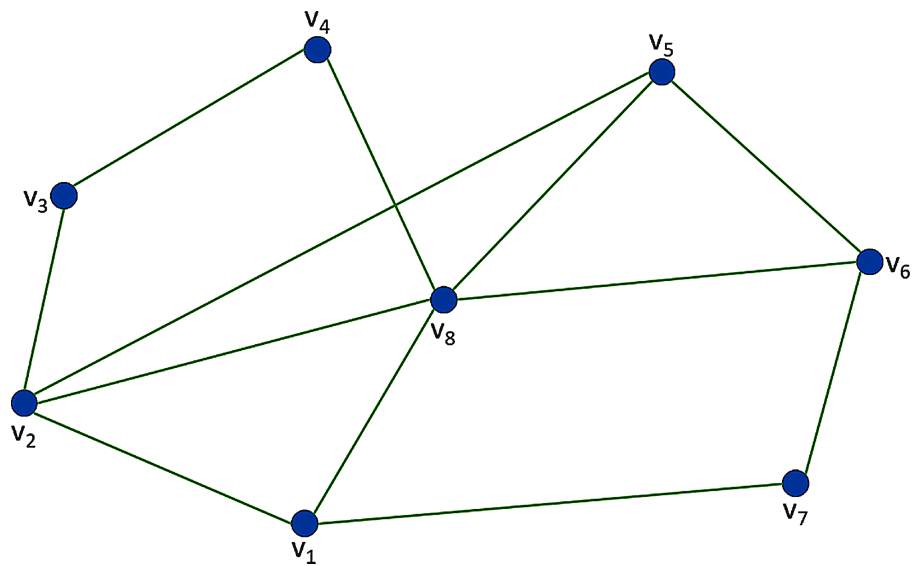 Fig 3: An undirected graph where sets {v4, v6, v7, v8} form a code that uniquely identifies all 8 members.
The paper extends this to:
- Discriminating Codes: For bipartite networks (e.g., Doctors providing steroids to MLB players).
- Augmented Identifying Codes (AIC): A "realistic" model where some agents are already deployed, and we need to add the minimum number of new monitors to fix the "identity gaps."
Experiments: Real-World Cartels and Terror Cells
The researchers tested their ILP (Integer Linear Programming) solutions on datasets like the Operation Juanes (Mexican drug smuggling) and the 2015 Paris Attacks network.
Performance vs. Centrality
The results were a wake-up call for law enforcement:
- Resource Reduction: In "Operation Juanes," they only needed to monitor 22 out of 50 suspects (a 56% reduction) to guarantee unique identification of all 50.
- The Wastage Gap: Traditional centrality metrics (Degree/Betweenness) required monitoring 45 out of 50 people to achieve the same result—a 104% wastage of manpower compared to the Identifying Code approach.
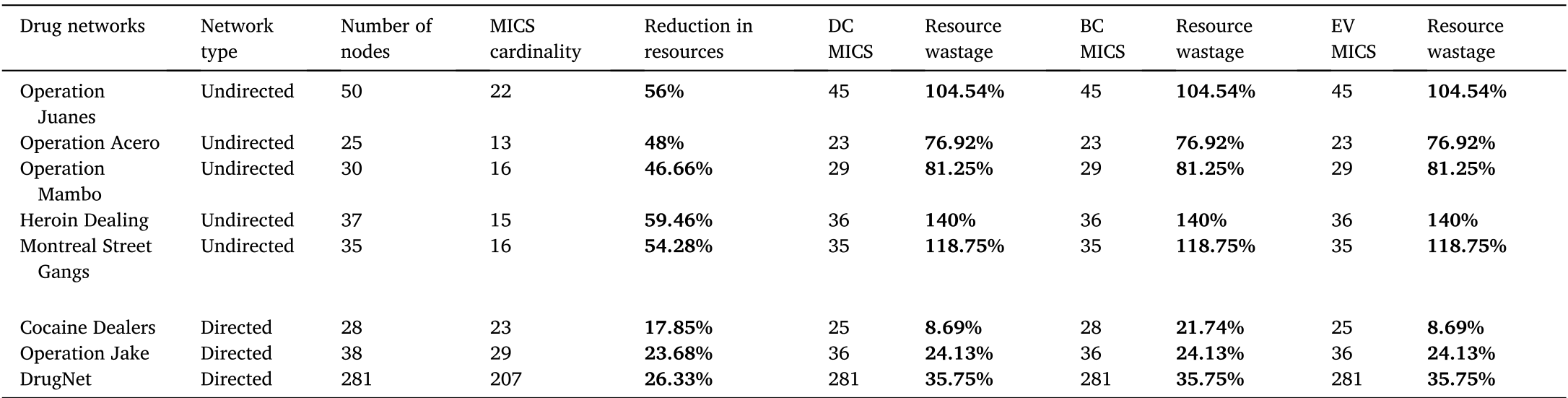 Table 4 highlights the dramatic reduction in resources and massive wastage in standard SNA approaches.
Critical Insight: The Global vs. Local View
Why does the Identifying Code approach win? Standard SNA is "Local": It looks at how "important" a node is in its immediate neighborhood. Identifying Codes are "Global": They look at the architecture of the entire network to see how nodes distinguish one another.
The paper proves a counter-intuitive truth: To monitor a network perfectly, you must monitor a mix of important AND unimportant individuals. Focusing only on the "Big Fish" creates redundant coverages and massive blind spots.
Conclusion and Future Outlook
This work moves beyond identifying "Key Players" to "Unique Coverage." While the model assumes a "snapshot" of a network, the introduction of Augmented Identifying Codes shows how agencies can adapt to new intelligence.
Limitations: The model currently assumes "Twin-free" graphs. If two suspects have the exact same connections, no amount of external monitoring can tell them apart—they must be treated as a "super-node" until more data is found.
For future surveillance, the message is clear: Stop looking for the most popular criminal. Start looking for the one who completes the code.