
Beyond Citations: Decoding the Duality of Influence in Academic Social Media
12468_Identifying influential scholars in academic social media platforms.
This paper explores multi-dimensional measures for identifying influential scholars on academic social media platforms like Mendeley. It introduces "R-Index" and readership-based metrics for academic impact alongside network centrality norms for social influence, finding that these two dimensions are largely uncorrelated.
Executive Summary
TL;DR: This study investigates how to identify influential scholars on Mendeley by decoupling "Academic Influence" (what you know) from "Social Influence" (who you reach). By analyzing a massive real-world dataset, the authors demonstrate that being a top-tier scientist does not automatically make one a social hub within the research community—a finding that challenges how we perceive authority in the digital age.
Positioning: This work is a foundational exploration into Altmetrics and Social Network Analysis (SNA), bridging the gap between traditional bibliometrics and modern social media dynamics.
The "Impact" Paradox: Why Citations Aren't Enough
For decades, the h-index has been the gold standard for academic prestige. However, citations are "slow" data—they take years to accumulate. In the era of Web 2.0, platforms like Mendeley provide "fast" evaluative metadata: bookmarks, reads, and social tags.
The authors argue that measuring a scholar requires looking at two distinct axes:
- Academic Influence: The scientific visibility of their work.
- Social Influence: Their structural position in the professional network (capacity to control information flow).
Methodology: The Two Pillars of Ranking
1. Academic Influence (The Readership Lens)
The paper introduces three metrics based on readership rather than citations:
- Total Readers: Overall reach.
- Max Readers/Paper: Identification of "one-hit wonders" or seminal breakthrough works.
- R-Index: A scholar has an R-Index of n if they have n papers with at least n readers.
2. Social Influence (The Centrality Lens)
To measure social power, the authors construct Local Graphs based on specific research queries (e.g., "Machine Learning"). They use LDA (Latent Dirichlet Allocation) to ensure the network is topically relevant.
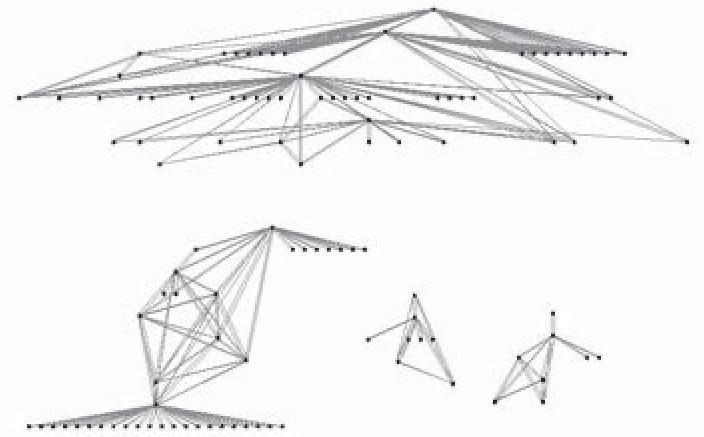 Fig 2: Visualization of disconnected subgraphs representing distinct research communities.
The social score is calculated using the Euclidean Norm of three normalized centrality measures:
- Degree: Involvement level.
- Closeness: Speed of information access.
- Betweenness: Control over information "bridges."
Key Insights from the Mendeley Dataset
The study utilized a dataset of ~1 million profiles. The results shattered the assumption that academic and social impacts are synonymous.
The Seniority Gap
Academic influence is dominated by Senior Scholars (Professors make up 81% of the top 1% by R-Index). However, social influence profiles look very different, often favoring active, well-connected younger researchers who facilitate networking and group memberships.
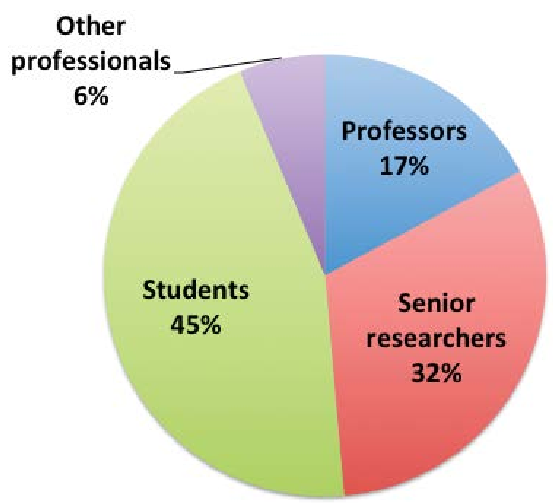 Fig 1: General distribution of academic status vs. the top 1% results discussed in the study.
The Zero Correlation Finding
Perhaps the most striking result is found in Tables IV, V, and VI. The Spearman correlation between academic metrics and social centrality norms is consistently near zero.
| Measure Comparison | Correlation (HCI Community) |
|---|---|
| Social Norm vs. Total Readers | 0.0457 |
| Social Norm vs. R-Index | 0.0599 |
This quantification proves that being a scientific authority does not imply being a social influencer.
Critical Analysis & Conclusion
Takeaway: If you want to find an expert for a committee, look at the R-Index. If you want to spread a "Call for Papers" or viralize a new methodology, find the Social Influencers.
Limitations: The study is limited to Mendeley. As the authors note, an influential scientist in the real world might simply not be active on social platforms. Furthermore, the model treats co-authorship and "adding a contact" with equal weight, which ignores the depth of professional relationships.
Future Outlook: The future of scholar ranking lies in Multi-Platform Aggregation. By combining data from ResearchGate, Twitter (X), and Mendeley, we can create a "Universal Scholar Score" that reflects both intellectual depth and community breadth.