
UserRank: Mapping Influence in Healthcare Social Networks Through Content and Context
Identifing influential users in an online healthcare social network
The paper introduces UserRank, a hybrid ranking algorithm designed to identify influential users in online healthcare social networks (OHSNs). By integrating link analysis with content-based features—specifically response immediacy and message similarity—the method effectively isolates key opinion leaders in forums like MedHelp.
TL;DR
Identifying "who matters" in an online health crisis is a matter of public safety. This paper introduces UserRank, a novel algorithm that goes beyond simple link-counting to identify influential users in healthcare forums. By analyzing how fast people respond and how relevant their content is, UserRank outperforms classic algorithms like PageRank in finding the true voices of authority during events like the H1N1 outbreak.
Background & Motivation
During a pandemic, online forums like MedHelp become battlegrounds for information. Identifying influential users is critical for two reasons:
- Combating Rumors: Detecting those spreading panic or misinformation.
- Information Propagation: Leveraging "super-users" to spread accurate health advice.
The authors argue that existing methods like PageRank are "content-blind." They treat every reply as an equal endorsement of authority, which isn't true in a medical context where a reply might be spam or a tangential argument.
Methodology: The Hybrid UserRank Approach
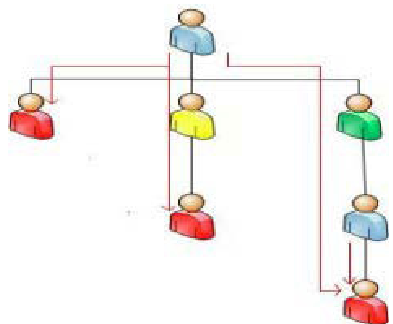
The core innovation lies in how the social network is constructed. Instead of a simple flat graph, the authors use a Thread-Tree Structure.
1. The Thread-Tree Logic
In a forum, if User A replies to User B, and User C replies to User A, User C is indirectly influenced by User B. The authors model these paths to capture the flow of authority across a conversation.
2. The Weighting Strategy
UserRank calculates edge weights using two primary "Inductive Biases":
- Immediacy (Temporal/Structural Distance): Users who reply faster or are "closer" in the thread structure (shorter path length) are assigned higher influence.
- Content Similarity: Using the Vector Space Model and Cosine Similarity, the algorithm checks if the reply actually matches the topic of the original post.
The final influence score is an iterative computation where authority flows through these weighted edges, similar to PageRank but enriched with "qualitative" weights.
Experimental Battleground: Swine Flu & Alcoholism Forums
The researchers tested UserRank against PageRank, In-Degree, and Out-Degree centrality across two datasets: a small, specialized Swine Flu community and a larger Alcoholism forum.
Key Findings
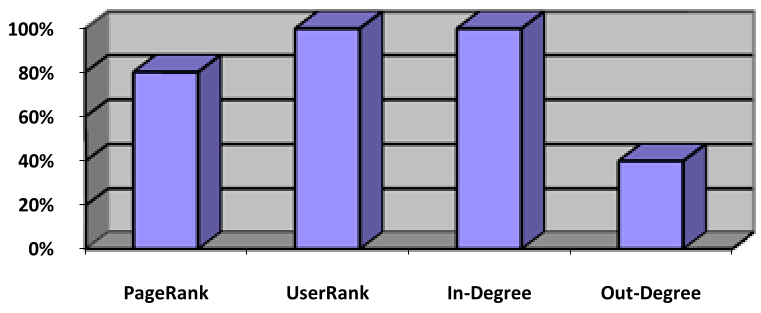
- Precision Supremacy: In the Swine Flu forum, UserRank identified the top influential users with perfect precision (100%), while PageRank and Out-Degree lagged significantly.
- Scalability: In the larger Alcoholism forum (737 threads), UserRank maintained its lead in precision, proving it can handle higher volumes of social data.
Critical Insight: Why UserRank Wins
The failure of Out-Degree (ranking users by how much they post) highlights a common misconception: Activity does not equal influence. A user who spams every thread with irrelevant comments has a high out-degree but near-zero actual influence. UserRank's "Content Similarity" filter naturally suppresses these noisy actors, while the "Immediacy" factor rewards experts who are actively engaged in the core of the discussion.
Conclusion & Future Directions
The paper successfully demonstrates that in specialized domains like healthcare, topology is not enough. By weaving content analysis into link analysis, UserRank provides a more "human-centric" view of influence.
Future Work: The authors suggest incorporating Language Models (the precursors to today's LLMs) to better understand the sentiment and nuance of posts, potentially distinguishing between a "helpful expert" and a "highly-engaged contrarian."
Editor's Note: This work serves as a foundational bridge between classical Graph Theory and modern Semantic Analysis, establishing a blueprint for identifying authority in the age of digital misinformation.