
Identifying Influential Users: Beyond Follower Counts to Content Interaction
Identifying Influential Users by Their Postings in Social Networks
This paper introduces a topic-specific graph model for social networks to identify influential users based on their posting content rather than just follower counts. It identifies two key influential roles: "Starters," who trigger discussions, and "Connecters," who act as bridges between different clusters of posts, validated through Twitter experiments.
TL;DR
This research shifts the focus of social network influence from "who you follow" to "how your posts impact others." By modeling posts as nodes in a graph and distinguishing between Starters (conversation catalysts) and Connecters (structural bridges), the authors provide a more granular way to identify true opinion leaders within specific topics.
Context: Published at ACM Hypertext 2012, this work occupies a critical spot in the evolution of social network analysis, moving from static social graphs to dynamic, content-driven interaction graphs.
The Problem: The "Follower" Fallacy
In the early days of social media analysis, influence was a numbers game—the more followers you had, the more influential you were. However, this approach has two fatal flaws:
- Topic Agnosticism: A celebrity might have millions of followers but zero influence on a technical discussion about "iOS 5."
- Interaction Blindness: It ignores the "silent" influence where a post is read and inspires a new, independent post without a direct @-reply.
Methodology: The Post-Based Graph Model
The authors build a Directed Acyclic Graph (DAG) where the relationships are defined by time and content.
1. Defining the Links
- Explicit Relationships: Direct retweets, replies, or shares.
- Implicit Relationships: These are the "hidden" links. If User B posts about a topic shortly after User A, and the content is highly similar (measured via Tanimoto coefficient and keyword matching), an edge is drawn from B to A.
2. Identifying the Roles
The model identifies four types of nodes:
- Roots: The originators.
- Followers: Those who respond.
- Starters: Nodes with high in-degree (many followers) but low out-degree (they don't just follow others).
- Connecters: The rare nodes that link two different "starter" clusters together.
 Note: The study emphasizes that a single user can play multiple roles over the lifespan of a topic.
3. Three Metrics for Influence
To find these users, the authors use:
- Degree Measure: Simple counting of weighted in-degrees and out-degrees to find Starters.
- Shortest-Path Cost Measure (SCM): Measures how much the connectivity of the graph "suffers" if a specific node is removed.
- Graph Entropy Measure (GEM): Uses structural information theory to find nodes that contribute the most to the "organization" of the network.
Experiments & Results: The "Steve Jobs" Case Study
The model was tested using Twitter data from October 2011, focused on the death of Steve Jobs and the release of the iPhone 4s.
Data Cleaning and Transformation
Social media is noisy. The authors applied several "clean-up" steps:
- Merging nodes: If a user posts three times in a row, it's one "thought" (one node).
- Removing low-weight edges: Relationships based on very low content similarity are discarded to focus on high-impact interactions.
Performance Comparison
The results showed that Graph Entropy (GEM) was the most robust metric for finding influential Starters, identifying them much earlier in the rankings than the Shortest-Path method.
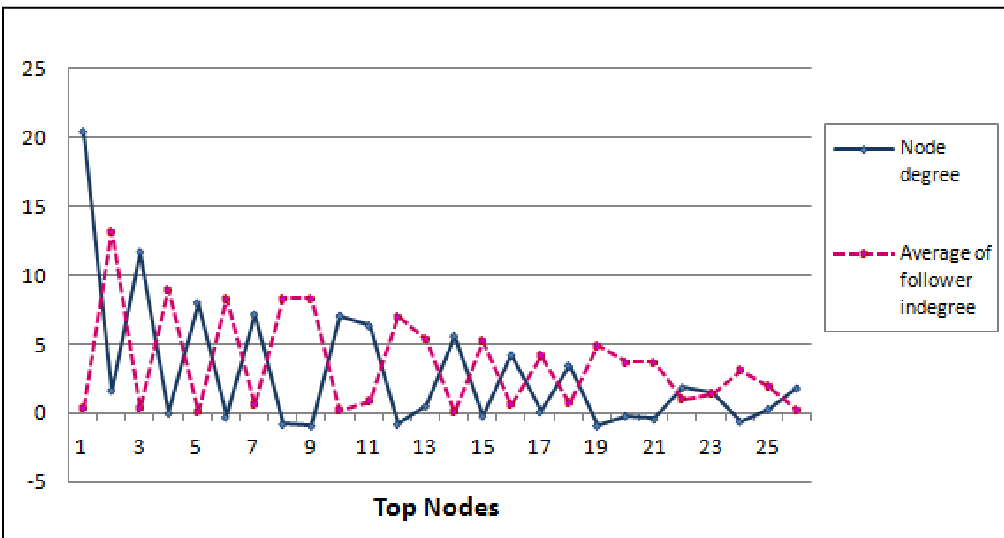 Figure: The trade-off between In-degree and the popularity of followers in the Starter identification process.
Critical Analysis & Conclusion
Takeaway
The distinction between a Starter and a Connecter is the most valuable contribution here. In modern marketing or sentiment analysis, finding the "Connecter"—the person who links the "Tech Enthusiast" cluster to the "General News" cluster—is often more valuable than finding a Starter who is only influential within a single silo.
Limitations
The keyword-based Tanimoto similarity is a product of its time (2012). Today, this would be replaced by Vector Embeddings (BERT/RoBERTa) to capture semantic meaning rather than just matching words like "Siri" or "Apple." Additionally, the model assumes a friend/follower restriction for implicit links, which may not capture "viral" discovery across the "For You" pages of modern algorithms.
Future Impact
This work paved the way for Information Cascade research and current Social Listening tools. It reminds us that influence is not a static score, but a dynamic structural property of a conversation.