
Identifying Key Players: Bridging Diffusion Probability and Network Topology
Identifying Key Player Using Sum of Influence Probabilities in a Social Network
The paper introduces a new probabilistic approach for identifying key players in social networks by measuring the "Sum of Influence Probabilities" (KPP/SIP). By extending edge weights to path-based successful diffusion probabilities, the method accurately identifies nodes that maximize influence spread, aligning closely with the Independent Cascade Model (ICM).
TL;DR
This research addresses a fundamental question in social network analysis: Who is the most influential person in a group? By moving beyond static centrality (like how many friends someone has) and focusing on the probability of successful diffusion, the authors propose the KPP/SIP (Sum of Influence Probabilities) metric. It provides a mathematically elegant way to predict influence spread that aligns perfectly with the Independent Cascade Model (ICM) without the computational overhead of heavy simulations.
The Core Motivation: Why Influence is Not Just Centrality
In the past, identifying "Key Players" relied on Centrality Measures (degree, betweenness) or Network Efficiency (how much the network breaks if a node is removed). However, these methods don't capture the "viral" nature of information.
The authors argue that a true key player in a marketing or social context is defined by the expected number of adoptions they can trigger. Prior work by Kempe et al. used greedy algorithms to solve this, but this paper seeks a more direct, probabilistic formula to define influence through paths.
Methodology: From Paths to Probabilities
The innovation of this paper lies in how it calculates the Influence Probability () between two arbitrary nodes, A and B.
1. The Single Path Case
If information only travels through one sequence of people, the probability of success is the product of all edge weights (individual influence probabilities) along that path.
2. The Multi-Path Case (General Case)
In a real social network, A can influence B through multiple independent paths. The authors treat these paths as independent events. The probability that B accepts an innovation from A is minus the probability that none of the paths succeed:

3. The KPP/SIP Metric
Finally, the Key Player is defined as the node that maximizes the sum of its influence probabilities over all other nodes in the network:
eq i} P_{ij}$$ ## Experimental Validation: Consistency with SOTA The authors tested their method against two main baselines: 1. **Network Efficiency**: They found that efficiency-based methods often pick different nodes (e.g., $v_1$ vs $v_2$). The paper argues that $v_2$ is the correct choice because it aligns with the actual diffusion dynamics of the Independent Cascade Model. 2. **Greedy Approximation (Kempe et al.)**: Using a real-world dataset from the **arXiv database** (187 researchers), they compared their KPP/SIP to the widely-accepted stochastic approximation method. 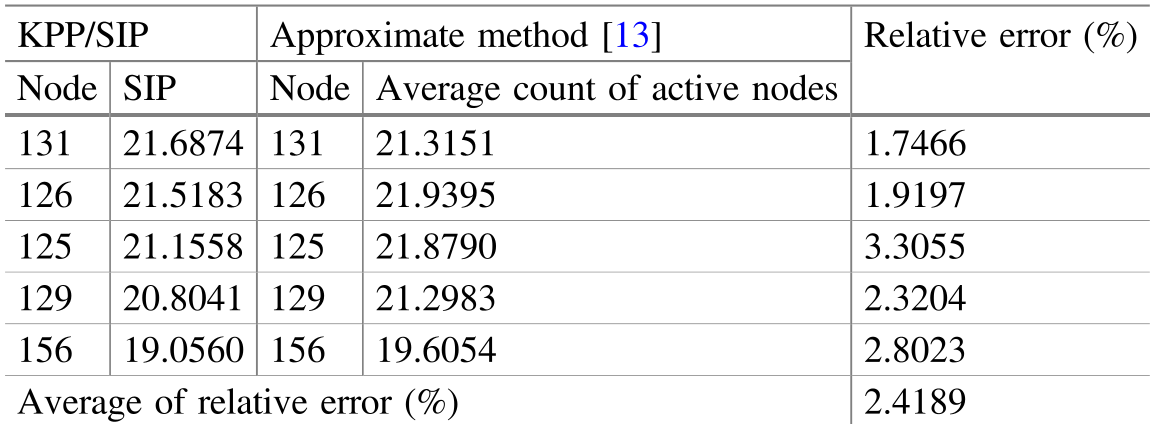 **Key Result**: The nodes identified by KPP/SIP were identical to those found by the approximate method, with a **relative error of only 2.4%**. This proves that the SIP formula is a highly accurate proxy for expected influence spread. ## Critical Insight & Practical Value For practitioners in **Digital Marketing** or **Public Relations**, this research moves away from the "black box" of simulations. Instead of running 10,000 diffusion iterations, one can theoretically calculate the SIP to identify the "Opinion Leader" most likely to maximize the total number of adoptions. ### Limitations and Future Work While the formula is elegant, calculating all possible paths between every pair of nodes in a massive network (e.g., millions of Facebook users) remains computationally expensive ($NP-hard$ in complex graphs). Future research could focus on **Pruning Heuristics**—ignoring paths with negligible probabilities to speed up the SIP calculation for large-scale applications. ## Conclusion The KPP/SIP method successfully bridges the gap between **structural network analysis** and **probabilistic diffusion modeling**. It provides a clear, justifiable metric for influence that is both easy to understand and highly consistent with established diffusion theories.