
f-PageRank: Pinpointing the Architecture of Influence in Business Processes
Identifying Key Resources in a Social Network Using f-PageRank
This paper introduces f-PageRank, a modified PageRank algorithm specifically designed for business process mining to identify key resources in social networks. By incorporating frequency-based weights into the traditional eigenvector centrality measure, it achieves superior identification of influential performers in work-handover scenarios compared to standard centrality metrics.
Executive Summary
In any industrial or business environment, not all participants are created equal. Some performers are "Key Resources"—the linchpins whose efficiency determines the throughput of the entire system. This paper presents f-PageRank, an evolution of the famous Google PageRank algorithm tailored for the nuances of Business Process Social Networks. By moving beyond simple connectivity to "frequency-aware" influence, the authors provide a powerful tool for predicting bottlenecks and optimizing organizational structures.
The "Single Link" Fallacy: Why Standard SNA Fails Business
Social Network Analysis (SNA) typically treats a link as a simple boolean: Does A talk to B? However, in a factory or an office, the intensity of interaction matters immensely. Traditional algorithms like HITS or Degree Centrality often fail in "Exchange Networks" where power is derived from the volume of work-handover rather than just the number of distinct contacts.
The authors argue that the original PageRank—while revolutionary—suffers from the same limitation: it views every link as a single vote. In a business process, if Sara hands over work to Mike 50 times, Mike's influence (and potential to be a bottleneck) is significantly higher than if she handed it over once.
Methodology: Introducing f-PageRank
The core innovation is the horizontal integration of communication frequency into the eigenvector centrality calculation.
The Mathematical Intuition
The traditional PageRank formula distributes "authority" across out-links. The f-PageRank formula (shown below) introduces the term , representing the frequency of the transfer:
By incorporating the count of interactions, the algorithm ensures that the "vote" passed from a node is proportional to how often that specific path is actually traversed.
Visualizing the Difference
The paper contrasts a standard social network graph with a frequency-based one. As seen in the architecture below, the thickness of edges (representing frequency) completely changes the "center of gravity" of the network.
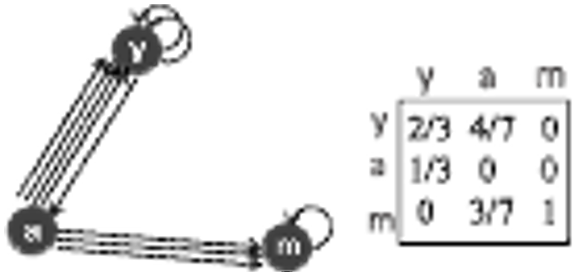 Figure 1: Adjacency matrix reflecting frequency-weighted handovers.
Experimental Validation: From Repairs to Steel
The authors tested f-PageRank against two distinct datasets: a IT repair log (LD-1) and a massive 380,000-event log from a Korean steel manufacturer (LD-2).
Key Findings in Steel Manufacturing
In the steel manufacturing case, the network is split between two physical factories. Standard metrics highlighted machines with the most connections (M-AN1). However, f-PageRank identified M-CRC and M-ANA as the true "Key Resources."
Why? Because although they might have fewer distinct connections, they handle the "Cold Rolling" and "Annealing" activities—the most frequent and bridge-forming steps in the process.
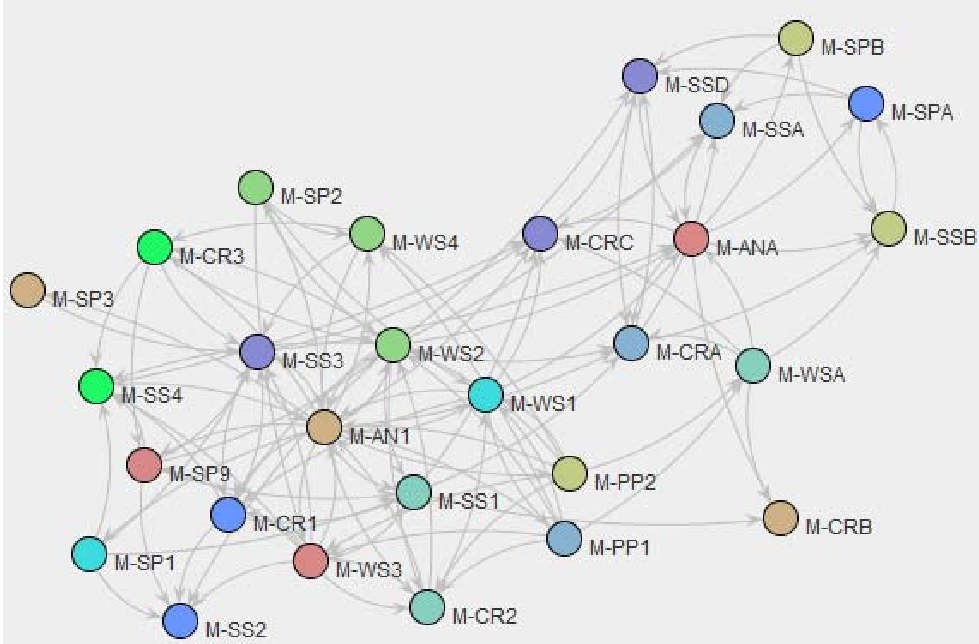 Figure 2: The Social Network of a Steel Manufacturing Process, where edge thickness indicates the frequency of work handovers.
Performance Comparison
The table below demonstrates how f-PageRank creates a more nuanced ranking compared to traditional In-degree or Betweenness metrics, which often result in "ties" (identical scores) for different resources.
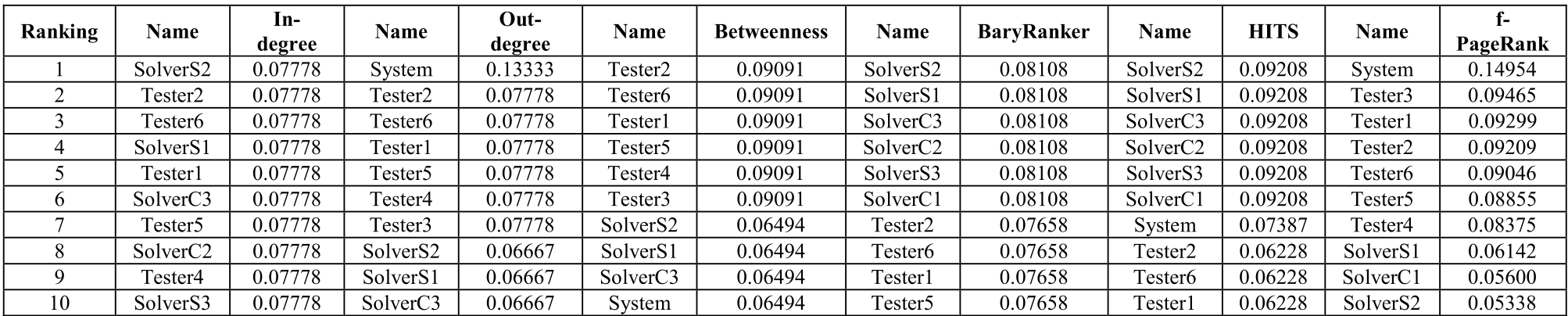 Figure 3: Comparative Analysis of Centrality Measures. Note how f-PageRank provides distinct, high-resolution importance scores.
Deep Insight: Beyond Connectivity to Bottleneck Diffusion
The most profound takeaway is the link between centrality and vulnerability. In the PageRank concept, an "important node contributes more." In a process environment, a "bottlenecked node passes the bottleneck."
By identifying nodes with high f-PageRank scores, managers can target these specific resources for:
- Predictive Maintenance: Since these machines/performers are used most frequent, they are the first to wear out.
- Dynamic Resourcing: Adding parallel capacity to these specific "Key" areas provides the highest ROI for overall process speed.
Conclusion
f-PageRank successfully bridges the gap between Graph Theory and Process Mining. It proves that in the world of industrial operations, repetition is a form of importance. While the current model is robust, future iterations incorporating "waiting times" could allow us to map not just the flow of work, but the flow of delays across a global enterprise.