LUCI: Deciphering the Hidden Pulse of Social Leadership Through Interaction Dynamics
Identifying Leaders and Followers in Online Social Networks
This paper introduces the Longitudinal User Centered Influence (LUCI) model, a novel framework for identifying leaders and followers in online social networks using only interaction timestamps and identifiers. By clustering users into Introvert Leaders, Extrovert Leaders, Followers, and Neutrals, the model achieves a classification accuracy of 90.3% on the Everything2 dataset and provides consistent topological insights on a large-scale Facebook dataset.
TL;DR
Researchers have developed the Longitudinal User Centered Influence (LUCI) model to categorize social media users into four distinct roles: Introvert Leaders, Extrovert Leaders, Followers, and Neutrals. By analyzing when and with whom users interact—rather than what they say—the model achieves over 90% accuracy in identifying community administrators and reveals that true influence isn't just about having the most friends.
Motivation: Why Structural Topology Isn't Enough
In the quest to find "influencers," most algorithms look at the Friendship Graph (who follows whom). However, having 500 friends doesn't mean you talk to them. Traditional metrics like PageRank or Degree Centrality often fail because they treat every connection as equally active. Furthermore, privacy regulations increasingly block "Content Mining" (reading messages), leaving researchers with a "black box" of interaction timestamps.
The authors of this paper argue that leadership is a behavioral trait visible in the rhythm of interaction. Do you post because your friends messaged you (Follower), or do you post regardless of the noise (Leader)?
The Methodology: Deconstructing the LUCI Model
The LUCI model is built on an evolution of the Friedkin-Johnsen (FJ) Influence Model. It treats a user's outgoing activity at time as a linear combination of two key factors from time :
- Ego Coefficient (): The "Self-Drive." High means your current activity is highly correlated with your own past activity. You are a self-starter.
- Network Coefficient (): The "Social Response." High means your activity is a reaction to the messages you received.
The Four Personas
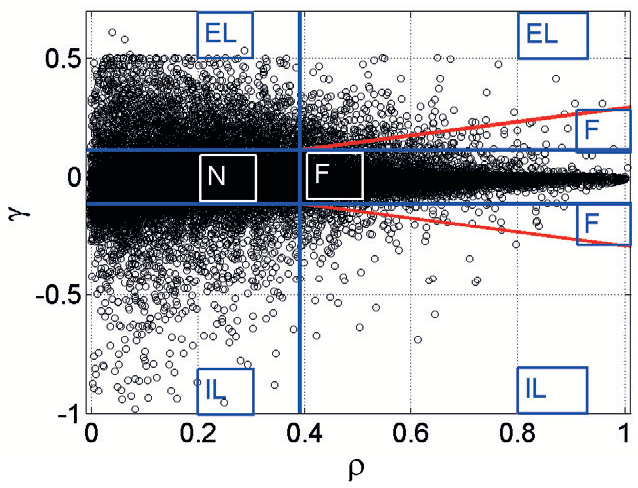
By plotting these coefficients on a 2D plane and using Kernel K-Means clustering, the researchers identified four distinct behaviors:
- Extrovert Leaders (EL): High Ego (), Low Network (). They are highly active and self-motivated.
- Introvert Leaders (IL): Negative Ego (), Low Network (). They are "sought-after" hubs; they talk little but receive much.
- Followers (F): High Network (), Zero Ego (). Their activity is almost entirely dictated by their neighbors.
- Neutrals (N): Both coefficients near zero. Disengaged observers.
Experimental Evidence: From Everything2 to Facebook
Validation on Everything2
The researchers first used Everything2, a wiki-like community where "administrators" provided a clear ground truth for "leaders."
- Performance: Using only the two coefficients, a Support Vector Machine (SVM) achieved an AUC of 90.3%.
- Insight: This proved that interaction metadata is a high-fidelity signal for formal social roles.
Scaling to Facebook
Applying LUCI to a dataset of 3 million Facebook users, the authors looked for topological "fingerprints" of these roles:
- Degree Distribution: Extrovert Leaders have the most friends (highest degree), but surprisingly, Introvert Leaders are better "shortcuts" in the network.
- Clustering Coefficient: Followers belong to tight-knit "cliques" (high clustering), whereas leaders act as bridges between diverse, unconnected communities (low clustering).
Critical Insights: The "Introvert Leader" Paradox
One of the most striking findings is the role of the Introvert Leader. While marketing firms usually chase "Extrovert Leaders" (the loud, high-degree influencers), the Introvert Leaders actually possess the smallest average shortest path length to the rest of the network. They are the true "hubs" of the small-world phenomenon—highly reachable and authoritative, even if they aren't the most talkative.
Conclusion and Future Outlook
The LUCI model provides a privacy-preserving, computationally efficient (linear complexity) way to map social influence.
- Takeaway: Identifying leaders is a longitudinal problem, not a static one.
- Limitations: The model currently uses fixed time windows (6 months); future work needs to address how these roles shift as social networks age.
- Application: This has profound implications for "Viral Marketing" and "Public Health Campaigns," suggesting that targeting the "responsive" followers might be less effective than targeting the "self-driven" extrovert leaders or the "authoritative" introvert leaders.