
Structuring Longevity: How Social Communities Persist Over Decades
Identifying Long Lived Social Communities Using Structural Properties
The paper proposes a two-step framework for identifying and extending long-lived community evolutions in dynamic social networks. Using axiomatic foundations and a heuristic merging process, it successfully tracks communities in DBLP and LiveJournal for up to 21 years, validating structural changes through thematic topic modeling.
TL;DR
Researchers have developed a robust two-step pipeline to track how social communities evolve over decades. By first capturing "tight" microscopic changes and then merging them using structural heuristics, they can predict a community's lifespan using only membership data. The study reveals that a community's size and internal interaction density are the "vital signs" that determine if it will last for a year or a quarter-century.
Problem & Motivation: The Fragmentation Trap
In dynamic social networks like DBLP (co-authorship) or LiveJournal (blogs), communities are not static. They grow, shrink, merge, and sometimes "go dark" for a period.
Traditional methods often fall into two traps:
- The Rigidity Trap: Event-based frameworks (Birth, Death, Split) are often too strict. If a community doesn't perfectly match a predefined "event" between two timestamps, the tracker breaks.
- The Threshold Dilemma: If you set a high similarity threshold, you get short, fragmented "stubs." If you set it too low, you merge unrelated groups into a "Frankenstein" community.
The authors' insight was to separate stability from continuity. Use a strict rule to find stable stubs, then use a relaxed, "fuzzy" vector-based approach to bridge the gaps.
Methodology: The Two-Step Evolution
The framework operates in two distinct phases:
Phase 1: Finding the "Tight" Stubs
Using an axiomatic approach, the researchers identify communities at each time step and link them if their Jaccard Coefficient () exceeds a threshold (e.g., 0.2). This ensures that each small segment of the evolution is "strongly connected" in terms of membership.
Phase 2: Heuristic Merging (The M-Value)
To form longer evolutions, the authors look at the "tail" of one stub and the "head" of another. They represent membership as vectors and calculate the Cosine Similarity (). This determines if two stubs are likely the same community that simply underwent a transition or was missed by the clustering algorithm in a single time step.
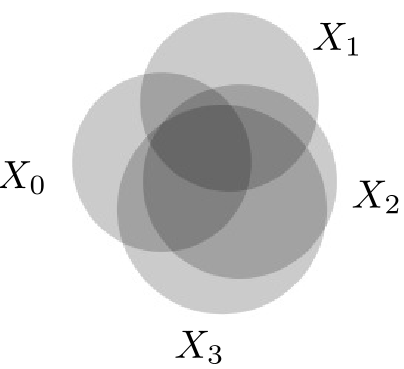 Figure 1: The early stages of an evolution, showing the intersection and "core" membership used for feature extraction.
Experiments: Validating with "Topic Morphing"
How do we know a 21-year structural chain is actually the same community? The authors validated their results by looking at the content of the papers (DBLP) and blog posts.
They found that communities naturally "morph." For instance, one DBLP community shifted from Functional Programming to Fuzzy Neural Systems and finally to Asynchronous Cellular Arrays over two decades. Remarkably, the structural algorithm tracked this shift without ever reading a single word of the papers.
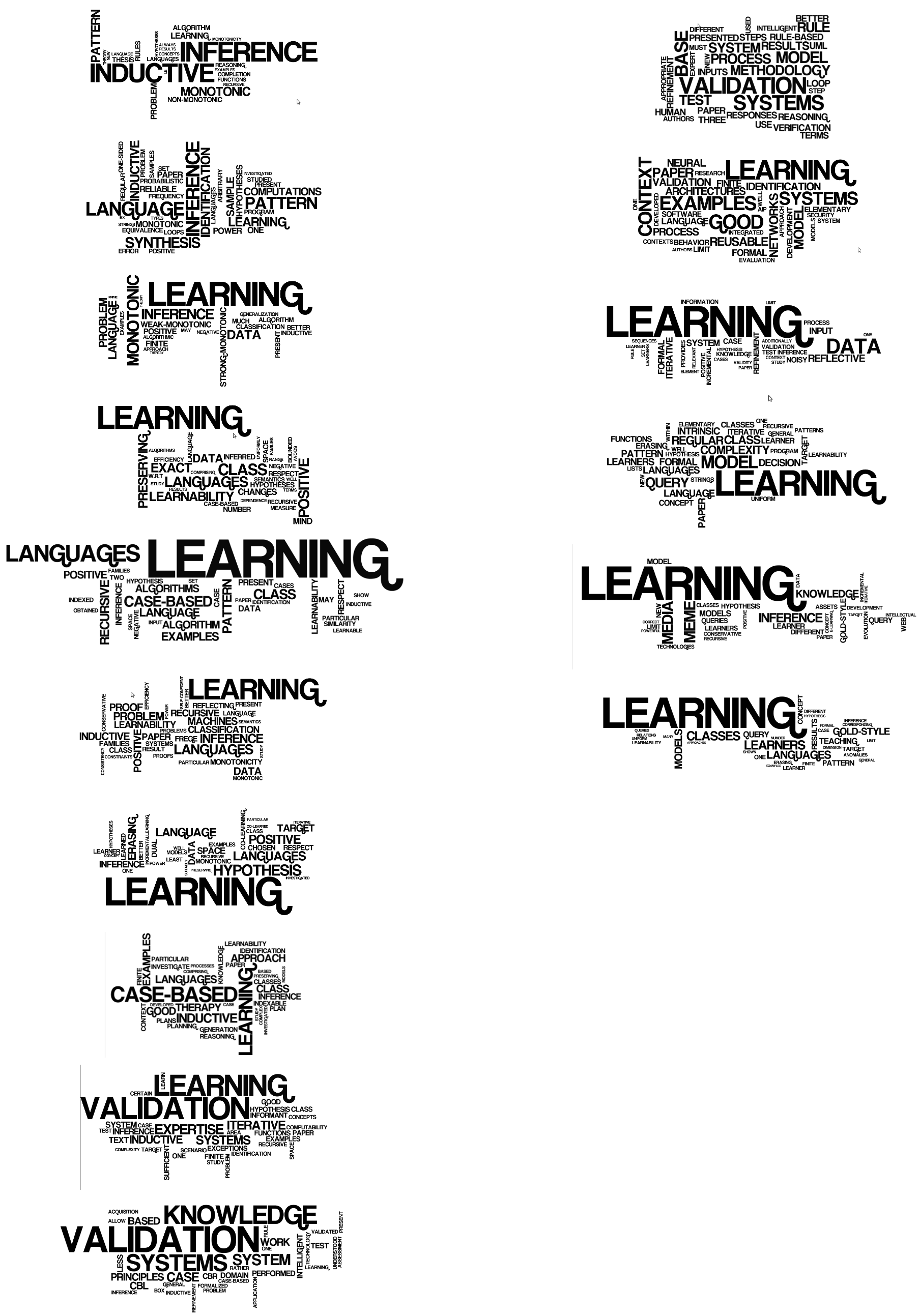 Figure 2: Word clouds demonstrating the thematic consistency and gradual shift across merged evolutions.
Predicting the Future: What Makes a Community Last?
By extracting 79 structural features from the first four time steps of a community’s life, the authors used linear regression to predict its total lifespan.
| Rank | Feature | Description |
|---|---|---|
| 1 | Density | High internal interaction vs. external noise. |
| 2 | Size | Larger initial communities tend to be more resilient. |
| 3 | Stability | The rate of turnover (who leaves vs. who stays). |
Interestingly, in "merged" evolutions, Density becomes the single most predictive factor. A community that interacts intensely among its members is far more likely to survive shifts in technology or interest.
Critical Analysis & Conclusion
This work demonstrates that structural patterns are a proxy for thematic intent. You don't need to know what people are talking about to know how long they will continue talking.
Limitations: The model relies on discrete time windowing (), which can be arbitrary. If the time window is too large, you lose the "micro-dynamics"; if it's too small, the network is too sparse.
Takeaway: For platform designers and social scientists, the lesson is clear: if you want to build a long-lived digital community, focus on interaction intensity and initial scale. These are the structural precursors to decades of relevance.