
Identifying Dementia through Spontaneous Speech: An Automated Acoustic-Linguistic Approach
Identifying Mild Cognitive Impairment and mild Alzheimer's disease based on spontaneous speech using ASR and linguistic features I
This paper presents a method for the early detection of Mild Cognitive Impairment (MCI) and mild Alzheimer’s disease (mAD) by analyzing spontaneous speech. The core approach utilizes a combination of automatically extracted acoustic features (via ASR) and linguistic markers (from transcripts), reaching a state-of-the-art F1-score of 86.3% in distinguishing healthy controls from patients.
TL;DR
Researchers at the University of Szeged have developed a highly accurate (up to 86% F1-score) automated system to detect Mild Cognitive Impairment (MCI) and Alzheimer's (mAD) from spontaneous speech. By fusing Automatic Speech Recognition (ASR) for hesitation analysis with Natural Language Processing (NLP) for semantic uncertainty detection, the study provides a blueprint for non-invasive, scalable mental health screening.
The Diagnostic Gap: Why Current Screens Fail
Early diagnosis of Alzheimer's is critical for treatments that decelerate cognitive decline. However, current tools like the Mini-Mental State Examination (MMSE) are often "too blunt" to catch the subtle shifts of Mild Cognitive Impairment (MCI). While MRI and PET scans are accurate, they are prohibitively expensive for mass screening.
The authors' central insight is that cognitive decline manifests in speech long before it appears in clinical tests. People with MCI don't just forget words; their "speech planning" breaks down, leading to distinct temporal gaps (hesitations) and a shift toward vague, uncertain language.
Methodology: Listening Between the Words
The researchers recorded 75 subjects (25 Control, 25 MCI, 25 mAD) performing three tasks: immediate recall of a film, a description of their previous day, and a delayed recall. They processed this data through two distinct pipelines:
1. The Acoustic Pipeline (Temporal Fingerprinting)
Instead of standard ASR that focuses on word accuracy, the authors used a Phoneme-level Deep Neural Network (DNN). This allowed them to track:
- Hesitation Ratios: The frequency and duration of silent vs. filled pauses (e.g., "uhm", "err").
- Phoneme Distribution: Tracking "confused" phonemes like schwas or "m" sounds that often mask hidden hesitations.
2. The Linguistic Pipeline (Semantic Uncertainty)
The speech was transcribed and analyzed for:
- Uncertainty Markers: Frequency of words like "maybe," "somehow," or "I guess."
- Memory Activity: Explicit mentions of forgetting ("I can't remember").
- Morphology: Reduced vocabulary richness and part-of-speech distributions.
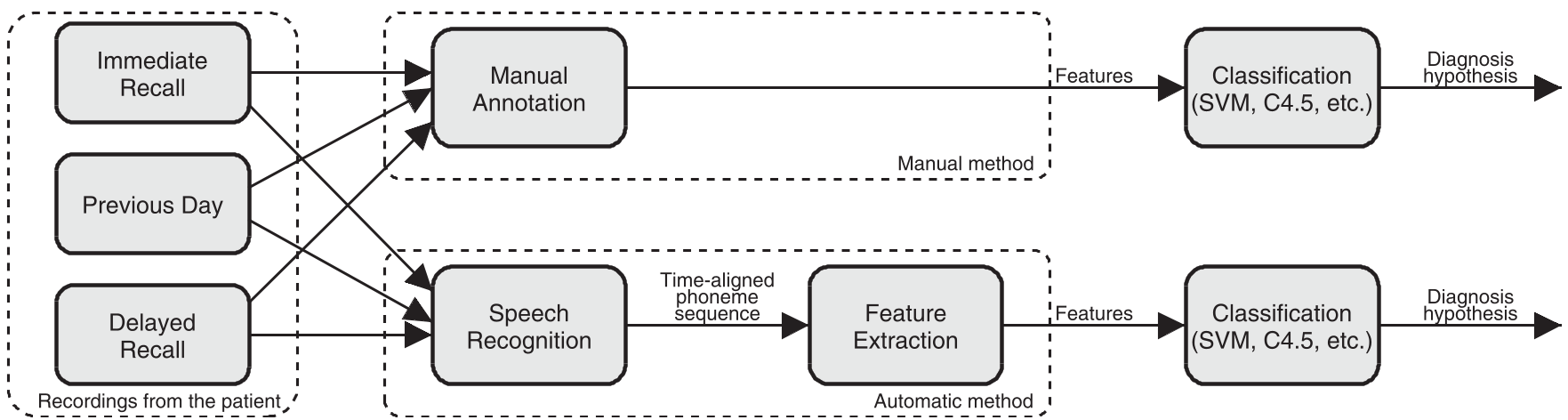 Figure 1: The automated workflow for acoustic marker extraction and subject classification.
Experimental Results: The Power of Fusion
The results confirm that while acoustic or linguistic features are strong individually, their fusion is the key to differentiating complex stages of dementia.
| Feature Set | 3-class Accuracy (Control/MCI/mAD) | 2-class F1 (Control vs. Patients) |
|---|---|---|
| Acoustic (Extended) | 58.7% | 78.3 |
| Linguistic (All) | 60.0% | 83.2 |
| Combined (Late Fusion) | 69.3% | 86.3 |
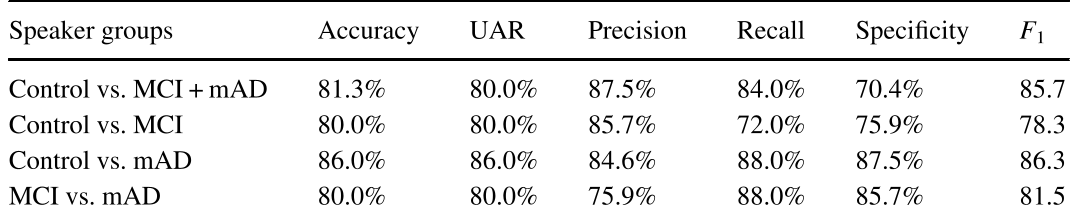 Table: Binary classification results showing high performance for differentiating MCI from mAD (80% accuracy).
Critical Insights:
- The "Uncertainty" Signal: Semantic features were surprisingly powerful. Patients often verbalize their mental effort ("something similar to an owl"), which serves as a massive red flag for MCI.
- MCI vs. mAD: The system successfully distinguished MCI from mAD with 80% accuracy, a feat that usually requires a comprehensive medical battery.
Critical Analysis & Future Outlook
The study’s strength lies in its holistic approach—it doesn't just listen to what is said, but how it is planned and delivered.
Limitations:
- Dataset Size: With 75 participants, the model is a successful pilot but requires validation on larger, more diverse populations.
- Transcription Dependency: The linguistic analysis currently relies on manual transcripts. While the authors suggest "Spoken Term Detection" could automate this, it remains a hurdle for real-time deployment.
Future Impact: This work paves the way for "Voice-based Screening" apps. Imagine a world where a 5-minute conversation with a smartphone could provide a risk score for Alzheimer's, prompting early intervention years before significant memory loss occurs.