
Beyond the Survey: Decoding Weibo Motives Through Digital Traces
Identifying the Motives of Using Weibo from Digital Traces
This study investigates the usage motives of Weibo among Chinese undergraduate students by analyzing "digital traces" rather than traditional self-reports. Using the NLPIR 2020 framework and Tf-idf text analysis, the researchers identified entertainment, information seeking, and stress alleviation as primary drivers for platform engagement.
TL;DR
Why do people really use social media? While most researchers ask users directly, this study analyzes what they actually post. By examining the "digital traces" of over 30,000 Chinese students on Weibo, the researchers moved beyond the biases of self-reporting to discover that entertainment and academic stress are the twin engines driving undergraduate SNS engagement.
The Problem: The "Social Desirability" Filter
In psychology, we often encounter the Social Desirability Bias. When asked "how much time do you spend seeking entertainment on Weibo?", a student might underestimate their usage to avoid looking lazy. Traditional questionnaires are subjective snapshots that often miss the messy, objective reality of digital behavior. This study aims to bridge that gap by looking at what students actually say when they think no one is "surveying" them.
Methodology: From Crawling to Coding
The researchers developed a systematic framework to convert raw social media data into psychological insights.
- Data Extraction: They sampled 200 university accounts to find 30,677 verified undergraduate users, collecting nearly 160,000 tweets.
- Preprocessing: Using the Jieba library for Chinese word segmentation and removing "stop words" to isolate meaningful content.
- Keyword Weighting: Implementing Tf-idf (Term Frequency-Inverse Document Frequency) to identify words that are not just frequent, but uniquely representative of the users' interests.
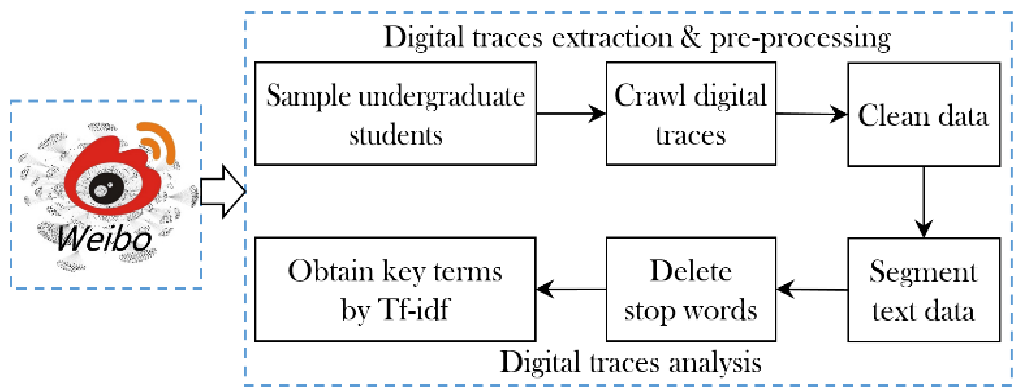 Figure 1: The systematic pipeline from raw Weibo traces to psychosocial motives.
The "Why": Why Weibo?
The results revealed a fascinating hierarchy of motives:
- The Entertainment King: Terms like Red packet (红包), Lottery draw (抽奖), and Haha (哈哈) dominated the Tf-idf rankings. This confirms that Weibo is, first and foremost, a space for digital "leisure" and dopamine-seeking.
- The Academic Pressure Cooker: Unlike Twitter, Weibo serves a massive academic function in China. The prevalence of Postgraduate entrance exam (考研) and Effort (努力) shows students use the platform for information seeking regarding their future careers and to project a "diligent" persona.
- The 10:00 PM Syndrome: Data showed a surge in activity at 10 PM. This suggests that Weibo acts as a "stress reliever" right before sleep—a digital decompression chamber after a day of study.
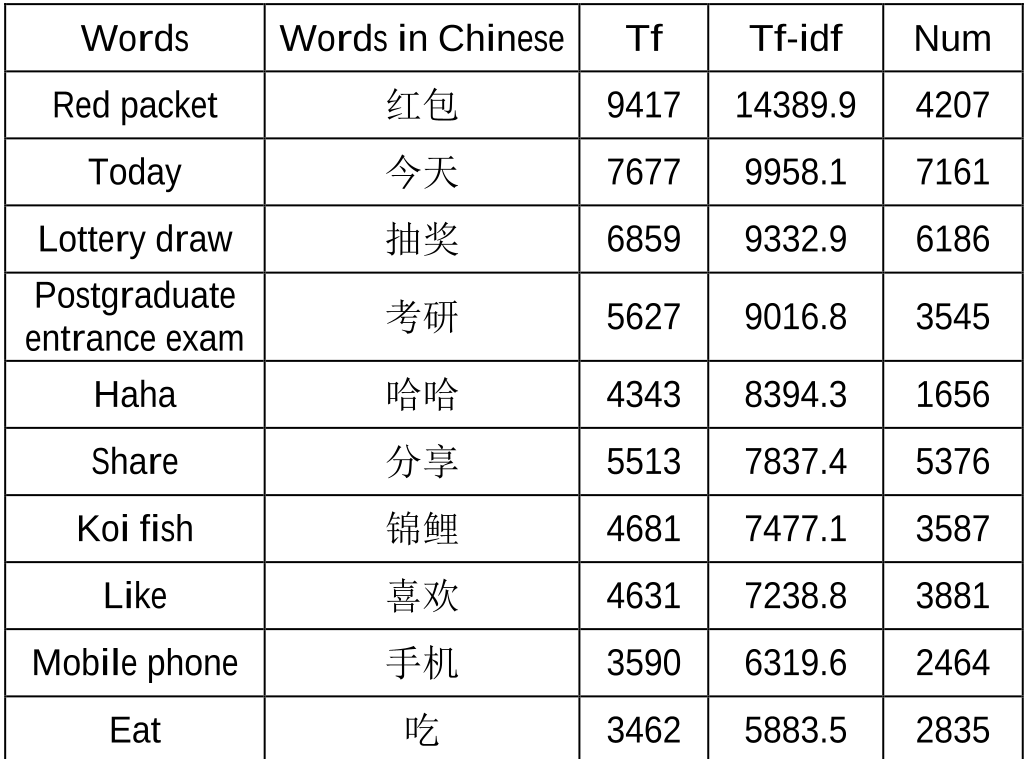 Table 1: Top 10 words by Tf-idf weight, showcasing the dominance of entertainment and life-event terms.
Critical Insight: The "Hardworking" Identity
A particularly nuanced finding is that even though "Entertainment" was the primary driver, users frequently posted about "Effort" and "Coming on." This points to Impression Management—users are consciously crafting a digital identity that balances fun with societal expectations of hard work.
Conclusion & Future Outlook
This work underscores a shift in social science: the move from asking to observing. While the study acknowledges limitations—such as focusing only on text and ignoring the rich data in pictures and videos—it proves that our digital footprints are often more honest than our self-reflections.
As we look forward, the challenge remains ethical: how do we leverage this "objective truth" found in digital traces without violating user privacy or enabling predatory targeted advertising?
Takeaway: Your digital traces are a window into your soul—or at least your subconscious motives. For undergraduate Weibo users, that soul is one part "Lottery Draw" and one part "Postgraduate Exam Stress."