
Beyond Static Influence: Identifying Opinion Leaders in Time-Varying Commercial Networks
Identifying Opinion Leaders in Time-Dependent Commercial Social Networks
The paper introduces a novel framework for identifying opinion leaders in "Time-Dependent Commercial Social Networks" (CSNs). By modeling influence as a time-varying weighted directed graph, the authors propose a Temporal Valued Centrality (TVC) metric that combines structural eigenvector centrality with the fluctuating business value of social interactions.
TL;DR
Static snapshots of social networks mask the true dynamics of influence. This paper proposes a Temporal Valued Centrality (TVC) framework that identifies opinion leaders by blending structural graph theory (Eigenvector Centrality) with the temporal "business value" of user actions. It shifts the focus from who is central generally to who drives value when it matters most.
Background: The Shift to Viral Marketing
In the Web 2.0 era, consumers have moved from passive content absorbers to active "partners in value creation." Word-of-mouth (WoM) now dictates purchasing behavior more than traditional advertising. However, not all voices carry the same weight. Identifying "Opinion Leaders"—individuals who ignite information epidemics—is the holy grail for Viral Marketing.
The Core Problem: The Illusion of Static Centrality
Most current Social Network Analysis (SNA) assumes time invariance. If a user was highly active two years ago, a static model might still rank them as a leader today.
The authors identify two fatal flaws in prior work:
- Structural Blindness: Ignoring the types of actions (sharing vs. just viewing).
- Temporal Decay: Treating the network topology as a fixed map rather than a shifting landscape.
Methodology: Mapping Time and Value
The authors represent a Commercial Social Network (CSN) as a time-varying weighted directed graph.
1. Action-Based Weighting
Instead of simple binary links, the weight () between user and is determined by an influence matrix . For example, if User posts (AT1) and User subsequently comments (AT4), the influence weight is higher than if merely views the post.
2. The Eigenvector Approach
The model adopts the "mutually reinforcing" principle: a node is important if it is connected to other important nodes.

3. Temporal Footprints and Business Value
The innovation lies in Temporal Valued Centrality (TVC). The CSN's "Business Value" () is sliced into chunks () corresponding to specific time intervals ().
The final score for a user is the weighted sum across all objects () and time intervals:

Experimental Insight: Static vs. Temporal
The paper presents a compelling simulation comparing a static model to their TVC model.
- The Scenario: User creates a post in the first interval but disappears later. Users and drive engagement and "business value" in subsequent intervals.
- Static result: User is crowned the top leader simply for being the origin node.
- TVC result: Focus shifts to and , who were active when the "business value" chunks were higher.
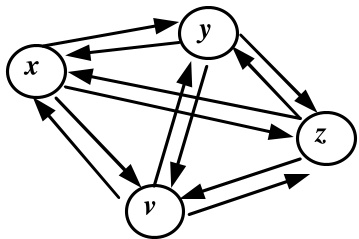 Fig 1. The overall weighted directed graph G(o) representing the influence story.
Critical Analysis & Conclusion
The strength of this work is its pragmatism. It recognizes that for a corporation, an "influencer" is only as good as the business value they generate in a specific campaign window.
Limitations:
- Externalities: The model is "closed-world"; it doesn't account for offline interactions or cross-platform influence (e.g., an influencer moving from X/Twitter to Instagram).
- Trust Factors: It assumes influence is positive, ignoring the "negative influencer" effect.
Future Outlook: By integrating this TVC model with modern Automated Machine Learning (AutoML), companies could theoretically adjust their marketing spend in real-time, pivoting their focus to different opinion leaders as different "business value chunks" are activated throughout a product launch.