
PNI: Teaching Autonomous Agents to "Read the Room" through Data Mining
Identifying prohibition norms in agent societies
This paper introduces the Prohibition Norm Identification (PNI) algorithm, a data mining-driven approach for agents in multi-agent systems to discover social norms through observation. It leverages association rule mining (WINEPI) to identify behavioral regularities that precede sanctions, achieving faster norm convergence in open societies compared to purely utilitarian models.
TL;DR
In open agent societies, norms aren't always written in the code—they are lived. This paper presents a framework that allows agents to identify prohibition norms (what not to do) by observing social sanctions. By treating sanctions as "special events" and applying a modified association rule mining algorithm, agents can autonomously learn, adapt to, and verify the rules of their environment.
Background: Beyond Hard-Coded Rules
In traditional Multi-Agent Systems (MAS), norms are often viewed from the top-down: constraints hard-coded by designers. However, in dynamic digital environments like Second Life or complex e-commerce platforms, norms shift. An agent might enter a "virtual park" and not know whether littering is allowed or if tipping is expected.
The authors argue that for agents to be truly autonomous, they must possess an internal Norm Engine capable of bottom-up identification. The key insight? Sanctions are the signals of norms. When an agent is yelled at or penalized, it’s a data point indicating a boundary was crossed.
Methodology: The PNI Algorithm
The core of the architecture is the Prohibition Norm Identification (PNI) algorithm. It operates on the logic of "Social Monitoring."
- Observation: The agent records sequences of actions (e.g.,
eat -> litter -> move). - Filtering: It identifies "signalling events" (sanctions like a "yell" or "disapproval shake").
- Episode Extraction: It looks at the window of events immediately preceding the sanction.
- Data Mining: Using a modified WINEPI algorithm, it calculates the Occurrence Probability (OP) of specific actions within those episodes. If "littering" happens before 90% of sanctions, it becomes a Candidate Norm.
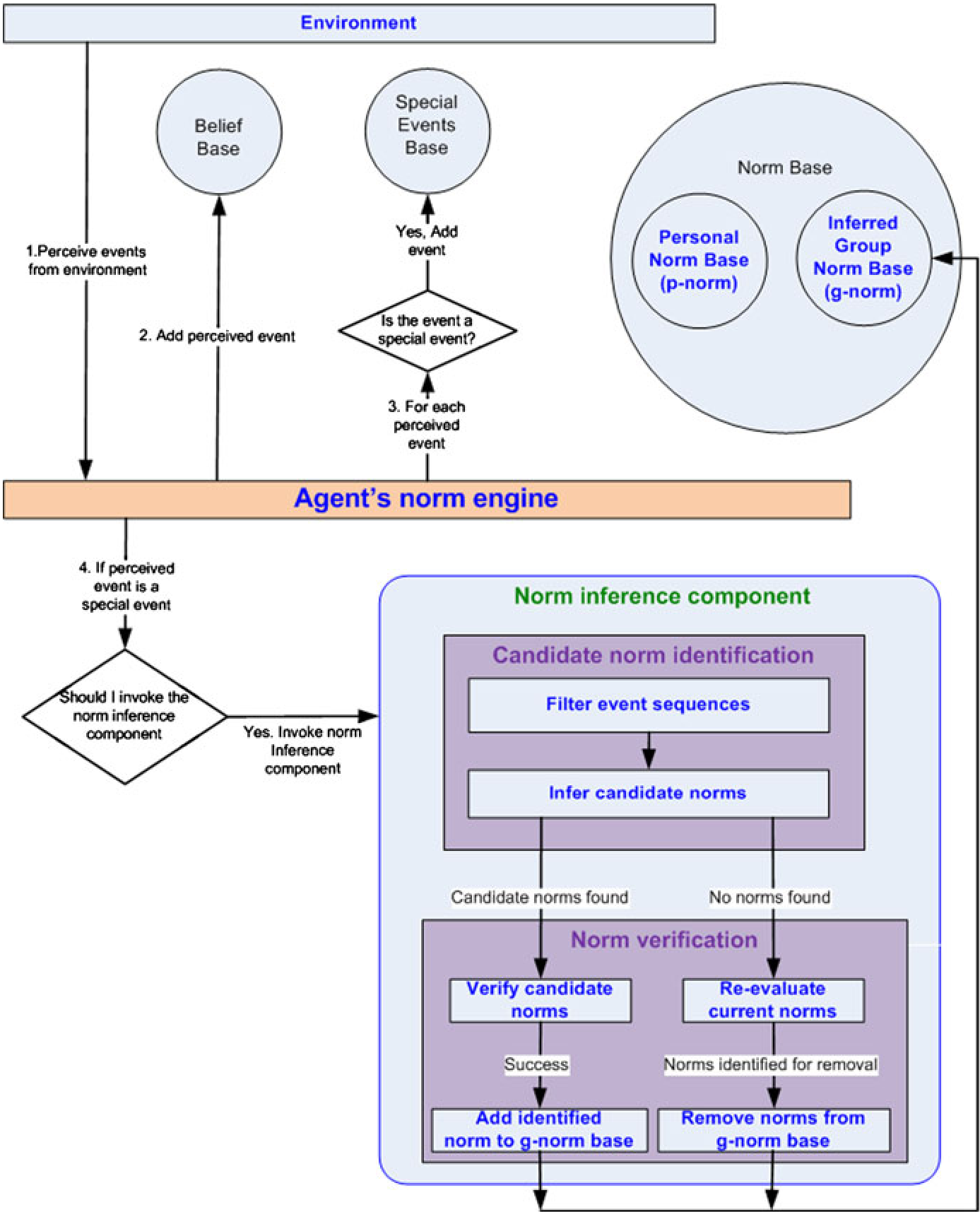 Figure 1: The Norm Engine Architecture, showing the flow from event perception to g-norm (group norm) storage.
The "Permutation with Repetition" Twist
Unlike standard association mining (like the Apriori algorithm) which treats items as a bag of words, PNI cares about order and repetition. It identifies that litter -> move -> sanction is a different pattern than move -> litter -> sanction, which is crucial for pinpointing the exact cause of a penalty.
Experiments and Results
The authors tested the framework in a simulated park with three agent types: Litterers, Non-Litterers, and Punishers.
Rapid Convergence through Social Verification
Identifying a candidate norm is only half the battle. The agent then verifies it by asking others. The study found that if agents can verify norms with any peer (who may have already learned the norm) rather than just the punisher, the society reaches norm consensus significantly faster.
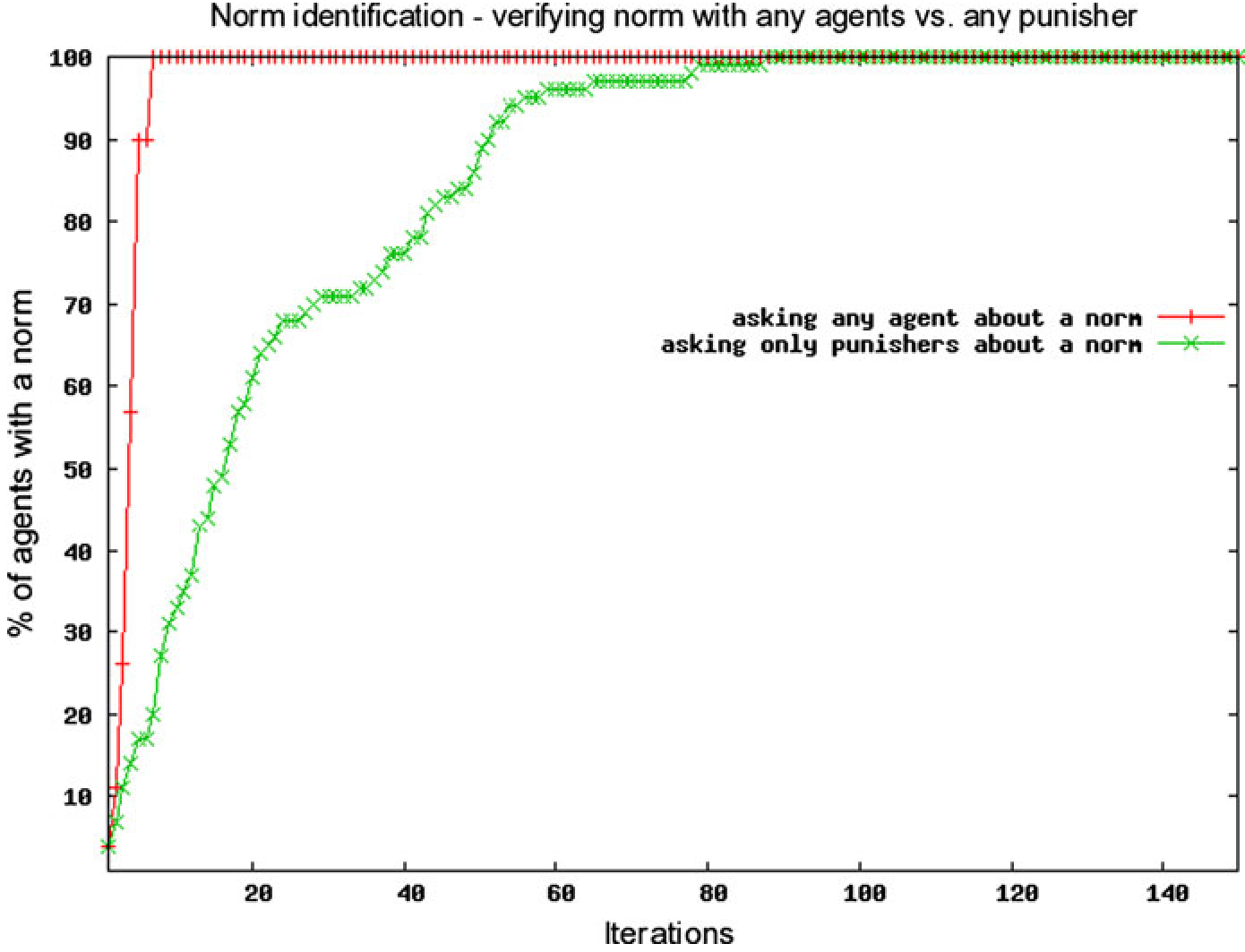 Figure 2: Impact of social verification on norm identification speed.
The Hybrid Advantage
The most striking result came from comparing "Utilitarian" agents (who only maximize their own reward) with "Hybrid" agents (who use PNI). Hybrid agents identified the norm and modified their behavior before the utility-only agents, leading to a much faster separation of the society into stable, norm-abiding groups.
Critical Analysis & Conclusion
Takeaway
The PNI framework proves that Association Rule Mining—a staple of 90s data science—remains a powerful tool for agent cognition. It provides a formal bridge between raw observation and deontic logic (Prohibitions/Obligations).
Limitations
- Delayed Sanctions: The current window-based approach fails if a sanction occurs long after the act (e.g., a speeding ticket arriving in the mail days later).
- Signal Interpretation: The framework assumes agents can perfectly categorize a "yell" as a sanction. In the real world, distinguishing a sanction from a greeting is a non-trivial NLP/CV problem.
Future Outlook
This work lays the groundwork for agents that can move between different cultures or "shards" of a metaverse, carrying a history of norms and adapting their "Signalling Threshold" to stay socially compliant in new contexts.