
Identifying Prominent Life Events on Twitter: Beyond Global News to Personal Milestones
Identifying Prominent Life Events on Twier
This paper presents a machine learning framework to automatically identify five prominent personal life events (Getting Married, Having Children, Starting School, Death of a Parent, and Falling in Love) on Twitter. By combining user, content, semantic, and novel interaction features, the authors achieve high classification performance, reaching F1-measures between 0.84 and 0.92 across different event types.
TL;DR
While most social media research focuses on "world events" like earthquakes or elections, this paper pivots to the personal. The researchers developed a system to detect five major life milestones—marriage, childbirth, starting school, falling in love, and the death of a parent—using Twitter data. By training classifiers on a mix of content, semantic, and user behavior features, they achieved up to a 0.92 F1-measure, proving that our digital footprints hold clear markers of our most significant human experiences.
Background: The Digital Reflection of Life Scripts
In psychology, "Life Scripts" represent the culturally shared expectations of the timing and order of major life events. As we move our lives online, these scripts manifest as tweets and posts. However, detecting a "wedding" tweet isn't as simple as searching for the word "wedding"—it requires distinguishing a photographer's advertisement from a bride's personal reflection. This study situates itself as a bridge between psychological theory and automated data mining.
The Problem: Noise and Subjectivity
The authors identify three core hurdles:
- Noise: Millions of tweets use keywords like "love" or "school" in mundane or metaphorical contexts.
- Lack of Data: There was no standard, publicly available "Life Event" dataset for researchers to use.
- Ambiguity: What defines an "event"? Is "going to the shops" an event? The lack of formal grounding makes manual annotation difficult.
Methodology: A Multi-Dimensional Feature Approach
To solve this, the team didn't just look at keywords (unigrams). They engineered four distinct categories of features:
- Content Features: N-grams, sentiment polarity, and readability indices.
- User Features: Social standing (follower counts) and platform age.
- Semantic Features: Mapping entities to DBpedia and Wikipedia concepts (e.g., linking the word "knot" to the concept of "Wedding").
- Interaction Features (Novel): Measuring the "Interaction Ratio"—do people who never talk to you suddenly tweet at you when you post something? This "unusual interest" is a strong proxy for a major life update.
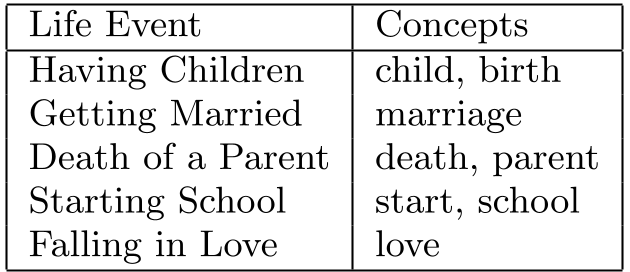 Figure 1: Root concepts used to seed the dataset for different life events.
Experiments and Insights: What Actually Tells a Story?
The researchers tested J48 (Decision Trees), Naive Bayes (NB), and SVM. Surprisingly, Content Features (specifically n-grams) remained the heavyweight champions of classification.
Key Findings by Event:
- Death of a Parent (F1: 0.92): High discriminative power in words like "passed," "expired," and "sad." Interestingly, this was the only category where Interaction Features significantly boosted performance, suggesting that condolences trigger unique social network behaviors.
- Getting Married (F1: 0.91): Success relied heavily on metaphors like "tying the knot" and semantic links to "wedding" protocols.
- Falling in Love (Lowest F1: 0.84): This proved the hardest to detect. The language of "love" is so pervasive and vague on Twitter that even human annotators struggled to identify true "falling in love" events vs. general affection.
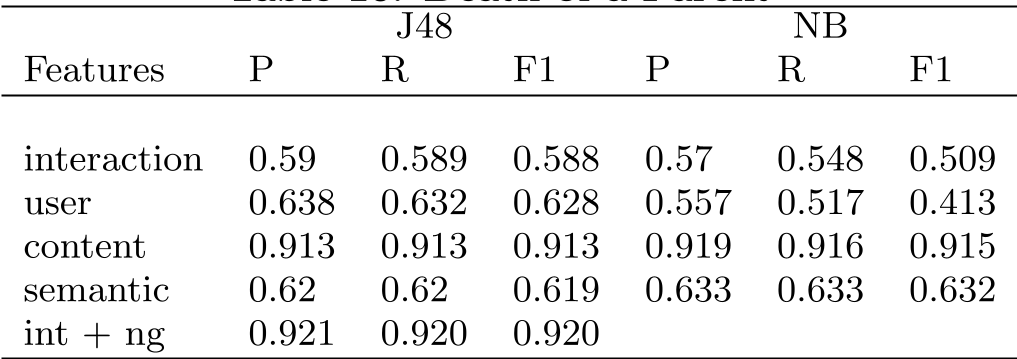 Figure 2: Performance metrics showing the strength of content and interaction combinations.
Critical Analysis & Conclusion
This work provides a foundational dataset for what the authors call "Digital Personhood."
The Twitter vs. Facebook Dilemma: The study found interaction features were less useful on Twitter than expected. The authors hypothesize that Twitter is a "broadcast" platform of weak ties, whereas Facebook—populated by close "offline" friends—would likely show much stronger interaction spikes during life events.
Takeaway: The success of the F1-scores (mostly >0.90) demonstrates that personal milestones are not just "private" memories anymore; they are statistically significant patterns in the global data stream. For developers of AI biographers or targeted marketing systems, this suggests that high-precision event detection is possible without needing "deep" neural networks, provided the feature engineering is grounded in human psychology.
Future Work: The next frontier involves moving beyond "single tweet" detection to "thread" analysis—identifying an event by the conversation it generates over several days.