
Beyond the Feed: Leveraging Diversity and Cognition to Tame Social Media Chaos
Identifying relevant social media content: Leveraging information diversity and user cognition
The paper introduces a novel framework for identifying relevant social media content on Twitter by leveraging information diversity and user cognitive measures. It proposes a greedy iterative clustering method based on Shannon's entropy to select item sets that match a target diversity level, outperforming traditional recency-based methods in user engagement and memory recognition.
TL;DR
Researchers from Rutgers and Microsoft Research have developed a method to pick the "best" tweets on any topic by focusing on Diversity rather than just Recency. By using an entropy-based clustering algorithm, they proved that users find content more engaging and easier to remember when it is either very focused (highly homogeneous) or very broad (highly heterogeneous).
The "Recency" Trap in Social Search
We have all been there: you search for a breaking news event on Twitter, only to be met with thousands of near-identical retweets or a chaotic mess of unrelated noise. The industry standard—sorting by the most recent post—fails to capture the rich dimensions of social media, such as geographic span, author authority, or thematic depth.
The authors argue that "relevance" isn't a static property. Instead, it is a cognitive experience. To solve the retrieval problem, we must bridge the gap between the Information Space (the data) and the Cognition Space (how our brains process that data).
Methodology: The Diversity Spectrum
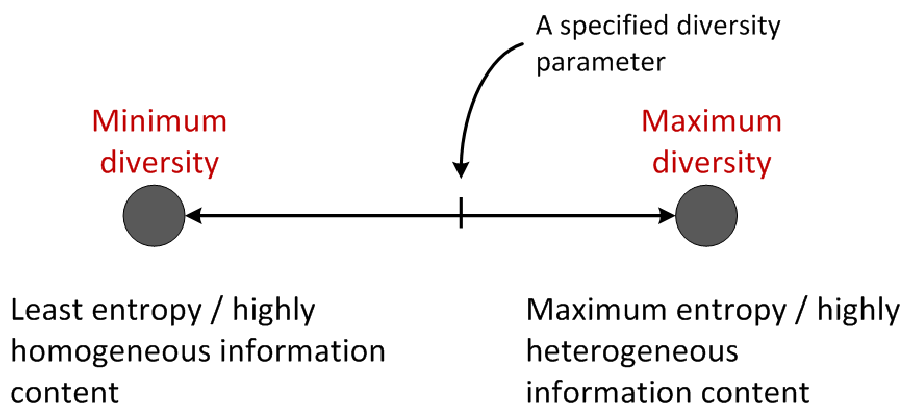
The core of this paper is the Diversity Spectrum. The authors define diversity using Shannon’s Entropy, moving from Homophily (highly similar content) to Heterophily (diverse, widespread perspectives).
1. Attribute Weighting
They identified nine key attributes of a tweet, including:
- Diffusion: Is it a retweet?
- Authority: How many followers does the author have?
- Thematic Association: What is the primary category (Politics, Sports, etc.)?
2. Entropy Distortion Minimization
Rather than a simple filter, they use a Greedy Iterative Clustering technique.
- Step 1: Start with a seed tweet.
- Step 2: Add a new tweet that results in a set whose total entropy is closest to the target diversity value ().
- Step 3: Repeat until the desired set size (e.g., 10 tweets) is reached.
Experimental Results: The U-Shaped Surprise
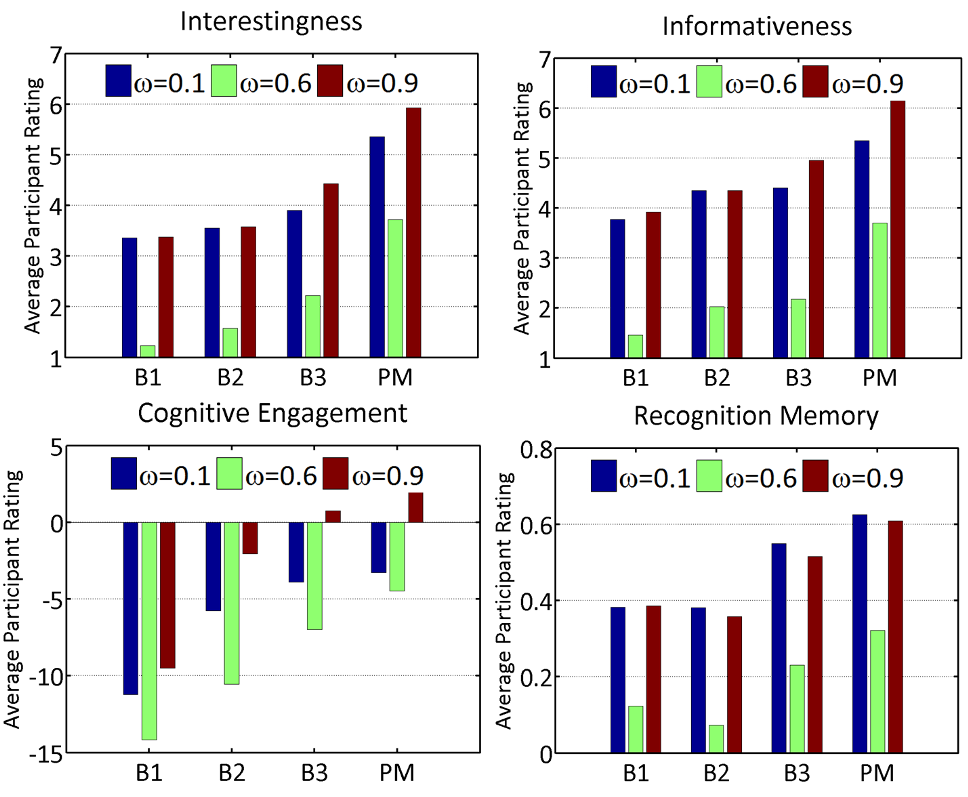
The researchers tested their algorithm against the "Firehose" of 1.4 billion tweets. They conducted a user study measuring Interestingness, Informativeness, Cognitive Engagement (how fast time seems to pass), and Recognition Memory.
The results were striking:
- Performance Leap: The proposed method beat the "Most Recent" baseline by roughly 30% across all cognitive metrics.
- The U-Shaped Curve: Users didn't like "middle-ground" diversity. They preferred sets that were either extremely focused on one perspective or offered a massive variety of views.
Critical Insight: Why Does Diversity Matter?
Why did users prefer the extremes?
- Low Diversity (Homophily): Provides deep, specialized knowledge. It reduces "cognitive dissonance" in a noisy environment like Twitter.
- High Diversity (Heterophily): Provides high "information gain." It satisfies curiosity by showing the global conversation from Finance to Politics.
The "middle ground" likely felt like "clutter"—too different to be cohesive, but too similar to be exploratory.
Conclusion & Future Work
This work shifts the focus of social search from "what is new" to "what is cognitively optimal." For future systems, this suggests that search UIs should perhaps include a "diversity slider," allowing users to intentionally plunge into a specialized niche or soar over a broad landscape of opinions.
Limitations: The study was conducted on Twitter (now X) and focused on textual data. As we move toward a video-first social web (TikTok, Reels), applying these entropy measures to visual and auditory "diversity" remains an open, exciting challenge.