
Identifying the Right Person: Why Sound Trumps Spelling in Social Networks
Identifying the Right Person in Social Networks with Double Metaphone Codes
This paper introduces a phonetic distance-based clustering method to solve the "homophonic name" disambiguation problem in social networks. By integrating the Double Metaphone algorithm with Affinity Propagation clustering, the authors successfully identify individuals whose names are spelled differently but pronounced identically (e.g., "Chris" vs. "Kris").
TL;DR
In modern social networks, the same person often appears under different aliases due to spelling variations—think John vs. Jon or Kris vs. Chris. This paper proposes a sophisticated clustering framework that uses Double Metaphone codes and Affinity Propagation to group these "homophonic names." The result is a system that identifies individuals based on how their names sound rather than how they are written, achieving a 94% completeness score in identifying homophone groups.
The Problem: The "Cat vs. Kat" Dilemma
In the era of Big Data (characterized by the 7 V's: Value, Variety, Velocity, Veracity, Volume, Variability, and Visualization), data quality—or Veracity—is a persistent hurdle.
The core issue is that human language is messy. Traditional string matching algorithms (like Levenshtein Distance) measure how many characters you need to change to turn one word into another. While useful for typos, it fails miserably at phonetic equivalence. For example:
- "Mare" vs. "Tear": Low edit distance, but they sound different.
- "Canada" vs. "Keneda": Moderate edit distance, but they sound identical.
Existing systems, particularly in academic co-authorship networks, use ORCID to solve this, but the broader web has no such universal ID. We need a way to link "Justin" and "Justyn" automagically.
Methodology: The Science of Sound
The authors propose a multi-stage pipeline that bridges graph theory and linear algebra.
1. Phonetic Encoding (Double Metaphone)
Unlike the classic Soundex algorithm (which often fails on edge cases like "cat" vs "kat"), the Double Metaphone algorithm produces two phonetic codes for a string to account for various pronunciations and spellings.
2. The Phonetic Distance Metric
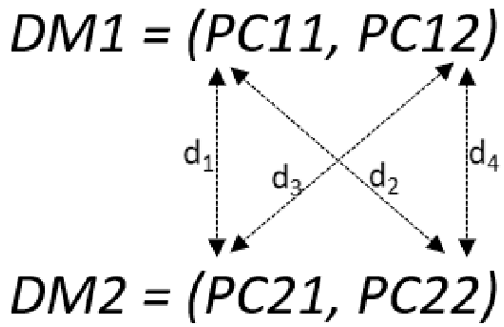
The authors define a custom codeDistance function. If two names have multiple phonetic codes, the distance between them is the minimum distance between any pair of their codes (as shown below):
3. Affinity Propagation Clustering
Instead of using K-Means (which requires you to guess how many people are in your dataset), the paper uses Affinity Propagation. It treats all data points as nodes in a graph and passes "messages" between them until a set of "exemplars" (cluster centers) emerges.
Experiments & SOTA Results
The researchers tested their approach against a dataset of 117 words containing 38 distinct homophone groups (e.g., "aye", "eye", "I").
- Standard Edit Distance Completeness: 0.800
- Proposed Phonetic Distance Completeness: 0.943
One of the most striking parts of the paper is the visualization. Traditional graphs become unreadable as data grows due to Kuratowski’s Theorem (non-planar complete graphs). However, by using t-SNE (t-distributed Stochastic Neighbor Embedding), the authors proved that their phonetic method creates much tighter, more logical clusters.
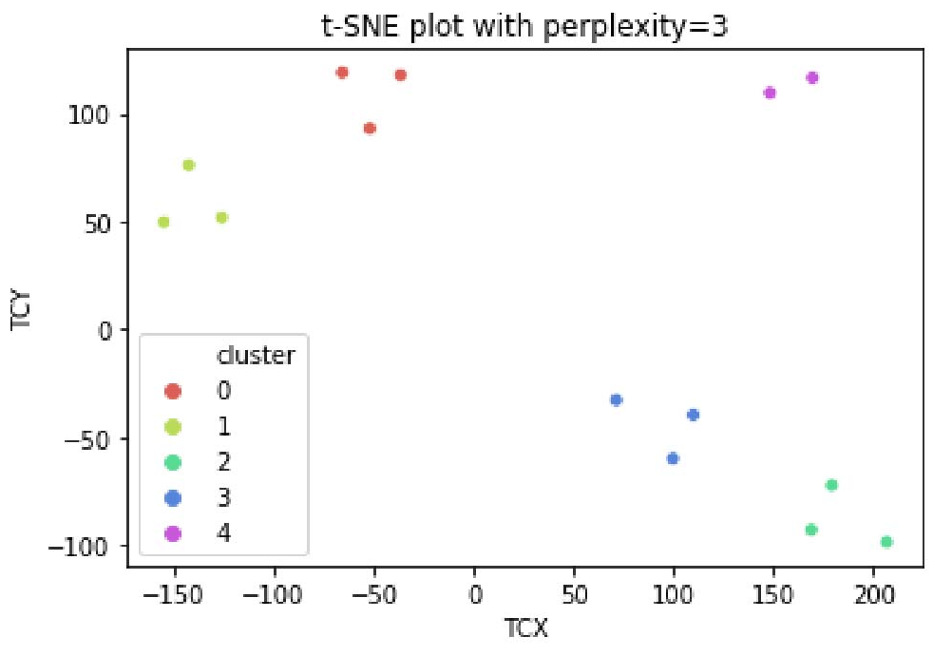 Fig: t-SNE plot showing clear separation of homophonic clusters.
Critical Insight: Beyond Local Matching
The true value of this work lies in its Inductive Bias. By encoding linguistic "rules" into the MATCH function (e.g., assigning low costs to vowel swaps or d vs t sounds), the system mimics human auditory perception.
Limitations & Future Work
While highly effective for English, the current "Double Metaphone" implementation may need adjustment for tonal languages or non-Latin scripts. The authors mention that future research will explore Spectral Clustering and Modularity to further refine the identification of "the right person" in massive, noisy Social Graphs.
Final Summary
By shifting the focus from "orthographic similarity" to "phonetic affinity," this research provides a powerful tool for data cleaning, persona linking, and historical record reconstruction in social networking environments.