
Shared Leadership: How Wikipedia Decentralizes Authority Beyond Administrators
Identifying shared leadership in Wikipedia
This paper investigates the phenomenon of "Shared Leadership" in Wikipedia by developing a machine learning framework to automatically classify editor interactions. Using an SVM-based model, the authors categorized 4 million messages into four leadership behaviors (Positive, Negative, Directive, Social), revealing that leadership in online communities is highly distributed beyond formal roles.
TL;DR
Contrary to the belief that a small "elite" runs Wikipedia, new research from Carnegie Mellon University proves that leadership is a distributed, collective activity. By training a machine learning model to analyze 4 million messages, the authors found that "peripheral" users—not just administrators—perform the vast majority of task-directing and motivational work within the community.
Problem & Motivation: The Myth of the "Boss" in Digital Commons
In traditional corporations, leadership is often synonymous with a job title. However, in "common-based peer production" environments like Wikipedia, the lines are blurred. Previous research focused heavily on the "core" contributors who do the most editing, but this paper asks a deeper question: Who actually leads the community? Is leadership concentrated in the hands of the 1,700 administrators, or is it "shared" across the millions of regular editors? Understanding this is crucial for the sustainability of any online community that relies on volunteer labor.
Methodology: Teaching Machines to Spot Leadership
The authors didn't just look at edit counts; they looked at behavior. They identified four pillars of leadership from organizational theory:
- Positive Feedback: Energizing people through acknowledgement.
- Negative Feedback: Reprimanding or correcting errors (Aversive leadership).
- Directing: Issuing instructions or assigning tasks.
- Social Exchange: Building transformational bonds through off-topic chat.
To scale this analysis, they built a Linear SVM classifier. While standard NLP (unigrams/bigrams) provided a baseline, the breakthrough came from Domain Knowledge Features. They coded for specific Wikipedia behaviors, such as the use of "Barnstars" (awards), specific jargon like "vandalism," and syntactic patterns like <You + modal> (e.g., "You should...").

Experiments & Results: The Rise of the "Peripheral" Leader
The results were startling. When the model was applied to 4 million talk-page messages on the Yahoo! M45 computing cluster, it revealed that leadership is remarkably flat:
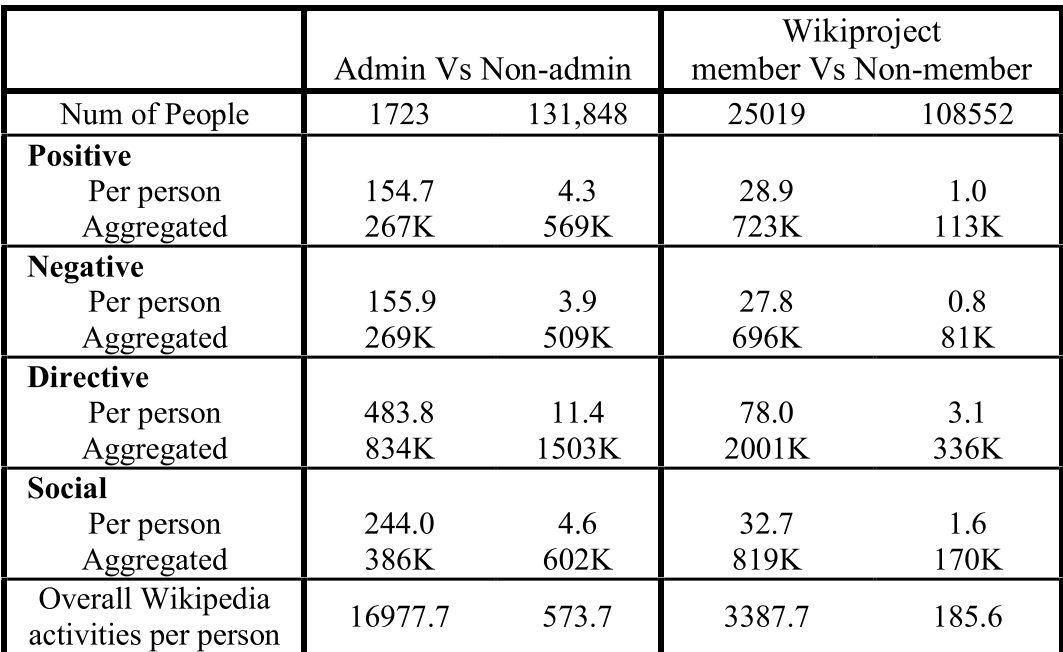
- The Non-Admin Influence: Non-administrators sent 64.3% of all directive messages. Leadership isn't just for those with "buttons" (admin privileges); it's performed by those doing the work.
- Style Differences: There is a nuance in how different users lead. As shown in the data, WikiProject core members (leaders of sub-groups) are more likely to engage in Social leadership (28.2%) to keep the peace, while regular members handle more of the gritty Directive work (62.3%).
Critical Analysis & Conclusion
The core takeaway is that in the digital age, leadership is a behavior, not a role. Wikipedia succeeds because it allows anyone to step up and guide others, regardless of their formal status.
Limitations: The study relies on text-based talk pages. It doesn't account for leadership that happens "in the code" (e.g., through edit summaries) or in external channels like Discord or IRC. Furthermore, "Directive" messages might sometimes be ignored—measuring the effectiveness of these leadership acts is the next logical step.
Future Outlook: This methodology provides a roadmap for community managers. By identifying "emergent leaders" through their behavior rather than their tenure, platforms can better nurture talent and prevent moderator burnout.
Reference: Zhu, H., Kraut, R. E., Wang, Y. C., & Kittur, A. (2011). Identifying shared leadership in Wikipedia. CHI '11.