
Decoding Reddit: Identifying Social Roles Through the Geometry of Interaction
Identifying social roles in reddit using network structure
This paper identifies the "answer-person" social role within Reddit by analyzing network structural signatures instead of content. Using supervised machine learning (Decision Trees) on egocentric network features, the authors achieve a mean classification accuracy of approximately 80% across diverse sub-communities.
TL;DR
Researchers from the University of Maryland have demonstrated that a user's role on Reddit—specifically the critical "answer-person"—can be identified with ~80% accuracy without reading a single word of their posts. By analyzing the topology of ego-networks, the study shows that behavior is more a product of individual social "signatures" than the specific community they inhabit.
Context: Beyond the "What" to the "How"
In the vast digital ecosystem of Reddit, understanding user dynamics is vital for measuring trust and stability. Traditionally, role identification required "heavy lifting" via NLP to parse sentiment and intent. This paper shifts the focus from content to structure, asking: Can we tell who a person is just by looking at who they talk to?
The "Answer-Person" Logic
The core focus is the Answer-Person: a user whose primary behavior is responding to queries from a wide array of others while engaging in very little lateral discussion.
The authors' insight is that this role creates a mathematically distinct pattern:
- The Hub-and-Spoke: A central node (the expert) surrounded by "isolates" (the question-askers) who do not talk to each other.
- Low Triadic Closure: Unlike a group of friends (a "Discussion-Person" role), the neighbors of an answer-person rarely form triangles.
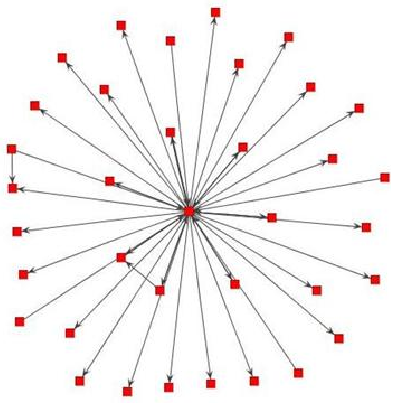 Figure 1: (a) The sparse, star-shaped signature of an Answer-Person vs. (b) the dense, interconnected signature of a Discussion-Person.
Methodology: The Math of Socializing
The researchers crawled 13 subreddits (e.g., IAmA, AskScience, Movies) and transformed interactions into weighted directed graphs. They calculated several key metrics for each user's ego-network:
- Network Density: Low density indicates a lack of neighbor-to-neighbor interaction.
- Neighbor's Degree: Answer-people typically talk to "newbies" or users with very low degrees in that specific thread.
- Triangle Density: A measure of "cliquishness" which is high for talkative community members but low for experts.
A Decision Tree classifier was then used to map these structural features to roles.
Experimental Results
The findings confirm that "structure is signal":
- High Accuracy: The structural model averaged 79.66% accuracy, hitting as high as 92% in certain segments.
- Structure > Community: The model was more accurate when looking at how a person talked than where they were talking. Even in subreddits like IAmA, the structural signature was a more reliable predictor than the subreddit name itself.
- The 3% Minority: Contrary to the idea of the "global Redditor," the study found that only 3% of active users participated proflifically in more than one subreddit. This aligns with the "1% Rule," suggesting that the pool of heavy contributors is both small and highly specialized.
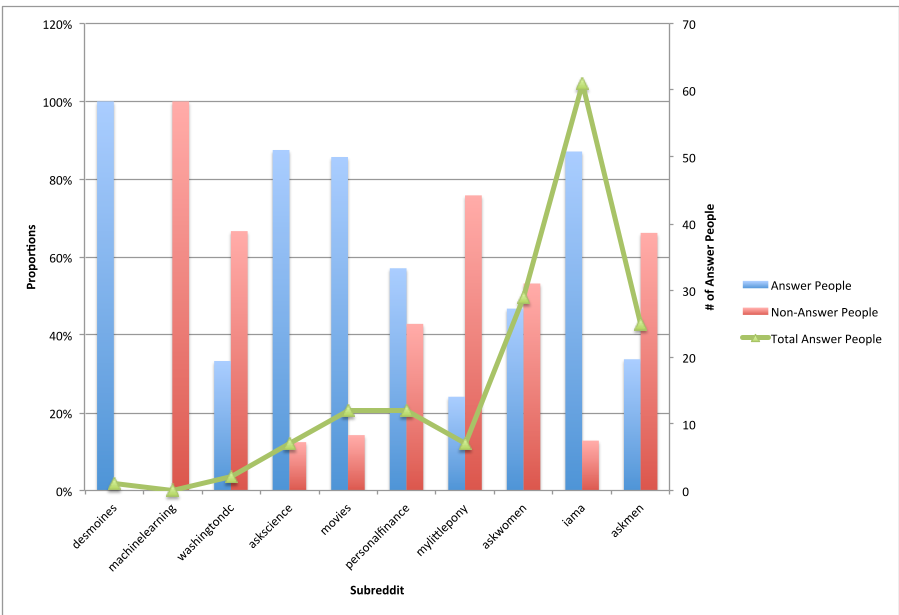 Figure 2: Distribution of Answer-Person roles across different subreddits.
Critical Insight: The "Throwaway" Obstacle
One fascinating caveat noted by the authors is the prevalence of "throwaway" accounts. On Reddit, experts often create temporary identities for specific sessions (like high-profile AMAs). This "identity volatility" makes long-term role tracking difficult, yet the structural signature of an answer-person remains consistent even if the username changes.
Conclusion & Future Work
This work provides a blueprint for building "Role-Based Recommendation Systems." By automatically identifying experts via their network footprint, platforms can route unanswered questions to the right people in real-time.
The next frontier? Determining if roles are conserved. When that 3% of multi-community users moves from a science sub to a hobby sub, do they remain the "expert," or do they morph into a "learner"? This study leaves that door open, suggesting that social roles might be more fluid than we previously assumed.